Archimède
Beyond Catfish: The Role of Real-World Academic Networks in a Successful South-South-North PhD Journey
In 2012, the MTV programme Catfish showed the world how differently people can present themselves in the world of social media, and how wise it is to get to know people in real life before entering into a relationship. The makers used the concept of catfishing to describe luring someone into a relationship by means of a fictional online persona.
Archimède Mushagalusa Mulega was born in Bukavu, DR Congo. An encounter with Prof. Maarten Vanhove (UHasselt) at Mohammed V University in Rabat, Morocco, opened the door to a collaboration in Belgium which connected no fewer than three different institutions.
As the 21st child in his family, Archimède's childhood dream was to become a medical doctor. However, in DR Congo the cost of education is considerably higher than in Belgium. More specifically: it is almost unaffordable in absolute terms; the average Belgian household would not be able to pay for a Congolese medical education.
‘Archimède: My sister suggested that I could choose to train as a mechanic. I could achieve this in six months, and she foresaw that this might be financially feasible.’
When he lost his father at a young age, it was – according to tradition – his eldest brother, Isidore Mulega who took on the role of head of the household. Thanks to his support, Archimède enrolled at the Institut Supérieur Pédagogique (ISP) in Bukavu. His aim was to study for three years to obtain a diploma in Applied Pedagogy, with a major in Biology. In 2016, he achieved his goal of becoming a teacher of Life and Earth Sciences for the lower classes of secondary school.
‘Archimède: To maximize my chances of one day becoming head of a secondary school and teaching final year classes, I decided to pursue the additional two years of study required to obtain the degree of Bachelor of Applied Pedagogy, Biology option. To finance part of my academic costs, I gave private lessons at home to families in Bukavu, while three of my brothers took care of the other part.’
He graduated in 2018. Being top of his class, his elder brother – whose financial situation had improved in the meantime – offered him to enrol on a Master's programme at the University of Burundi as a token of his appreciation. However, Archimède had to wait until the 2019-2020 academic year, as registrations for 2018-2019 were already closed.
During this waiting period, he had the opportunity to take part in a VLIR-UOS training course in Uvira, where he met researchers Prof. Maarten Vanhove and Prof. Maarten Van Steenberge for the first time. He also taught in several secondary schools in Bukavu before being recruited in February 2019 as a research assistant at the Uvira Hydrobiology Research Centre (CRH-Uvira).
When he enrolled at the University of Burundi, Archimède received financial support from VLIR-UOS, as a researcher of CRH, to cover part of his Master’s studies. The other part was covered by his older brother. At the same time, he obtained a scholarship through the CRH-Uvira to study in Morocco. In order to begin the administrative procedures required for his departure and to finance his plane ticket, the CRH management committee (chaired by Prof. Pascal Masilya), decided to grant him the $ 600 initially allocated to support his studies in Burundi. His elder brother also donated the sum he had set aside to cover the academic costs of his two years of study.
‘Archimède: I landed in Morocco on 16 November 2019. There, I started the Master’s program in Biodiversity, Valorization, and Conservation at the Faculty of Sciences of Mohammed V University in Rabat.’
It was during this Master’s program that Archimède met Dr. Antoine Pariselle, a French researcher from the Institut de Recherche pour le Développement (IRD) and the University of Montpellier, who at the time was based at the Faculty of Sciences in Rabat (FSR). He was a lecturer in parasitology. Archimède had the chance to be supervised by him for his Master’s thesis. He did not know at the time that Antoine had been a colleague/mentor of Prof. Maarten Vanhove for the past 15 years.
‘Archimède: In fact, Dr. Pariselle had initially decided not to take on any more students, as he was preparing for retirement. However, he advised me to focus my Master’s research on the molecular analysis of catfishes from Lake Tanganyika, with the possibility of working on parasites later.’
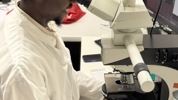
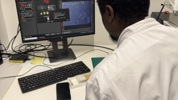
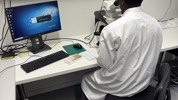
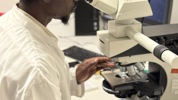
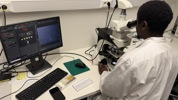
He was eager to learn from Dr. Pariselle, and spent his spare time investigating the monogenean parasites found on the gills of siluriform samples from Lake Tanganyika, which had been sent by Professor Masilya.
‘Archimède: I was focusing on being a researcher, but then in my spare time, I made a remarkable discovery. This, combined with the fact that a technical problem arose with the sampling of the fish species under investigation in the laboratory in France, ultimately meant that a large part of my Master's thesis ended up being about parasites.’
Dr. Pariselle clearly indicated that it was his dream to leave behind as many collaborations as possible. At the time, he was working with Prof. Vanhove and the Institute of Natural Sciences in Brussels. He therefore invited him and Prof. Maarten Van Steenberge to be part of the jury for Archimède's Master's thesis defence.
During Prof. Vanhove’s time in Morocco, he was able to connect with Archimède a week before the defence took place. At this point, Archimède had already carefully been considering pursuing a PhD, but Profs. Van Steenberge and Vanhove were the deciding factor on this path.
‘Archimède: During those chats, a PhD was born. One week after my defence, Prof. Vanhove and Prof. Van Steenberge, “The Maartens” (laughs), drafted the subject of my Sandwich PhD, and I applied in April of 2022.’
‘Prof. Vanhove: Having real-life contact is so important. It is essential. Getting to know a potential PhD student cannot be done ‘quick and dirty’. You need time to talk and discuss things in the same space to get to know each other.”
During his time in Belgium, Archimède was able to grow even more as a person and as a researcher.
“Archimède: I did expand my skills in a lot of ways when coming to Belgium. I was able to work with people who do the same kind of research as I do, I published papers and I got much more confident speaking English. I had been mainly speaking French my entire life, so I wanted to push myself to communicate in English. It makes networking so much easier. I don't think I would have done that if I didn't come to UHasselt.”
When asked what he wished could have been different during his time at UHasselt, he was clear:
‘Archimède: I could stay for 3 months at a time. I wish this could have been longer. There are just so many things you want to do during that period that can only be done at UHasselt; my supervisors included me in workshops, conferences, networking and many other activities.’
‘Prof. Vanhove: It would be beneficial if Sandwich PhD students could stay here for a longer period. If budgets become available to extend the stay, and good agreements can be made with the student's home university, my colleagues and I will certainly try to make this happen.’
Archimède has two siblings who work outside DR Congo, but he is the only member of his family in the international academic world.
‘Archimède: I had never been to Europe before I came to Belgium. The first time I went there in 2022, I spent time at the Institute of Natural Sciences in Brussels and was able to study the taxonomy of African catfishes. I also had the opportunity to attend my first international conference in La Rochelle, France.’
Prof. Vanhove adds enthusiastically: ‘You presented your poster there, in English too! That was an important step for you as a researcher.’
During his stay in Belgium, Archimède lost his sister who was like a second mother to him. During this period, he travelled back to the DR Congo for sampling and was able to spend ten very needed days with his family in Bukavu. One might wonder how he managed to combine so many drastic changes in his life in just a few year’s time. Did he ever think about giving up or at least slowing down?
‘Archimède: I never thought about giving up. Never. My PhD is not just for me, but also for my brothers. It really is for them too.’
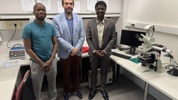
On Wednesday 11 June 2025, Archimède defended his (BOF-BILA) PhD in English under the watchful eye of – among others – his UHasselt promoter Prof. Maarten Vanhove and co-promoter Maarten Van Steenberge.
In his doctoral dissertation, he presents research into catfishes, some of which are used in aquaculture on the African continent, with a focus on specifically the (Upper) Congo Basin. Using parasites as markers, he investigated how they move from one place to another.
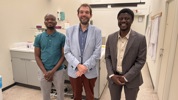
For the celebratory event, Hasselt University invited the entire Mohammed V University jury consisting of five academics, including his former French promoter Dr. Pariselle and his Moroccan promoters Profs. Bazairi and Benhoussa. Due to personal reasons two guests were not able to attend in Belgium, but were present online, alongside several hundreds of other stakeholders.
In this testimony, the catfish luckily only appears in Archimède's research. Thanks to every single grant and funding opportunity he encountered, there were plenty of ways to have real conversations and form genuine face to face relationships with people in his field of research. Not in just one place in the world, but as a South-South-North cooperation, in three different countries, spanning over two different continents.
It will be fascinating to see how this journey will unfold and which doors it will open to new opportunities for all parties involved.
‘Archimède: After my PhD, I plan to apply for a professorship at the University of Lubumbashi in my country, the Democratic Republic of the Congo. I will also apply for a postdoc at UHasselt in Belgium. If this works out, it will enable me to fulfil my dream of pursuing my research career while contributing to appropriate training for young Congolese people. As a product of cooperation myself, I plan to work in this area throughout my career.’
- Article by Brigitta Bijloos, International Office, Global Minds