Rapid Assessment Units: experimental climate controlled units

Prof. dr. Nadia Soudzilovskaia

To combat climate change and nitrogen eutrophication, we need to understand how the functioning of terrestrial ecosystems is affected by interactions between land use, climate and biodiversity. In Limburg, Flanders and beyond, the agriculture and horticulture sector and related companies can and do significantly reduce their impact on the environment (climate change mitigation) or adapt their methods and products to changing conditions (climate change adaptation). This requires on the one hand research at the interface between ecology and agriculture, with targeted, well-replicated, long-term but also rapid research experiments, where climate is manipulated on a very realistic scale and we make integrated assessments of ecosystem responses to climate and other environmental changes.
Already today, Hasselt University supports the agricultural industry with these challenges by using the state-of-the-art research infrastructure “Ecotron Long Term Research Units (LTRU).”
The Ecotron is digitally connected to the “Belgian Integrated Carbon Observation System” (ICOS), a European research infrastructure for long-term observation of greenhouse gases over Europe. However, the Ecotron LTRU in its current configuration is explicitly designed for long-term research and is best suited to answer fundamental scientific questions: testing new biological techniques to reduce the increase of CO2 in the atmosphere; assessing crop varieties for tolerance to climate extremes such as drought; testing biotechnological products, such as (bio-)fertilizers and (bio-)pesticides.
Complementary to this LTRU, this project therefore envisages the acquisition of “Rapid Assessment Units (RAU)” infrastructure to answer urgent questions about adaptation and management techniques in the context of changing climate and environmental conditions, which require targeted, well-replicated short-term experiments.
The Ecotron RAU will finally consist of 8 climate-independent experimental chambers where (agricultural) ecosystem units can be subjected to experimental treatments of several weeks to several months representing environmental changes such as nitrogen deposition, climate change, application of soil conditioners, land use change, with the aim of comprehensively testing the ecosystem response (including biodiversity, soil health, carbon, nutrient and water balance) to the experimental treatment.
In addition and last but not least, this project and its potential partners aim to create a Limburg Sustainable Agriculture Ecosystem in which the questions and/or opportunities that exist for Limburg, regional and international agriculture and horticulture are inventoried and tested against the extent to which they contribute to adapting or coping with environmental changes in the agricultural and natural sector.
Rapid Assessment Units
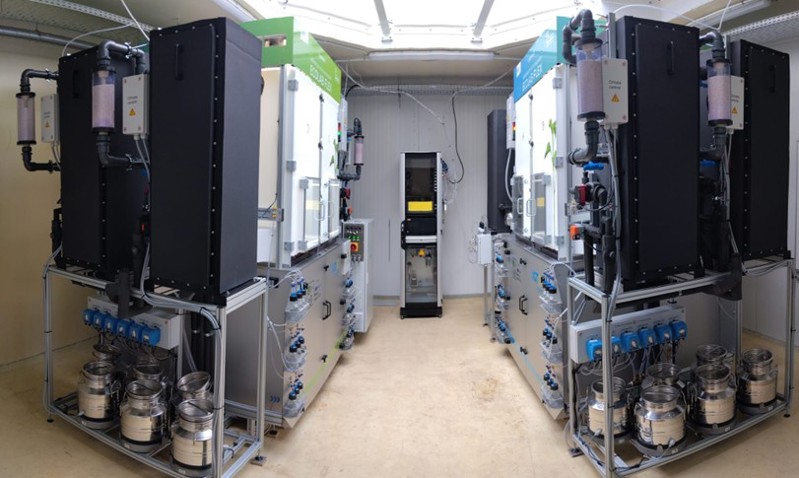
In 2025, with the support of VLAIO (EFRO) and the private foundation Edaphon, a new set of RAU (Rapid Assessment Unit) Ecotrons is installed, expanding the Ecotron of Hasselt University in Maasmechelen. These consist of 8 new climate-controlled chambers where we can expose ecosystems for several weeks or months to different environmental change phenomena, such as climate change or different types of soil conditioners. In this way, we are expanding our long-term research, which runs over several years in the Ecotron, to include more pressing, shorter-term research questions.
The new RAU Ecotron enhances replicability through two specialized units, each comprising four chambers (0.65 x 0.70 x 1.3 m) with independent atmospheric and soil compartments. These chambers accommodate either one large lysimeter (50 cm diameter and 90 cm deep) or three smaller lysimeters (20 cm diameter and 90 cm deep) per unit, with the latter sharing an atmospheric compartment. Capable of the same high-precision measurements as the Macroscale Ecotron, the RAU also features advanced solar irradiance regulation.
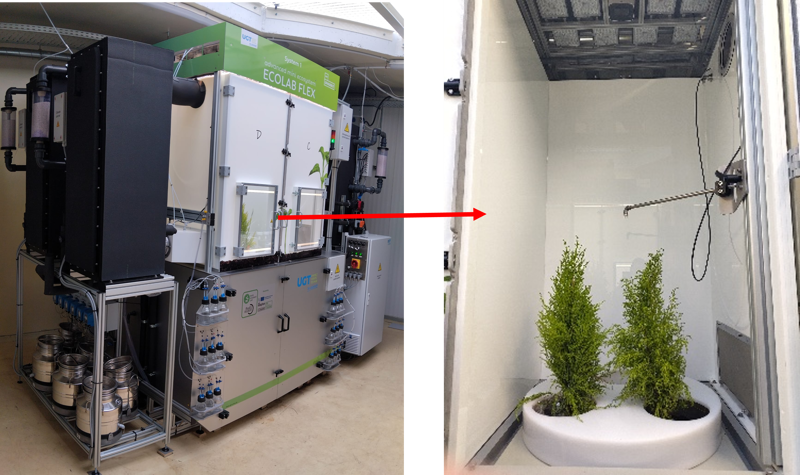
Using these chambers, we can monitor ecosystem functioning at high resolution by integrating automated, real-time data with periodic sampling. Atmospheric and soil sensors are used to track greenhouse gas concentrations (CO2, CH4, N2O), net ecosystem exchange (NEE), air temperature and humidity, and soil temperature and moisture at various depths. These data are complemented by precise lysimeter weighing for water balance monitoring and root imaging to track growth dynamics. To resolve underlying biogeochemical mechanisms, we quantify nutrient dynamics through tri-weekly soil solution sampling while tracking aboveground biomass with embedded camera systems.