
Research
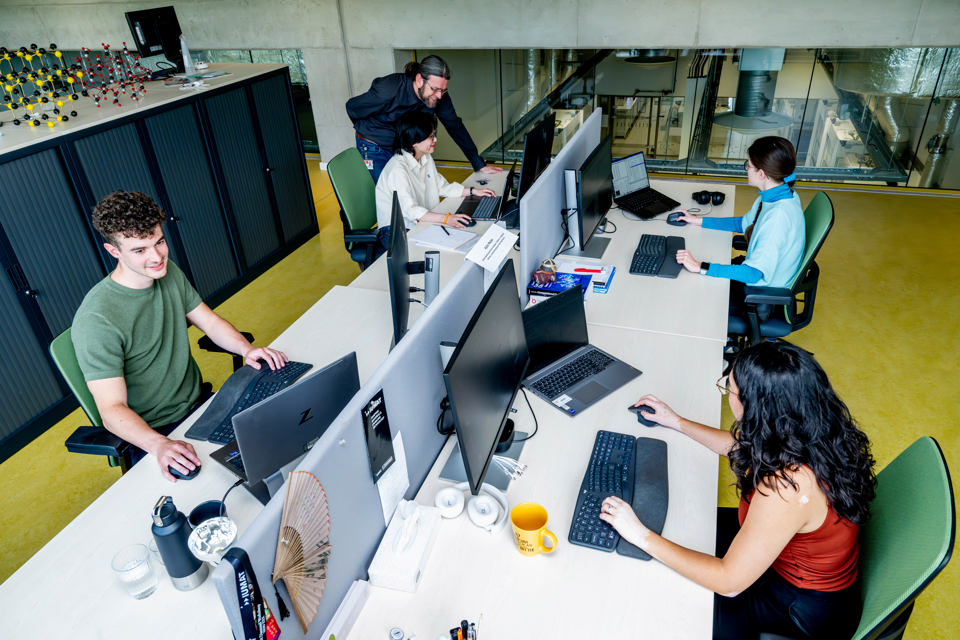
The expertise group “Quantum & Artificial inTelligence design Of Materials” (QuATOMs) focuses on the computational modelling of materials by means of quantum mechanical modelling and artificial intelligence. It is the aim of the QuATOMs group to gain a fundamental understanding of the physical and chemical properties at the atomic scale and link these to experimental observations, as well as identify underlying patterns in experimental observations.
View the content of this page
Research lines
The expertise group QuATOMs, Quantum & Artificial inTelligence design Of Materials, focuses on the computational modelling of materials by means of quantum mechanical modelling and artificial intelligence. It is the aim of the QuATOMs group to gain a fundamental understanding of the physical and chemical properties at the atomic scale and link these to experimental observations, as well as identify underlying patterns in experimental observations.
Point defects in quantum materials
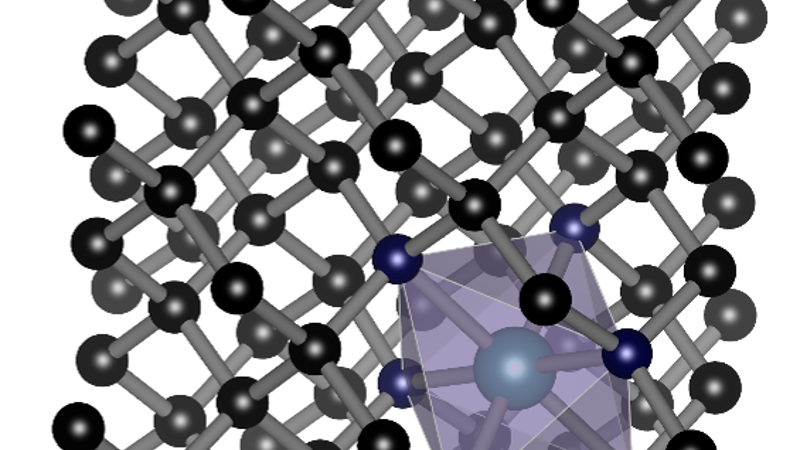
Many modern-day high-tech materials gain their interesting properties from atomic scale defects. Colour centres in diamond are considered as single photon sources as well as qubits for quantum technology applications, while point defects are used to tune the properties of transition-metal oxides, relevant for their potential as transparent conductors and electrochromic applications.
At QuATOMs, the electronic and vibronic band structures of these materials are studied using quantum mechanical modelling to gain insight in the structure-property relations of point defects in these materials. To accelerate and extend the scale our quantum mechanical modelling, AI-based models are developed with a focus on the vibrational and electronic structure.
Lignin models for sustainability
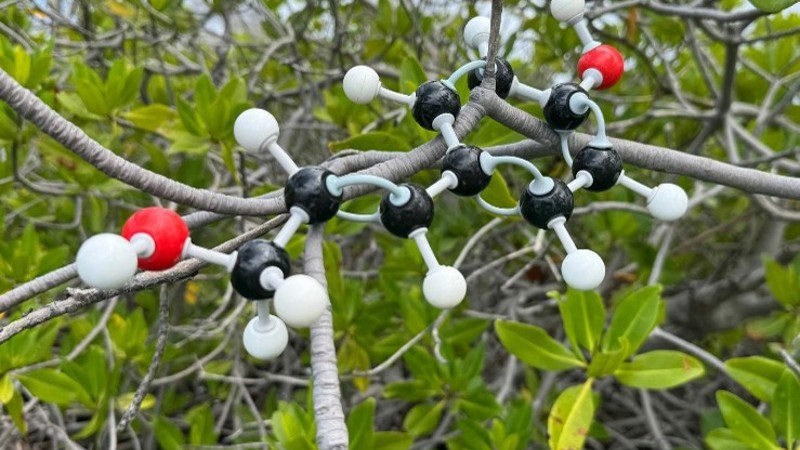
Lignin is the second most abundant biopolymer on earth, of which over 100 Mt is yearly produced as by-product of the paper industry. Although most of it is incinerated, it presents a sustainable renewable alternative for the oil-based aromatic feedstock for polymer industry.
Within the QuATOMs group, our research focusses on elucidating the complex molecular structure of lignin (i.e., combinations of 3 different building blocks and 7 different interconnects gives rise to a combinatorial explosion of possibilities) and finding the relations with the global properties and behaviour, making use of quantum chemical calculations. AI-based models help us to map the combinatorial space.
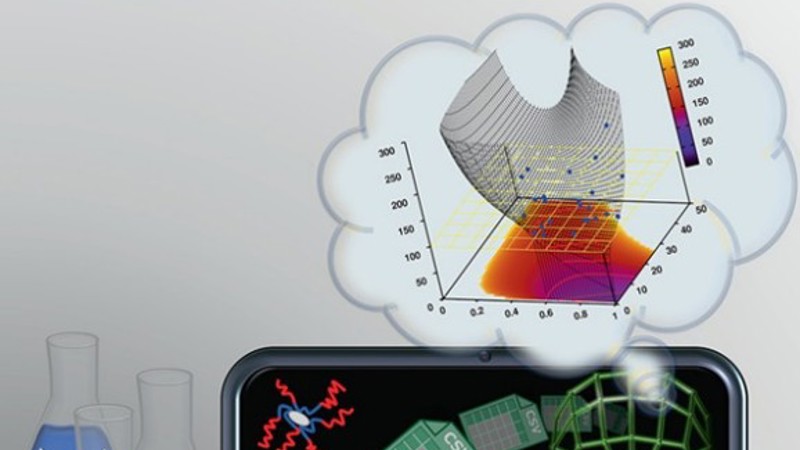
Small data: bringing AI to the lab
Machine Learning (ML) and Artificial Intelligence (AI) are permeating all aspects of life, including research. However, training a high quality model requires enormous quantities of data. This stands in stark contrast to general academic and industrial lab-scale data sets resulting from (innovative) research projects.
At QuATOMs, we are developing dedicated models based on small data sets (<50 samples), for real-life lab applications. The created models are by construction the best possible models, while being formulated as simple human interpretable analytical equations
Contact
Prof. dr. Danny Vanpoucke