Ans Swinnen
“Always evolving. Always moving forward.“
Completing a master’s in medical physics in just one year instead of two. Writing a PhD while holding a full-time job. Ans Swinnen did it all and more. ‘When you have found your sparkle, hard work doesn’t feel like work,’ the UHasselt alumna says with a laugh. ‘And I happened to find my sparkle in radiation therapy. That’s where you see first-hand how abstract physics can really make a difference in people’s lives.’
TOGETHER STRONG
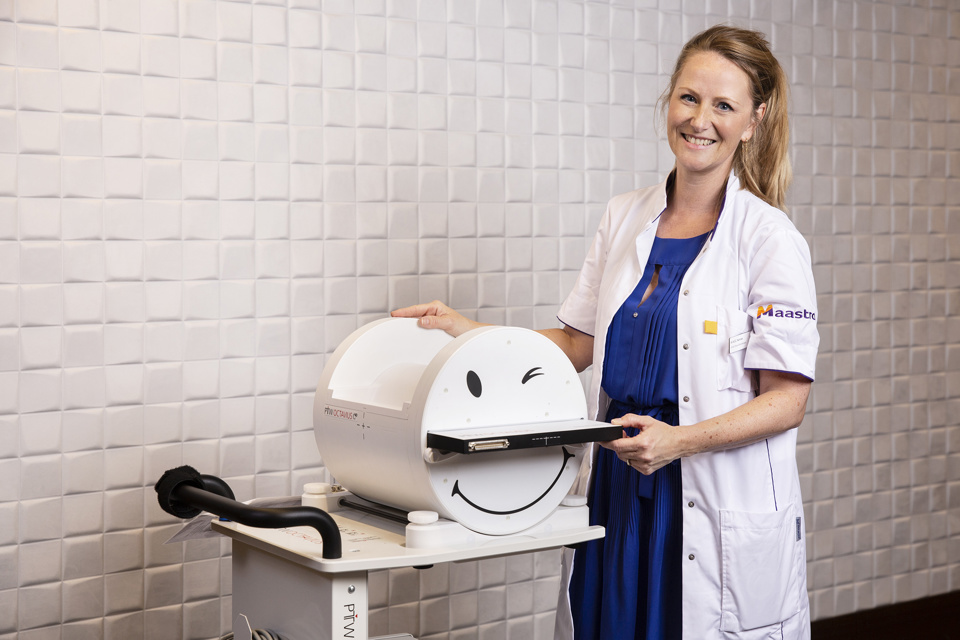
Ever since her first job as a radiation physicist at UZ Leuven, Ans has been looking for ways to make an impact. She worked on a European project aimed at advancing radiotherapy in Eastern Europe. ‘The resources were limited, and the equipment was often outdated. But that’s where I learned how sharing knowledge can make all the difference. By working together, we could really bring about change.’
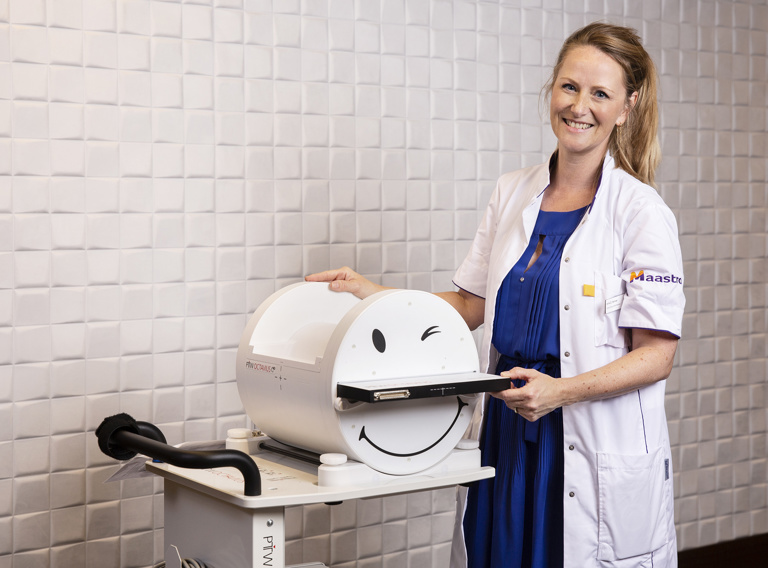
This experience also fuelled her interest in research. In addition to her demanding job, she started working on a PhD – as the first radiation expert in Belgium. ‘I had set up a system that allowed us to measure radiation doses directly on the patient’s skin, using detectors that could be sent by post. It would have been a shame to let this knowledge go to waste. By pooling and sharing knowledge, you not only make a difference to your own centre; you also help to advance an entire discipline. It is tremendously satisfying.’
ALWAYS EVOLVING
‘Medical physics is an incredibly fascinating field of study that is continuously evolving,’ she says. ‘Today’s technology is very different from the technology they had 20 years ago. Every new device, every innovation opens new doors to better treatments. You continually reinvent yourself, working in teams where physicists, doctors and technicians explore new possibilities together. It never gets boring.’
PASSION FOR TEACHING
Ans continued to teach despite her busy schedule. ‘I believe practical experience is only really valuable when shared,’ she says. ‘There is nothing better than passing on your expertise and seeing young people grow.’ And so she teaches nuclear medicine, is a supervisor for postgraduate students, and a member of committees that advise on guidelines for radiation therapy.
SHORT BIO
STUDIES
• 1993-1995: candidate in physics, UHasselt
• 1995-1997: licentiate in physics, KU Leuven
• 1997-1998: Biomedical engineering techniques and medical radiation physics, KU Leuven
• 2000-2005: PhD in medical sciences (with a dissertation on quality assurance in radiotherapy), KU Leuven
WORK EXPERIENCE
• 1998-1999: research associate, EROPAQ project for TLD monitoring of photon beams, KU Leuven
• 1999-20012: medical physicist, UZ Leuven
• 2012- present: medical physicist radiotherapy, MAASTRO Clinic
• 2025-present: Fellow UHasselt
10 questions for Ans
After secondary school, I went on to study physics because...
My plan A was medicine, but at the time, the medical field was overshadowed by the many protests against the numerus clausus (restriction on university admissions where the number of applicants exceeds the number of available places). My prospects of becoming a doctor seemed very bleak and uncertain. One day, my maths teacher said, why don’t you take a look at physics? I think it’s just the thing for you. Physics was the ‘queen of science’. When I heard that so few students chose to study physics, it only piqued my curiosity even more. Then I went to the info day at the LUC, and I immediately knew, this is where I belong.
What made studying in Diepenbeek so special...
The fact that it was a small university and the strong sense of community. There were just 12 students in our physics class: a close-knit group in which you easily found your place. The campus was no different in this respect: students knew each other regardless of which degree they were pursuing. We all were in one central location, which facilitated easy and spontaneous contacts. This closeness only added to the friendly, family atmosphere that I really missed when I went to study in Leuven afterwards.
My favourite spot on campus was...
The agora. As a child, I used to climb on those blocks whenever I visited the campus with my father – who was a professor at the Economische Hogeschool Limburg. As a student, it always felt like a familiar place to me. It was the heart of the campus, where everyone gathered to eat a sandwich, talk, and have a laugh. That’s where friendships were born.
The teacher who inspired me the most was...
Professor Serneels. He lectured in thermodynamics. His exam questions were always very difficult, but at the same time, he always succeeded in making you feel confident. I found it tremendously motivating.
As a student, I was...
Definitely a high achiever, always striving for the best results. I was adamant about passing all my exams in June so that I could enjoy two months of holidays without a care in the world. I was also very active in student club. In my first year, I was even a member of the praesidium [governing body of a student club], and I always enjoyed the parties. But even cleaning up after a party at the Fitlink until the wee morning hours didn’t deter me from being in class at 8 am. My student years were all about this balance between study and play.
If there’s one thing I learned at Hasselt University, it’s...
Structure. The trimester system meant there was always a clear rhythm. I learned how to tackle projects efficiently thanks to good supervision, concrete roadmaps and tight interim deadlines. I have stuck to this approach throughout my career.
How would you describe your job in no more than 5 sentences?
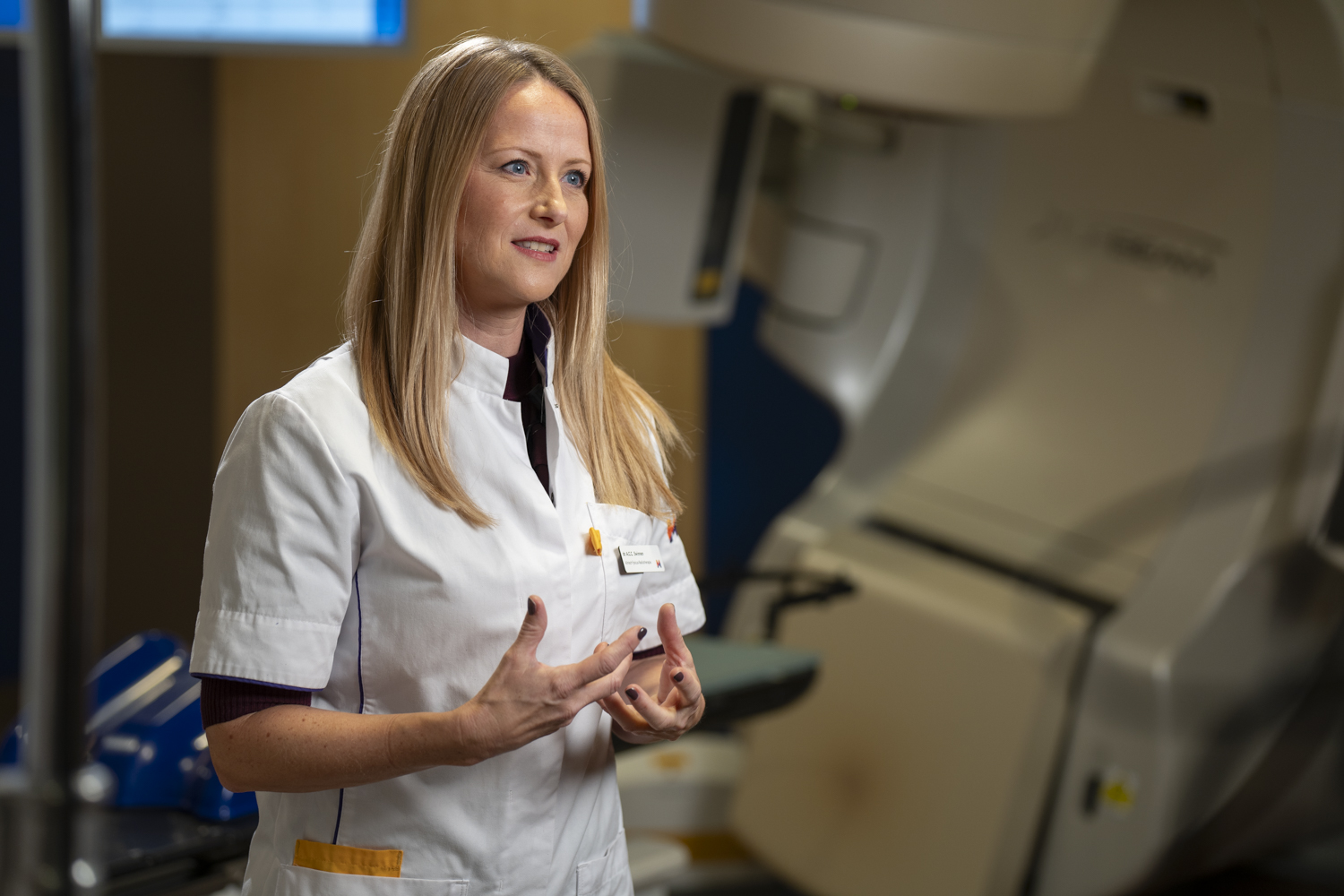
As an expert in medical radiation, I make sure that the radiation dose is aimed directly at the tumour with great precision, down to the last millimetre, protecting healthy tissue as much as possible. Just like a hospital pharmacist weighs medication with great precision, I calculate the correct dose using sophisticated algorithms and high-energy X-rays. Thanks to current imaging equipment, we can position the patient in the same way every day, ensuring that the radiation always targets the tumour site. What’s more, we also conduct rigorous quality controls to ensure the safety and reliability of each treatment. Each treatment is tailored to the individual patient.
What do you find most enjoyable / challenging about your job?
The versatility, social relevance, and working with doctors, physicists and other specialists. We join forces across our individual disciplines to provide the very best care for every patient. I also like that I work in a field where technology is evolving at a rapid pace and constantly opening up new opportunities. It is this constant progress that makes my job so tremendously challenging and exciting and keeps me on my toes.
In my opinion, the key to success lies in...
Passion and perseverance but, above all, a solid foundation and a warm network. My parents have always encouraged me to pursue my dreams, and my husband supports me unconditionally in every choice I make. This gives me the confidence and courage to persevere, even when the road is hard. Working hard doesn’t feel like a chore when you are doing what you love and are surrounded by people who believe in you.
If you were able/want to do something or give back to your alma mater, what would it be?
My time and my experience. As a Fellow at Hasselt University, I like sharing my expertise during lectures on nuclear medicine. I believe that practical experience only becomes really valuable when shared with the next generation. It feels like an honour to share my experience in the place where my own passion was first ignited.