
Bart Appeltans
“I am a designer first and foremost”
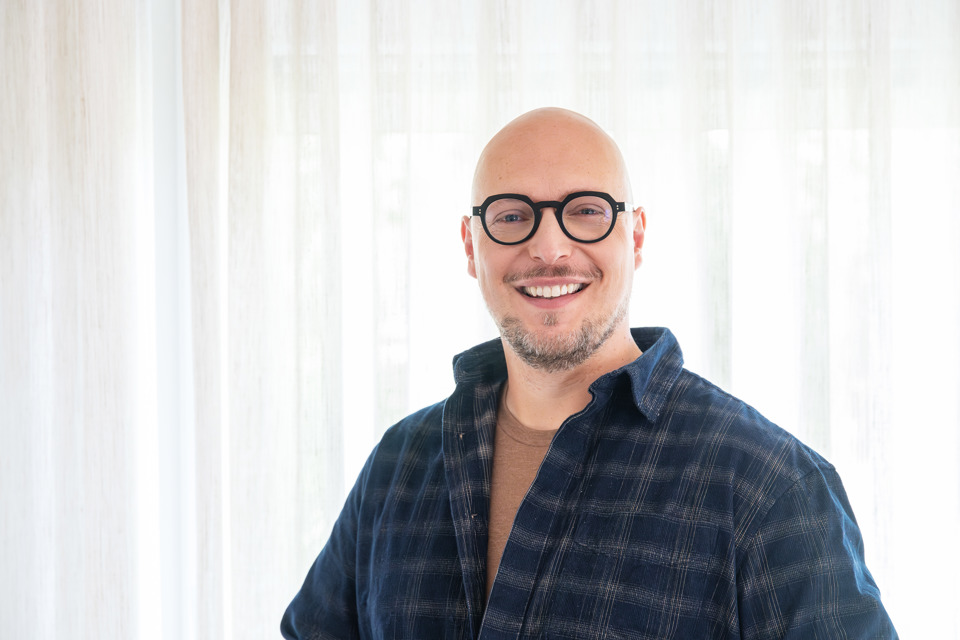
You may know him from Belgian TV programmes like Blind Gekocht, Huis Gemaakt, or from his own interior design books, inspirational pathways, and masterclasses. An architect, entrepreneur, TV personality, born storyteller and Limburger through and through. But who is the real Bart Appeltans? “In essence, I’ve always been a designer. Everything I do always starts from the same premise: giving form to an idea.”
 © BorgerhoffLamberigts
Many balls in the air
After studying interior architecture at the PHL (renamed Uhasselt since then), Bart has had an impressive and versatile career. He designed furniture, established his own architectural firm, taught architecture, and became a TV personality. “I’ve never had just the one job. I’ve always combined different things,” he says with a smile. “I like variety, moving around. Going from one project to the next, always fuelled by curiosity, an appetite for new challenges, and an incredible passion for what I do. The next opportunity arises well before I feel restless. That’s how my path grows – very organically.”
Inspiring more people
Bart has been a familiar face on television since 2019. It allowed him to take his mission of making interior design accessible to a broader audience to the next level.
“Thanks to my TV programmes, books and master classes, I am able to inspire many more people than through one-on-one projects, something that I find particularly rewarding. I want to encourage people to think about their living environment — regardless of their budget, stage of life, or lifestyle. Because everyone deserves a place that feels just right. Where you can come home, breathe, and unwind. Where you get to be yourself.”
He also advises companies on their spatial identity. “A brand story does not start with a slogan, but at the front door. The look and feel of a space determines how people feel – a powerful and ultimately often underestimated tool. I love helping companies develop this.
Designing his own career
Twenty years later, Bart sold his architectural firm. Not out of dissatisfaction or boredom, but because he needed space for new forms of creativity. “As long as I feel energised by what I do, I feel grounded. And as long as I continue to inspire others with my story, I will also continue to grow. Perhaps this is the essence of everything: having the courage to dare to redesign your life – and your career – over and over again.”
STUDIES
- 1999-2004: Master’s degree in Interior Architecture, PHL (now: UHasselt
- 2004-2005: postgraduate degree in Furniture Design, Katholieke Hogeschool Mechelen.
WORK EXPERIENCE
- 2005-2008 interior architect, Simoni architecten nv
- 2008- 2024: interior architect / business owner, SFAR architects of atmosphere
- 2007-2015: lecturer/assistant practicals, Interior Architecture, PHL/UHasselt
- 2015-2019: manager of his own interior design shop
- 2018-present: interior architect for TV programmes such as Huis gemaakt
 © Aanhuis
10 questions for Bart
After secondary school, I went on to study interior architecture because...
“...I loved interiors and design as a teenager. While my classmates saved for games or gadgets, I preferred to spend my pocket money on an elegant vase or a timeless bowl. (laughs) I used to love watching all the makeover programmes on the BBC – long before they were broadcast in Flanders – and would traipse through the interior design shops of Sint-Truiden and Hasselt, looking for inspiration for my own crafts. At school, my favourite subjects were English, marketing, and advertising, and I did consider studying them, but everything changed the day I first set foot in the architecture school in Diepenbeek. It was as if every cell in my body suddenly knew where it belonged. I can remember that moment very well – the smell, the light, the silence full of promise.”
What made studying in Diepenbeek so special...
“...was the warm embrace. Instead of anonymous auditoriums or endless corridors, our campus felt like a second home — small-scale, welcoming, imbued with that typical Limburg hospitality. The lecturers were accessible, the engagement high. You knew each other by name, you felt seen. And, of course, there was also the iconic building that always made you walk a little straighter as a student. It was an inspiring setting, growth came naturally.”
My favourite spot on campus was...
“That’s easy: the studios, of course. They were so much more than workspaces – they were our creative home. In the morning, we’d walk in and find our usual spot, among model materials, rolls of paper for sketching, laptops and the smell of coffee wafting around. That’s where the magic happened.”
The teacher who inspired me the most was...
“The studio supervisors: Paul Clarebots, Willy Stuyck, Huub Berger, Jo Klaps and Philippe Swartenbroux. You spent most of your time with them – sketching, thinking, moulding ideas. They taught me to really look, to think and inspired me. But above all, they made me believe in my designing power.”
As a student, I was..
“Passionate, driven and an extreme perfectionist. I was a creative swot (laughs). I intuitively felt that this is where I fit in, this is my talent. So I kept raising the bar. Each assignment became a new playing field to reinvent myself and grow as a designer.”
If there’s one thing I learned at UHasselt, it’s..
“Learning to work in a team. Creating together and enhancing each other’s ideas. Learning to interpret and give feedback. There’s no better place to learn how to mentor people in a creative process than in a studio setting. It is only later, when I became a teacher myself, that I realised how much this experience shaped me.”
How would you describe your job in no more than 5 sentences?
“In essence, I am and always will be a designer – that is the starting premise of everything I do. Today, I am no longer the kind of interior designer who merely prepares files and follows up on sites; I’ve become a creative bridge builder who makes interior design accessible to a wide audience. Since my work on TV, I have also embraced the role of influencer: I want to inspire as many people as possible, through books, programmes and master classes, to create their own place, regardless of their budget, type of housing or stage of life. I also advise companies on how their interiors can really reflect who they are and what they stand for, and how to make this more tangible. These days, my work is multifaceted and multi-layered; deep down, however, it still revolves around one simple but powerful conviction, namely that good design makes all the difference.”
What do you find most enjoyable / challenging about your job?
“That magical moment when everything comes together and when I or the client have that lightbulb moment. When ideas click, plans fall into place, and you can sense enthusiasm. The spark of insight, the feeling that something is starting to change and transform: that’s where I get my energy from. When you know intuitively that the design is good. And precisely because the foundation is rock solid, I can confidently pass it on to others who can shape it further.”
In my opinion, the key to success lies in...
“A great deal of luck; there’s no denying that. I’ve never had to apply for a job; they always called me. But what people saw in me most of all, I think, was my genuine passion for the profession. So, yes: know what makes you sparkle, and don’t be afraid to go for it full steam ahead. You really don’t need to master all the aspects of your craft to excel. Success does not mean being able to do everything; it’s all about knowing what you can do better than anyone else. Find that one talent where you can make a real difference. Keep feeding it, keep nurturing it. And remember: don’t be afraid to adjust your career path along the way. Sometimes, you may discover a part of yourself that is just as powerful and energising. When that happens, you need to follow your gut instinct and not be afraid to take the leap.”
If you were able/want to do something or give back to your alma mater, what would it be?
“Recently, I was at an alumni event, and it felt like coming home. The building, the atmosphere, the vibrant young energy – I felt as if I’d never left. At some point in my career, I’d love to give guest lectures, lead inspirational sessions, and share real-life stories that excite students. Besides, engaging with young people is also good for you as a designer; it keeps you sharp, fresh and connected to what’s going on.”