Sari Kees
"Football is a dream, but it also tests you, every day again."
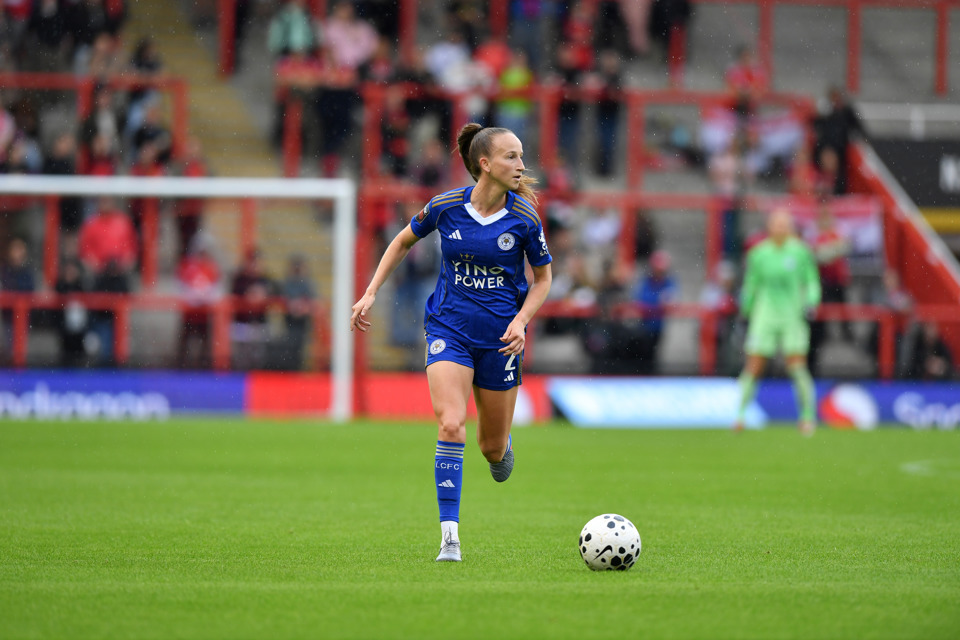
Sari Kees has a dream job: she is a professional footballer for Leicester City F.C. The UHasselt alumna’s life is all about turf, studs and stadium lights. From the training pitch to the match day. From a recovery session to the next selection. Because in the UK, football is not just a sport; it’s a universe unto itself, where nothing is a given, except the intensity.
Not straight for the goal
In effect, Sari could have gone abroad much sooner. Offers started flooding in soon after her first European Championship with the Red Flames. The ball was in position. All she had to do was tap it in. But the defender chose to be patient. ‘I wanted to finish my studies’, she explains. ‘And see whether I could maintain this level of play. Understand whether I was ready for this next acceleration.’ Two years later, she was given another chance. And this time, she was ready to score.
The bar is set high
Today she plays for Leicester City F.C. in the FA Women’s Super League - a league that is known for its intensity, professionalism and visibility. ‘Playing for LCFC is a luxury’, she says. ‘Everything is just right: the support, the facilities, the pace. Every day, you can sense that this is top-tier football. The bar is set tremendously high. Each training is intense. And every weekend, you get to play against some of the world’s best footballers. Quite taxing for a defender, but it keeps you on your toes. Here you grow, with every match you play.’
Sideline pressure
Playing on this level also comes with pressure. A lot of pressure. ‘In the UK leagues, your position is never guaranteed’, Sari explains. ‘You need to earn it every week again. Football may be a team sport, but it is also highly competitive. New transfers, other systems, unexpected choices by your coach: nothing is set in stone. That can be mentally taxing. You never stop asking yourself, “What can I do better?” Why am I not playing this week? You learn to put things into perspective, reflect and have faith. Mental resilience is just as important as your physical performance.’
‘Being able to spend time outside every day. Doing something physical. Working on yourself continually. Doing what you love best: it is a dream come true.’ What’s next? Sari smiles: ‘One of the top 5 UK clubs perhaps? That would be nice. I’d love for them to call me.’
Short bio
STUDIES
- 2018-2021: Bachelor of Rehabilitation Sciences and Physiotherapy, Hasselt University
- 2021-2024: Master of Rehabilitation Sciences and Physiotherapy, Hasselt University
WORK EXPERIENCE
-
2017-2024: professional footballer, OHL Leuven
-
2019-present: Belgian international, Red Flames
-
2024-2026: professional footballer, Leicester City F.C. Women (UK)
10 questions for Sari
After secondary school, I went on to study rehabilitation sciences and physiotherapy because...
‘the programme tapped into my passion for sport. For a long time, I had no idea what I wanted to study. But during the student information days, I got talking with Professor Valentijn Schroyen. After that conversation, everything fell into place.’
What made studying in Diepenbeek so special...
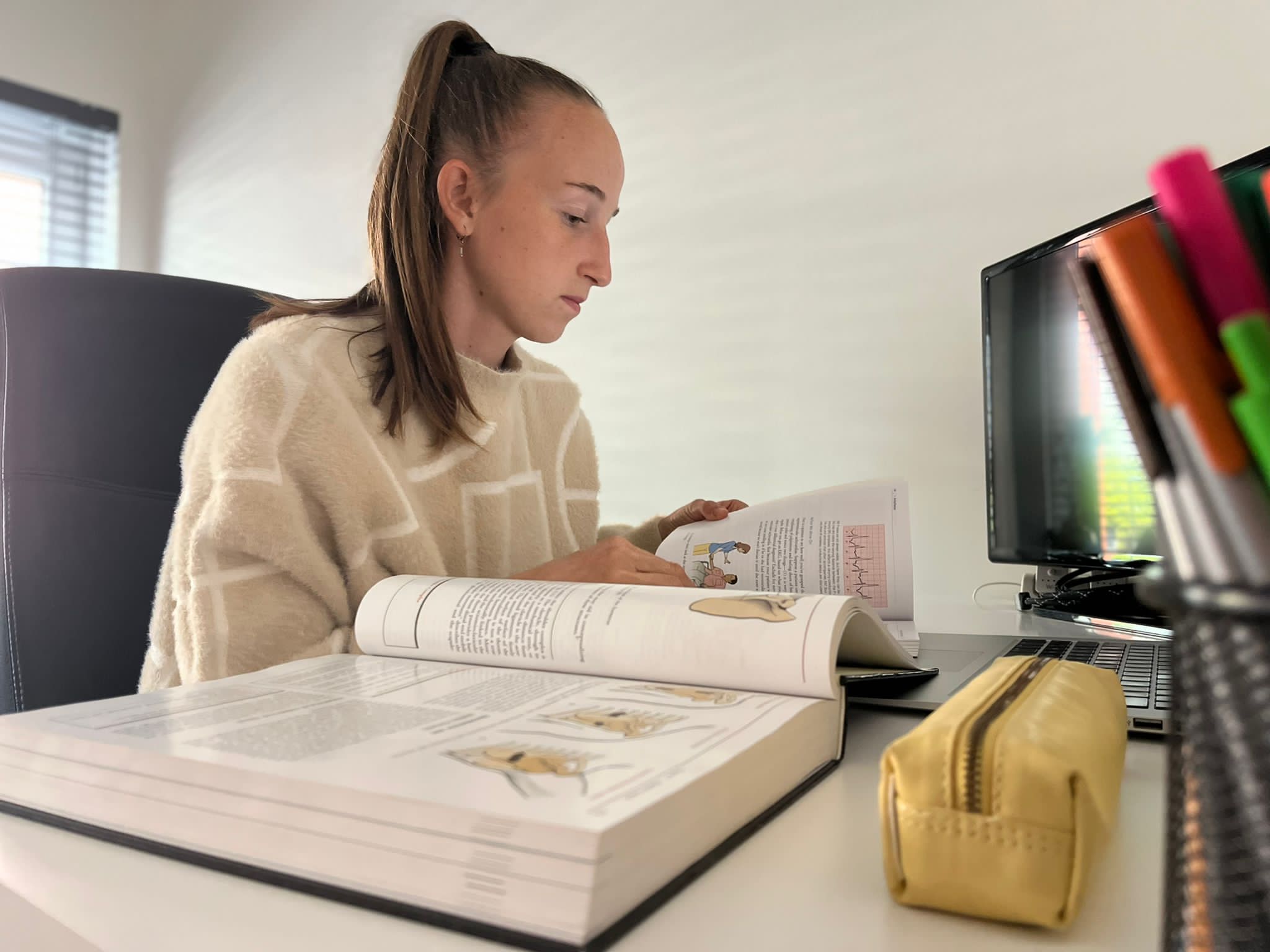
‘the personalised approach and the amazing flexibility. As an elite athlete and student, I could always count on understanding and support: rescheduling exams or classes was never an issue. All my lecturers knew me personally and were genuinely interested in helping me achieve my goal.’
My favourite spot on campus was...
‘the agora. The beating heart of the campus: that’s where you ran into everyone and where you could relax in between lectures.’
The teacher who inspired me the most was...
‘All my practicals lecturers really made an impression. I liked these courses the most: they were practical, interactive, and I could immediately apply what I learnt there. In the past years, Marga Swerts was someone I could really rely on for support. She assisted me with the organisation of my internship, including an international internship at my football club in the UK. I was able to spread this internship over two years, and Marga was always there for me, thinking things through with me. She always pointed me in the right direction.’
As a student, I was..
‘Driven. I had that typical elite athlete mindset. I really wanted to excel in my practicals and show what I was capable of. I was more pragmatic when it came to the theoretical subjects, lowering the bar a bit. In the last two years, I decided to also enjoy student life a bit more. Things never really got out of hand because I usually drank water (laughs). But I did go to the Election Week (for club and society elections) and to Pukkelpop. And when my friends went to Paris for the weekend, and I had an exam on Monday, I went with them. During the drive there, I revised my notes, but I also really enjoyed the time we spent together. What can I say: I do suffer from FOMO.’
If there’s one thing I learned at UHasselt, it’s...
‘to keep a lot of balls in the air. Figuratively speaking. My programme really taught me everything I need to know about flexible planning and combining different responsibilities.’
How would you describe your job in no more than 5 sentences?
‘Being a pro footballer involves a lot more than spending 90 minutes a week on the pitch. It is quite demanding. It means achieving peak performance and having the mental resilience to do this. There is so much competition, and you need to prove yourself day after day. In the UK leagues, your position is never guaranteed. You need to earn it every week again. It keeps you on your toes. And, of course, there’s the media attention.’
What do you find most enjoyable / challenging about your job?
‘It never feels like a job. Training outside every day, doing something physical, and doing something you love: it is a luxury. I think the psychological pressure is the biggest challenge. You need to achieve consistent peak performance. Living in another country, in an environment where everything revolves around football, can be a bit lonely at times.’
In my opinion, the key to success lies in...
‘making the right choices at the right time. Being patient. Knowing yourself - your strengths and your weaknesses - and being prepared to take intermediary steps. Not wanting to run before you can walk. Giving yourself a chance to grow. But, above all, you need to be down to earth. Keep both feet on the ground.’
If you were able/want to do something or give back to your alma mater, what would it be?
‘They can always call me for a guest lecture or an alumni event. Or for a session on how physiotherapists should work with elite athletes. I definitely have something valuable to contribute to the conversation.’


