LEADER - Monitoring and management of bird damage in fruit production using passive acoustic monitoring
Project summary
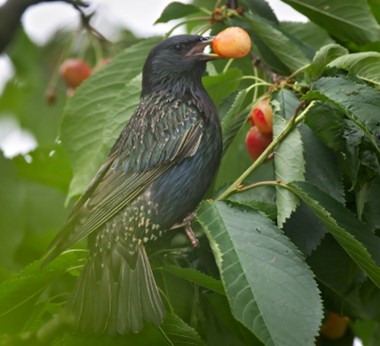
Fruit production is economically crucial in Flanders, with a market value of €645 million (2023) and a strong geographical concentration in West-Haspengouw. However, bird damage increasingly threatens yield stability and profitability.
This project develops and validates an innovative, data-driven approach to quantify, predict and prevent bird damage in fruit orchards in Southwest Haspengouw. By integrating ecological monitoring, spatial modelling and targeted deterrence strategies, we aim to provide fruit growers and policymakers with objective, evidence-based tools for sustainable damage management.
The project runs from January 2026 to June 2028 and is supported by the European Union through the LEADER programme (Haspengouw Zuidwest).
Background and knowledge gaps
Current bird damage management is largely based on generic deterrence methods that often:
-
lack objective monitoring data
-
do not distinguish between species
-
suffer from habituation effects
-
are labour-intensive and costly
Existing knowledge gaps include:
- Reliable and scalable monitoring methods
- Spatial risk determination of damage
- Evidence-based evaluation of preventive measures
- Cost-effectiveness and long-term efficiency
These gaps were explicitly highlighted in earlier sectoral consultations and are further substantiated in recent economic assessments.
Objectives
1. Objective quantification of bird damage
We combine:
-
Passive Acoustic Monitoring (PAM)
-
Bird counts
-
Systematic fruit damage assessments
to validate a reproducible method linking species presence and activity patterns to observed crop damage.
2. Spatially explicit risk modelling
Acoustic data, damage records and landscape variables (remote sensing and GIS) will be integrated into a predictive model that identifies where and when bird damage is most likely to occur.
This will result in a practical risk-indication tool for fruit growers in Southwest Haspengouw.
3. Evaluation of innovative deterrence strategies
Traditional deterrence measures often lose effectiveness due to habituation. This project tests real-time PAM-triggered deterrence systems that activate only when target species are detected.
We experimentally compare:
-
PAM-controlled deterrence
-
Conventional gas cannons
-
Control parcels without deterrence
This design (5 + 5 + 5 orchards in year 2) enables robust evaluation of effectiveness and behavioural responses
Methodological approach
-
Monitoring on 30 fruit orchards distributed across Southwest Haspengouw
-
Seasonal monitoring during critical periods (June–September)
-
Use of ARU’s (Automated Recording Units) for acoustic detection
-
Integrated species distribution modelling
-
Experimental field trials on targeted deterrence
The combination of acoustic sensing, ecological field validation and spatial modelling ensures scientific robustness while maintaining direct applicability for growers.
Expected outputs
The project will deliver:
-
Guidelines for acoustic-based damage monitoring
-
Guidelines for PAM-driven targeted deterrence
-
A spatial risk prediction tool for fruit growers
-
Policy-relevant recommendations for ecologically responsible bird damage management
Partners
Promoter
UHasselt – Centre for Environmental Sciences
Co-promoter
INBO (Research Institute for Nature and Forest)
Partners
UCLouvain
pcfruit
The project integrates academic expertise, ecological research capacity and direct sectoral engagement.
Societal and sectoral impact
This project contributes to:
-
Sustainable crop protection
-
Evidence-based faunal management
-
Reduction of unnecessary disturbance
-
Improved dialogue between agriculture and society
-
Increased resilience of fruit production systems
By shifting from reactive and generic deterrence to data-driven and selective intervention, the project supports both economic viability and ecological responsibility.