OSCAR-QUBE+ (2022-2024)
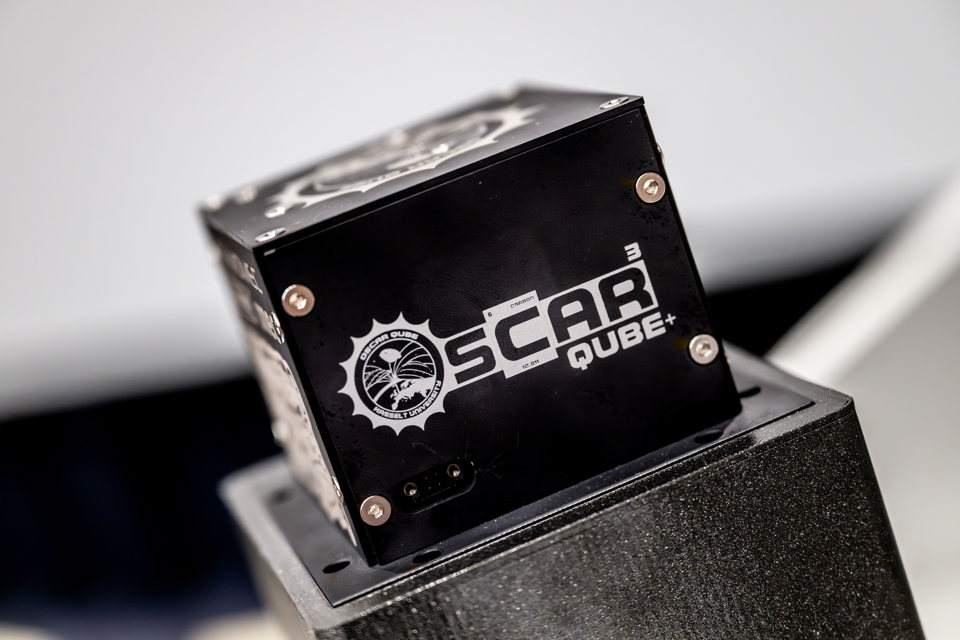
OSCAR-QUBE+ is an advanced version of the OSCAR-QUBE device that builds upon the proof-of-concept results from the original QUBE mission, incorporating lessons learned during the ISS mission.
About the project
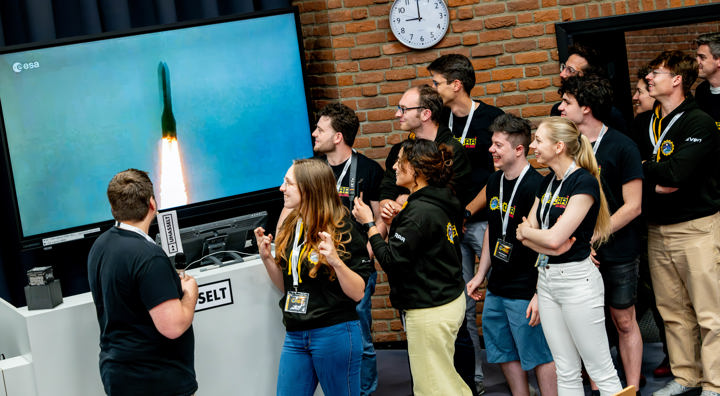
Between 2022 and 2024, the team successfully developed and launched OSCAR-QUBE+, the direct successor to the OSCAR-QUBE mission (2020-2022). This advanced version of the OSCAR-QUBE device builds upon the proof-of-concept results from the original QUBE mission, incorporating lessons learned during the ISS mission. Due to development time constraints, the mission’s architecture was adapted from the previous project, allowing for efficient upgrades while maintaining a proven framework. This iteration was tested aboard the Ariane 6 inaugural flight in July 2024. The project focused on enhancing the sensor’s sensitivity and overall performance, as well as testing the device directly exposed to the space environment. These improvements are an important step towards technical objectives of the project.
The project officially began in 2022 following an accepted request to serve as a scientific payload on the European Space Agency’s YPsat (Young Professionals Satellite) project. This was the first time that the OSCAR team collaborated with ESA young professionals which allowed the students to be in close contact with young professionals in the space industry at the European Space Agency.
The OSCAR-QUBE+ is build directly on the insights and heritage of the original mission on the International Space Station (ISS)/ It was redesigned from the ground up to feature significantly more compact optics and streamlined electronics. The designation "Plus" reflects this major evolution, representing a smaller, lighter, yet markedly more sensitive instrument than its predecessor.
It was also the first time the OSCAR team had to develop an autonomous interface to a satellite where the payload had to start, measure and store data without live commanding from the ground. The sensor itself was ~60 project smaller, 100g lighter, and 10x more precise compared to the original OSCAR-QUBE.
Goals
The technical goal was to miniaturize the technology and reduce the weight and power consumption, and enhancing the sensor’s sensitivity and overall performance. The OSCAR-QUBE+ has a scientific goal to use this improved sensitivity to evaluate the feasibility of determining the attitude and position of the rocket it flew on. This is possible by comparing the magnetic field measurement on the rocket’s flight trajectory to known magnetic field “maps” or mathematical models.
Results
The sensor operated successfully and measured the magnetic field around the rocket trajectory. YPSat’s ground-station network recovered the scientific payload data during the single available downlink pass. Major events in the rocket trajectory were also visible in the magnetic field spectrum such as booster separation, multiple re-ignition of the engines, engine cut-offs, fairing separation. The mission constituted the first OSCAR test of magnetic-navigation concepts.