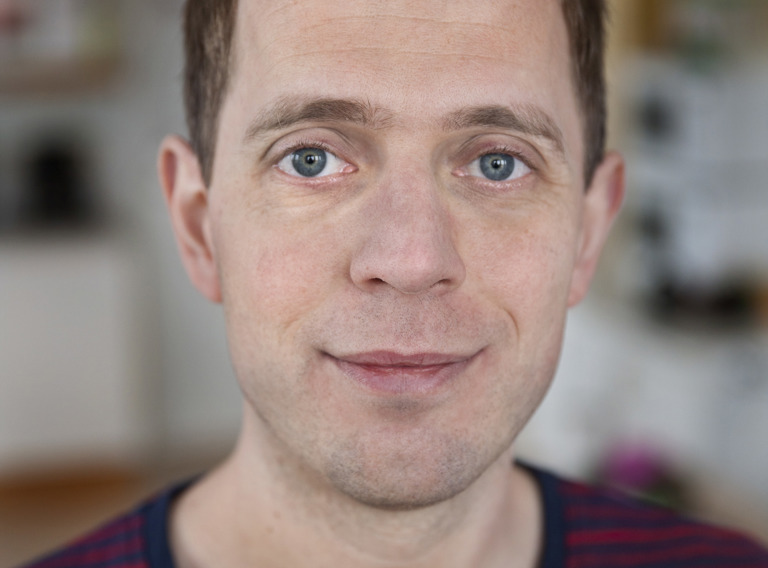
Meet the jury: Prof. Karl Börjesson
In this lecture, prof. Karl Börjesson will focus on how the Columbic coupling to the transition dipole moment of an organic chromophore can create new photophysical relaxation pathways and/or change the energetics of the excited states.

Using weak and strong interactions to control energetics and excited state relaxation pathways in molecular based systems
About the lecture
In this lecture, prof. Karl Börjesson will focus on how the Columbic coupling to the transition dipole moment of an organic chromophore can create new photophysical relaxation pathways and/or change the energetics of the excited states.
He will give a selection of examples using two different coupling scenarios:
The first scenario deals with weak exciton coupling, which enables energy transfer between chromophores. Prof. Börjesson will discuss how the energy transfer, commonly referred to as Förster type resonance energy transfer, can be used as a multiplicity converter.
The second scenario deals with strong exciton coupling, which results in new delocalized states with distinctly different energies than the uncoupled chromophore (so-called J-aggregates). Prof. Börjesson will start by showing that such systems can not only be used to red shift the absorption, but the delocalized nature results in a breakdown of the so-called energy gap law, giving a surprisingly high emission quantum yield in the NIR region of the electromagnetic spectrum. He will then continue with highlighting the benefit of strong exciton coupling for decreasing energy losses for triplet sensitizers.
This lecture is organized in the framework of the FWO – Scientific Research Network ‘Supramolecular Chemistry and Materials’ (W002126N)
About the speaker
Prof. Börjesson is leading a group which constructs molecules or molecular based systems that are able to perform highly specialized functions. The research questions are of fundamental nature, and competence of the group involves both the synthesis of complex molecules and the photophysical/electrical characterization of the molecular based systems. They mostly work with photoactive organic molecules and even though each molecule is able to perform a task on its own, their aim is not to use the single molecules but ensembles of molecules to create materials for the future.
Registration
This lecture is free of charge
Practical information
Thursday, December 17th
1 PM
Building D, Hall B5, Campus Diepenbeek