
Faces of innovation: PhD student Neeve Marien
Behind every breakthrough is a dedicated researcher pushing the boundaries of knowledge. In our Faces of Innovation series, we put the spotlight on our PhD students as they reach the home stretch of their research. With her doctoral defense right around the corner, meet Marien Neeve!
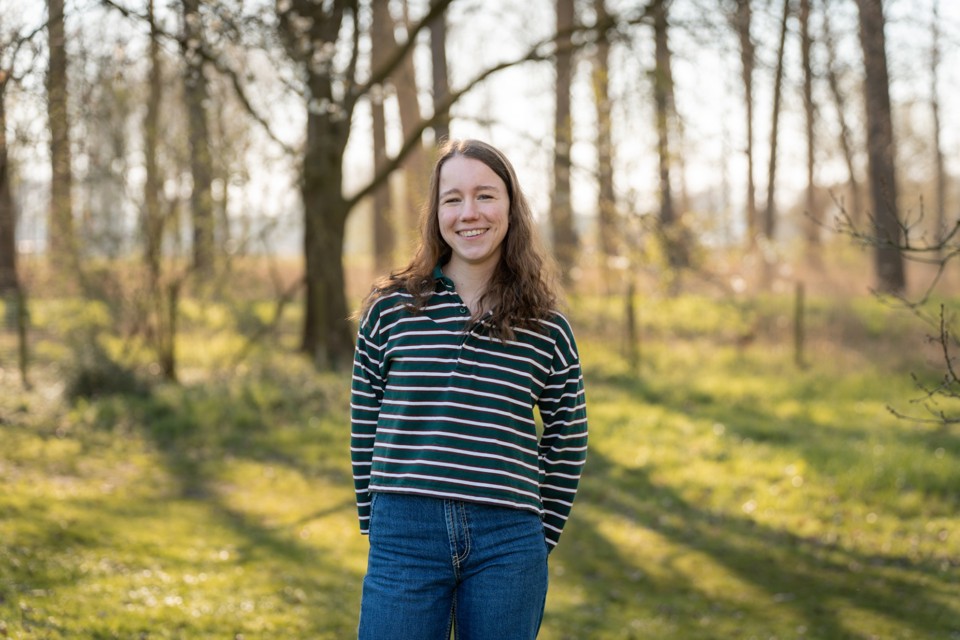
How do you explain your PhD defense to an outsider?
"My PhD focuses on the development of hydrogels for tissue engineering. Hydrogels can act as scaffolding to help the body grow new tissue. One of the challenges in scaffold design is the timing of hydrogel degradation: if the scaffolding breaks down too fast, the new tissue collapses; if it breaks down too slowly, it blocks new tissue from forming. My PhD focused on putting a 'switch' on this process using bioorthogonal chemistry. We attached chemical caging groups to the specific spots where enzymes cut the scaffold. When we want degradation to start, we add a specific release trigger that removes those cages."
IUMAT takes a highly interdisciplinary approach. How has this changed your perspective on materials technology?
"My PhD lies at the interface of organic chemistry, molecular biology and biomaterials. It taught me that materials shouldn't be designed from a purely synthetic standpoint: you have to design the chemistry with respect for the complex biological environment in which it will operate."
EUREKA moment: what was the absolute highlight of the past few years?
"We spent months working with one protease, only to find that, despite caging key elements, the enzyme's flexibility still allowed it to cleave the peptides. It was frustrating to see a discrepancy between our initial models and lab reality. We then pivoted to another model system where we obtained evidence that our shielding group could block enzymatic cleavage, thereby validating our core hypothesis."
Where do you hope your research will be in 7 years? What impact will this have on everyday life?
"This PhD project mainly focused on a new strategy at a fundamental level. In seven years, I hope to see this bioorthogonal release system optimized for in vivo applications and developed into a dynamic hydrogel for tissue regeneration. In the farther future, I hope to see tissue engineering as a true clinical solution and alternative for transplantation. For everyday life, this research paves the way for personalized regenerative medicine. It shifts biomaterials from passive structures into smart, dynamically responsive medical devices."
On Wednesday, 25 November 2026, Marien her doctoral defense will take place. Eager to learn more about her research?
- Wednesday, 25 November 2026, 3 p.m
- Aula H6, Gebouw D, Campus Diepenbeek