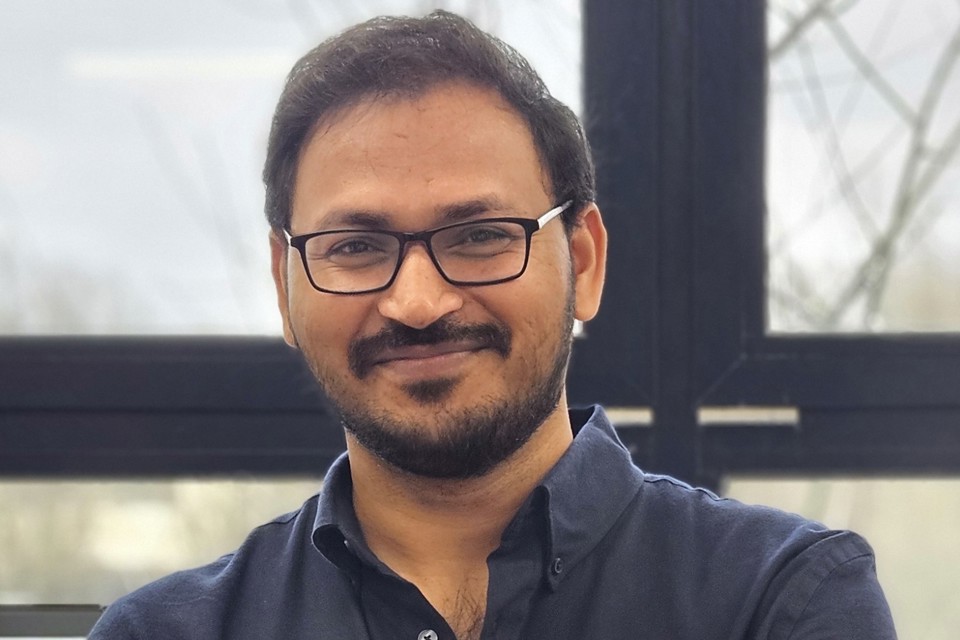
Faces of innovation: PhD student Suresh Ajmeera
Behind every breakthrough is a dedicated researcher pushing the boundaries of knowledge. In our Faces of Innovation series, we put the spotlight on our PhD students as they reach the home stretch of their research. With his doctoral defense right around the corner, meet Suresh Ajmeera!
How do you explain your PhD defense to an outsider?
"Imagine being able to deliver a medicine inside diseased cells, rather than delivering it uncontrollably throughout the entire body. That is essentially what my PhD research is about! I developed extremely tiny, nanometer-sized drug delivery systems using natural polymers, materials that can safely break down in the body after fulfilling their purpose. Scientifically, these are called stimuli-responsive drug delivery systems/ nanotherapeutics. To put their size into perspective, imagine taking the width of a human hair and dividing it into 1,000 slices lengthwise. That gives you an idea of just how small these systems are!
In my research, these systems are designed to break down in specific diseased environments, releasing medicine where it is needed. Think of the “message-carrier system with a self-destruct mechanism” in the Mission: Impossible movie: the message is the medicine, the carrier is the delivery system, and the self-destruct mechanism is a specially engineered feature that activates only under certain conditions.
The ultimate goal is to make treatments more controlled, targeted, effective, and potentially less harmful to healthy tissues. This technology has promising applications in several areas of medicine, particularly cancer treatment, tissue regeneration, and the treatment of other life-threatening diseases. “Small size, but big purpose”
IUMAT takes a highly interdisciplinary approach. How has this changed your perspective on materials technology?
"Working at IUMAT has taught me that the true potential of a material often extends far beyond the purpose for which it was originally developed. Throughout my PhD, I had the opportunity to collaborate with chemists, materials scientists, and biologists, each bringing a different perspective to the same challenge. These collaborations helped me understand how materials can be designed, modified, and fine-tuned to meet the specific needs of different biomedical applications.
This interdisciplinary environment has fundamentally broadened my perspective. Rather than thinking about materials development within the boundaries of a single discipline or application, I now approach it with a much wider outlook, constantly exploring how a material or technology developed for one purpose could potentially solve challenges in entirely different fields."
EUREKA moment: what was the absolute highlight of the past few years?
"I would say I had three major EUREKA moments throughout my PhD journey.
The first came in 2023, when I successfully simplified and streamlined a rather complicated fabrication method for the development of stimuli-responsive nanotherapeutics. What had initially been a challenging and time-consuming process became a much more straightforward and accessible approach.
The second came in 2025, when I saw this work published in an international scientific journal. It was incredibly rewarding to see how an idea could become a reality.
And then came my third EUREKA moment, also in 2025: successfully translating this streamlined approach to other materials. This demonstrated that the method was not limited to one particular material system, but had the potential to be applied much more broadly."
Where do you hope your research will be in 7 years? What impact will this have on everyday life?
"My ambition is to see the technology developed during my PhD move beyond the laboratory and closer to real-world medical applications. Looking seven years ahead, I hope to see these drug delivery systems manufactured on an industrial scale and advance to clinical trials. One particularly exciting application is cancer chemotherapy. While chemotherapy remains an essential cancer treatment, it can also affect healthy cells, leading to significant side effects that can take a considerable toll on patients' quality of life. By delivering drugs more selectively to diseased tissues, the systems I developed could reduce exposure to healthy tissues and, consequently, minimize treatment-related side effects."
On Wednesday, 25 November 2026, Suresh his doctoral defense will take place. Eager to learn more about his research?
- Wednesday, 25 November 2026, 9 am
- RH-1.16, Ceremony Hall, Refugiehuis, Maastrichterstraat 100 3500 Hasselt