
Faces of innovation: Sander Driesen
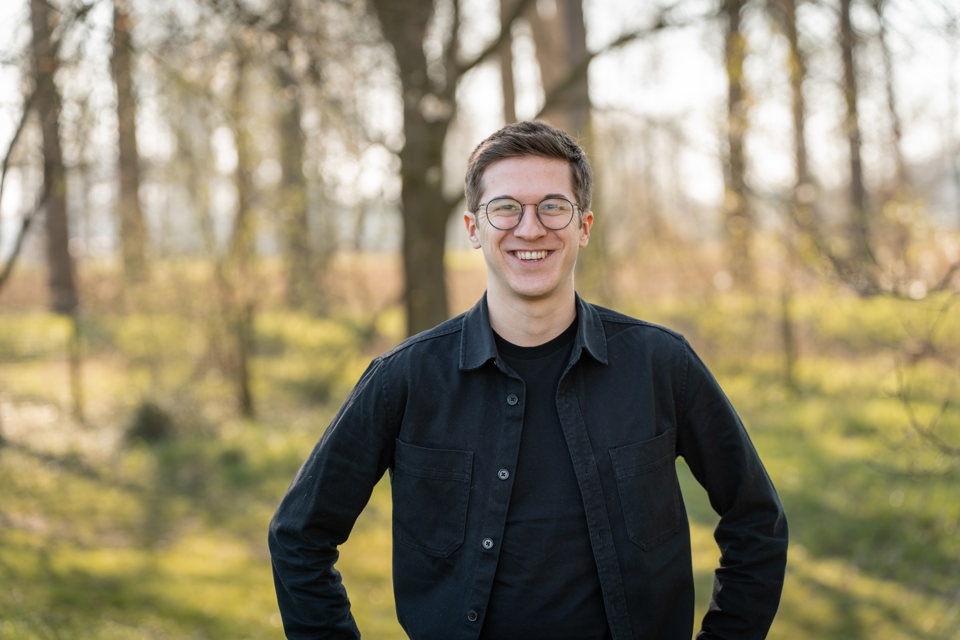
Behind every breakthrough is a dedicated researcher pushing the boundaries of knowledge. In our Faces of Innovation series, we put the spotlight on our PhD students as they reach the home stretch of their research. With his doctoral defense right around the corner, meet Sander Driesen!
How do you explain your PhD defense to an outsider?
"Cartilage is a remarkable tissue: it allows our joints to move smoothly and withstand large forces. Unfortunately, once it is damaged, it hardly repairs itself. In my PhD, I developed water-rich materials called hydrogels that aim to mimic these properties and support cartilage repair. The real challenge was combining strength, biological activity and practical usability in one material."
IUMAT takes a highly interdisciplinary approach. How has this changed your perspective on materials technology?
"This interdisciplinary approach is very noticeable in my research. My promotors actively encouraged me to collaborate with people from a wide range of backgrounds and to consider all possible aspects of my research project. As a result, I learned to look at materials from several perspectives: chemistry and physics for material design, engineering for mechanical testing and processability, and biology for cell studies and applicability. It really opened my eyes to how broad research is and how much you need to understand across different fields to become a good researcher."
EUREKA moment: what was the absolute highlight of the past few years?
"I would actually split this into two highlights. On a personal level, it was incredibly rewarding to see students I supervised during internships grow into researchers and eventually start PhDs of their own. Scientifically, one of the most exciting moments was seeing that our materials could actually support the formation of cartilage-like tissue. That was a very tangible confirmation that the work we had been doing could translate into a real biological effect."
Where do you hope your research will be in 7 years? What impact will this have on everyday life?
"I hope that my research has contributed a small step towards the development of more advanced hydrogels and a better understanding of how they can be designed and optimized to stimulate cartilage formation as effectively as possible. This is still a major challenge today, so I hope that the insights from my work can help guide future research towards better regenerative strategies."
On Wednesday, 2 September 2026, Sander his doctoral defense will take place. Eager to learn more about his research?
- Wednesday, 2 September 2026, 3 p.m
- Auditorium B5, Building D, Campus Diepenbeek