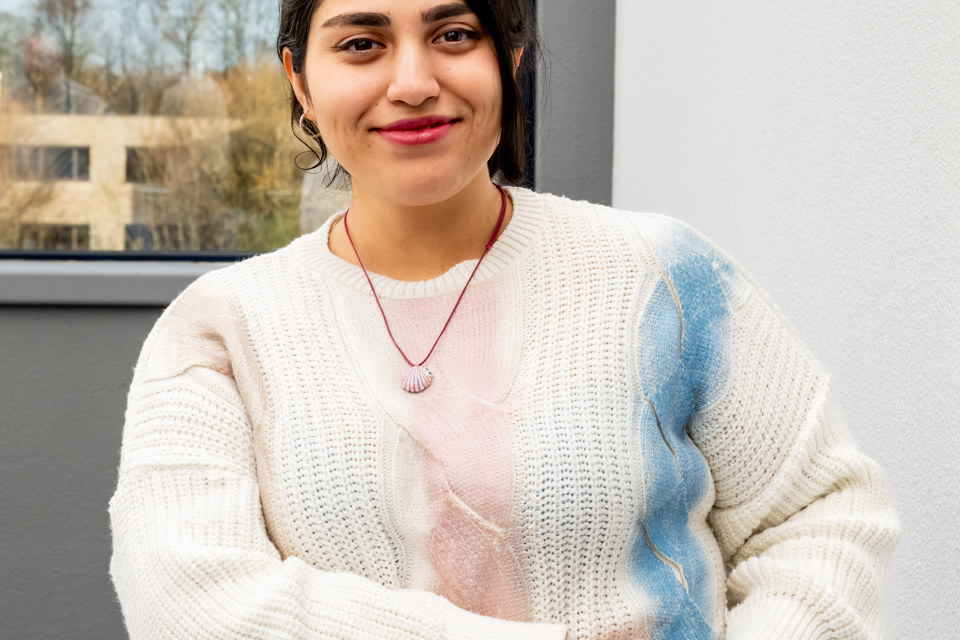
Faces of innovation: Shabnam Ahadzadeh
Behind every breakthrough is a dedicated researcher pushing the boundaries of knowledge. In our Faces of Innovation series, we put the spotlight on our PhD students as they reach the home stretch of their research. With her doctoral defense right around the corner, meet Shabnam Ahazadeh!
How do you explain your PhD defense to an outsider?
"My PhD is about creating light that our eyes cannot see. The light we normally see ends with red. Just beyond that lies near-infrared (NIR) light. It is invisible to us, although infrared radiation is also associated with the warmth we experience from sources such as sunlight. What makes NIR especially interesting is that, although we cannot see it, it can interact with our surroundings and even with the human body in ways that make it useful for sensing, imaging, communication and healthcare applications.
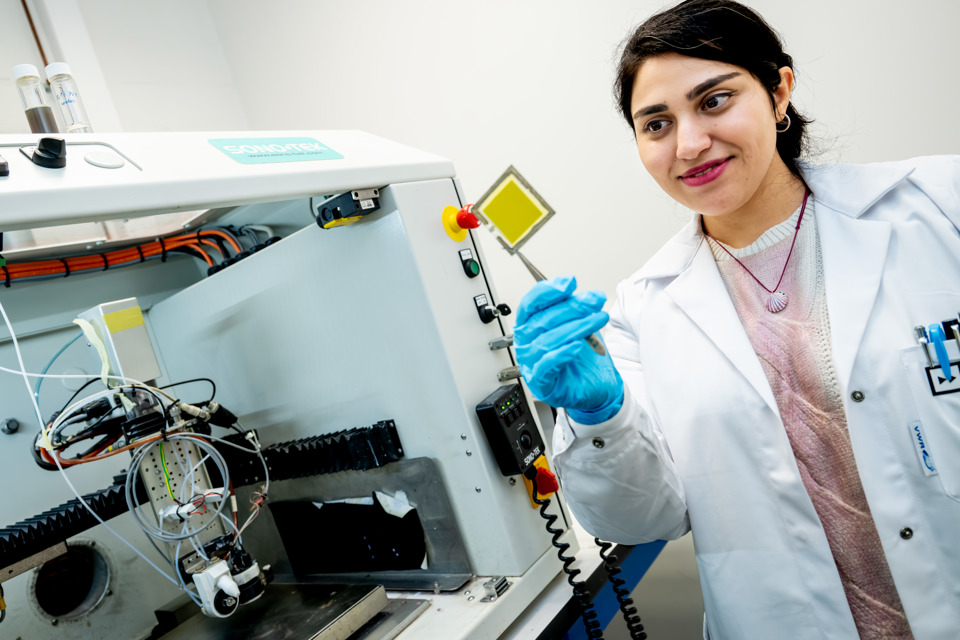
In my PhD, I worked with carbon nanotubes, extremely tiny tubes made of carbon that can emit light in this near-infrared region. But having a material that can emit NIR light is only the beginning. I investigated how these nanotubes can be processed from a solution, deposited as thin and uniform layers, and finally integrated into an electronic device that actually produces NIR light when a voltage is applied.
A major part of my research focused on ultrasonic spray coating, because I wanted to go beyond simply demonstrating an interesting material in the laboratory and explore processing methods that could eventually be used over larger areas and even on flexible surfaces.
So, in simple terms, my PhD followed the journey of carbon nanotubes from nanomaterial, to processed thin film, to a working near-infrared light-emitting device."
IUMAT takes a highly interdisciplinary approach. How has this changed your perspective on materials technology?
"One of the biggest things I learned during my PhD is that a material cannot really be studied in isolation. Its chemistry, surface properties, structure, optical behaviour, electrical properties and the way it is processed are all connected. My research naturally brought together materials science, chemistry, physics, electronics and engineering. Something that may initially look like a small chemical change, for example changing or removing the molecules surrounding a carbon nanotube, can influence how the nanotubes form a film, how they interact with light and ultimately whether the final electronic device works.
Being in such an interdisciplinary environment therefore changed the way I approach a research problem. Instead of looking only at the final device performance, I learned to follow the entire chain: how the material is prepared, how it is processed, what happens to its structure and interfaces, how its properties change, and finally how all of this determines the behaviour of the device. It also made me appreciate how important collaboration is. Many of the questions I encountered during my PhD could only be answered by bringing together people with very different expertise."
EUREKA moment: what was the absolute highlight of the past few years?
"Without any doubt, the first time I saw electroluminescence from my carbon-nanotube OLED. I still remember that moment very clearly. There had been so many experiments behind it: preparing and sorting the nanotubes, optimizing their deposition, improving the film quality, removing unwanted surfactants, characterizing their optical properties, building the complete device, and, of course, many attempts that did not work as we hoped. Then we applied the voltage and finally detected the near-infrared emission.
I actually cried from happiness. I immediately recorded the spectrum and sent it to my promoters, my family and friends. In the lab, there was shouting, laughing, and clapping from all sides. I can still remember the cheering voices of my colleagues. For someone looking at the spectrum from outside, it might have been just a peak on a graph. But for me, that peak represented years of work coming together in one moment. It was the first proof that the nanotubes we had processed and integrated into the device were really producing light electrically. That is definitely a moment from my PhD that I will never forget."
Where do you hope your research will be in 7 years? What impact will this have on everyday life?
"In seven years, I hope carbon-nanotube-based near-infrared emitters will have moved much further from laboratory proof-of-concept devices towards efficient, stable and scalable technologies. What particularly interests me is combining these materials with large-area and flexible manufacturing techniques. If we can make NIR light sources thin, lightweight and easier to manufacture, they could eventually be incorporated into wearable devices, sensors and healthcare technologies.
The interesting thing is that people might use such technologies every day without ever seeing the light itself. The NIR emission could be working invisibly inside a device to sense information from the body, assist imaging, monitor certain parameters or enable optical communication. For me, that would be the ideal continuation of this research: something that started with understanding and processing carbon nanotubes at the nanoscale eventually becoming part of a technology that has a real impact on people's everyday lives."
On Friday, August 21st, Shabnam her doctoral defense will take place. Eager to learn more about her research?
- Friday, 21 August 2026, 2.30 p.m
- Refugiehuis, Ceremony Hall, Maastrichterstraat 100, 3500 Hasselt