
New ultrathin device makes infrared images visible with a conventional camera
Researchers at IUMAT, the Institute for Materials Research of Hasselt University and imec, have developed a device only a few millimetres in size that converts invisible infrared patterns into visible images, without requiring an external power supply and even at very low light intensities. “Our device converts a near-infrared image into visible green light that can be captured via an inexpensive conventional camera, such as found in smartphones. The technology is an important step towards affordable infrared imaging for remote applications including agriculture, environmental monitoring and biomedical research,” say Dr Bernhard Siegmund and Prof. Dr Koen Vandewal.
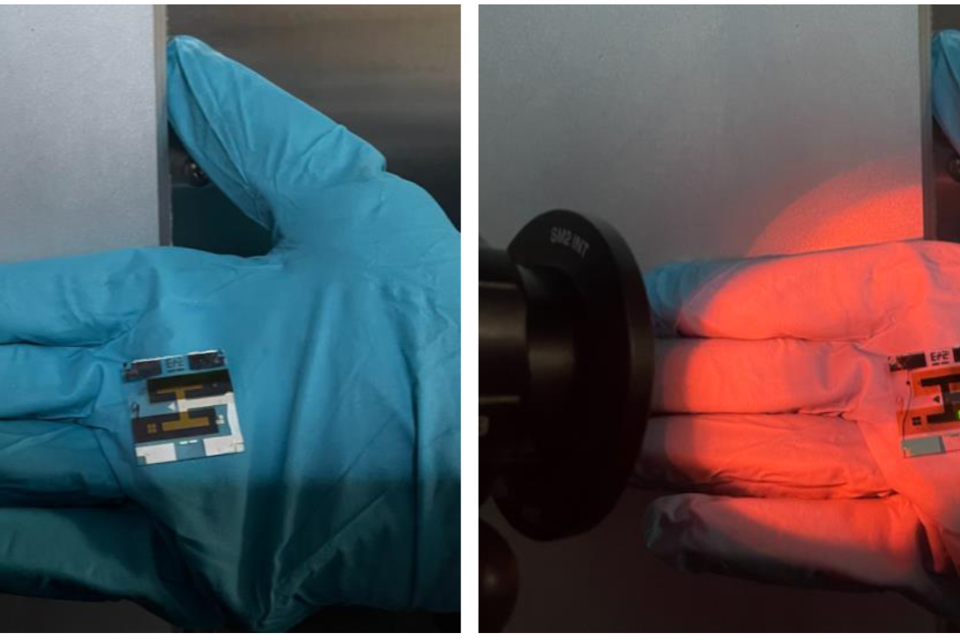
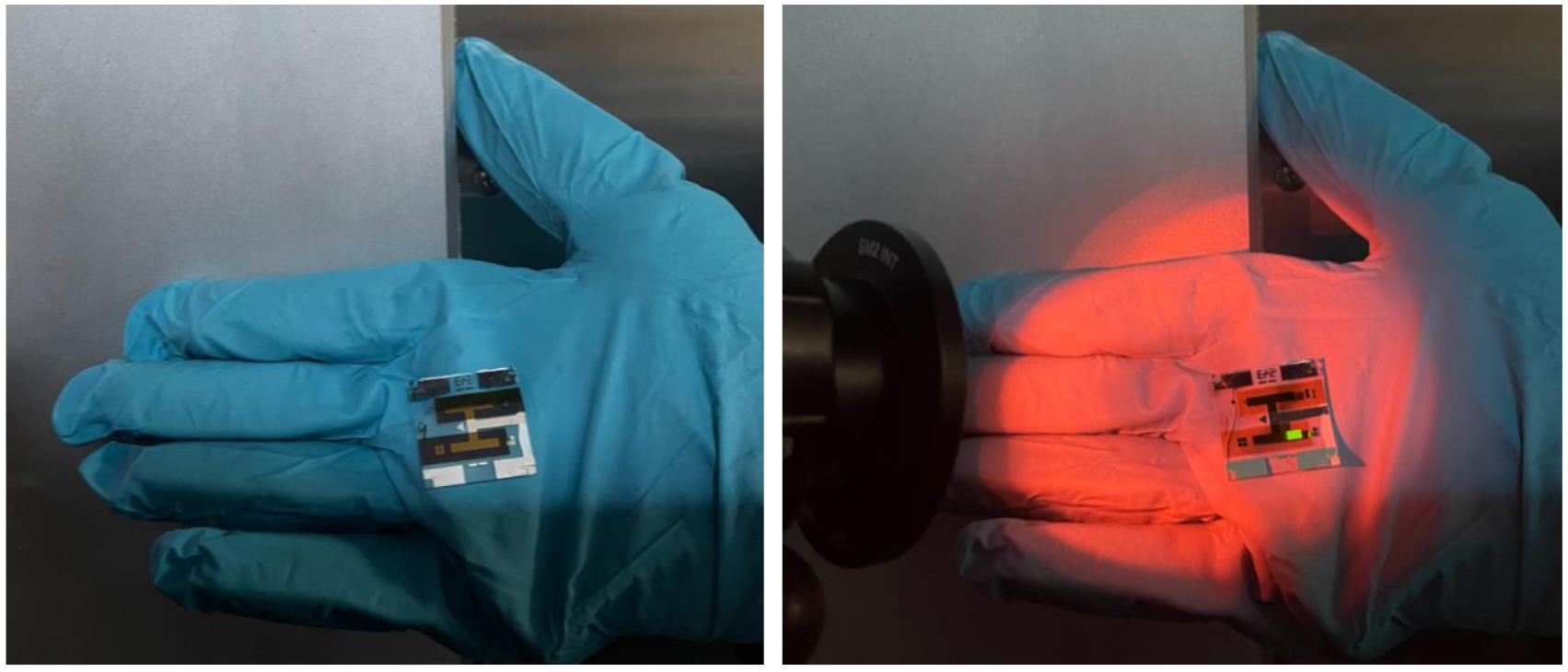
Near-infrared light is invisible to the human eye, but can provide a wealth of useful information about materials and products. In industry, infrared cameras are widely used, for example, to determine the water content and ripeness of fruits or to assess the composition of chemical products. Such measurements generally require specialised and often expensive near-infrared cameras.
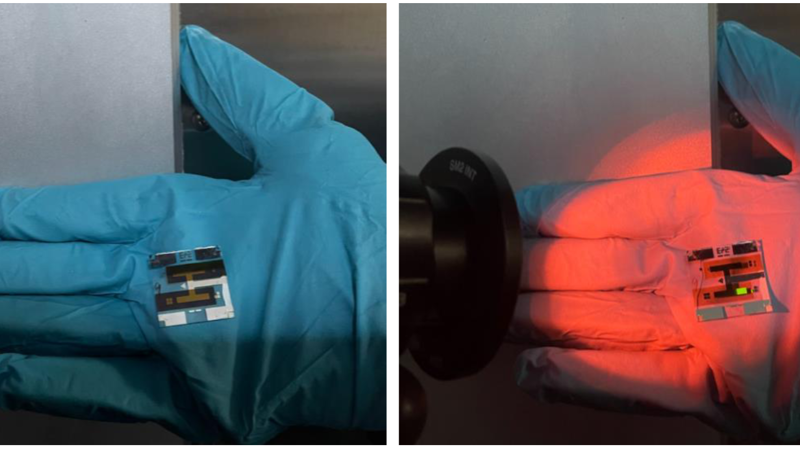
The new device developed by the IUMAT researchers consists of 38 carefully selected ultrathin organic layers. The structure is around 100 times thinner than an average human hair and can convert a near-infrared image into visible green light that can be detected by an inexpensive conventional camera.
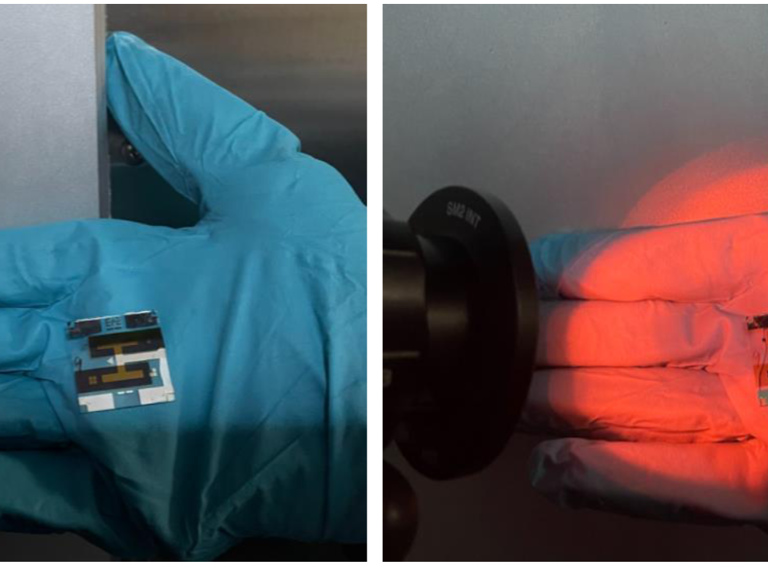
photo: Developed device in the palm of the hand, lighting up in green when illuminated with near-infrared or red light.
4,000 times less light required
“By connecting several near-infrared photodetectors in series within the structure, they jointly generate enough power to drive an OLED (organic light-emitting diode). The OLED then converts the infrared image into visible green light, without the need for an external power supply,” says project leader Dr Bernhard Siegmund. “In addition, the device already operates at a light intensity more than 4,000 times lower than comparable devices.”
It took the international research team, consisting of both chemists and physicists, several years to establish the dedicated lab and to arrive at the right composition and structure for the device. “When we saw the final 38-layer device produce a clear image, we knew that the many fabrication steps, simulations and individual improvements were finally working together,” says Dr Xueshi Jiang, who carried out most of the experiments and optical simulations as a doctoral researcher.
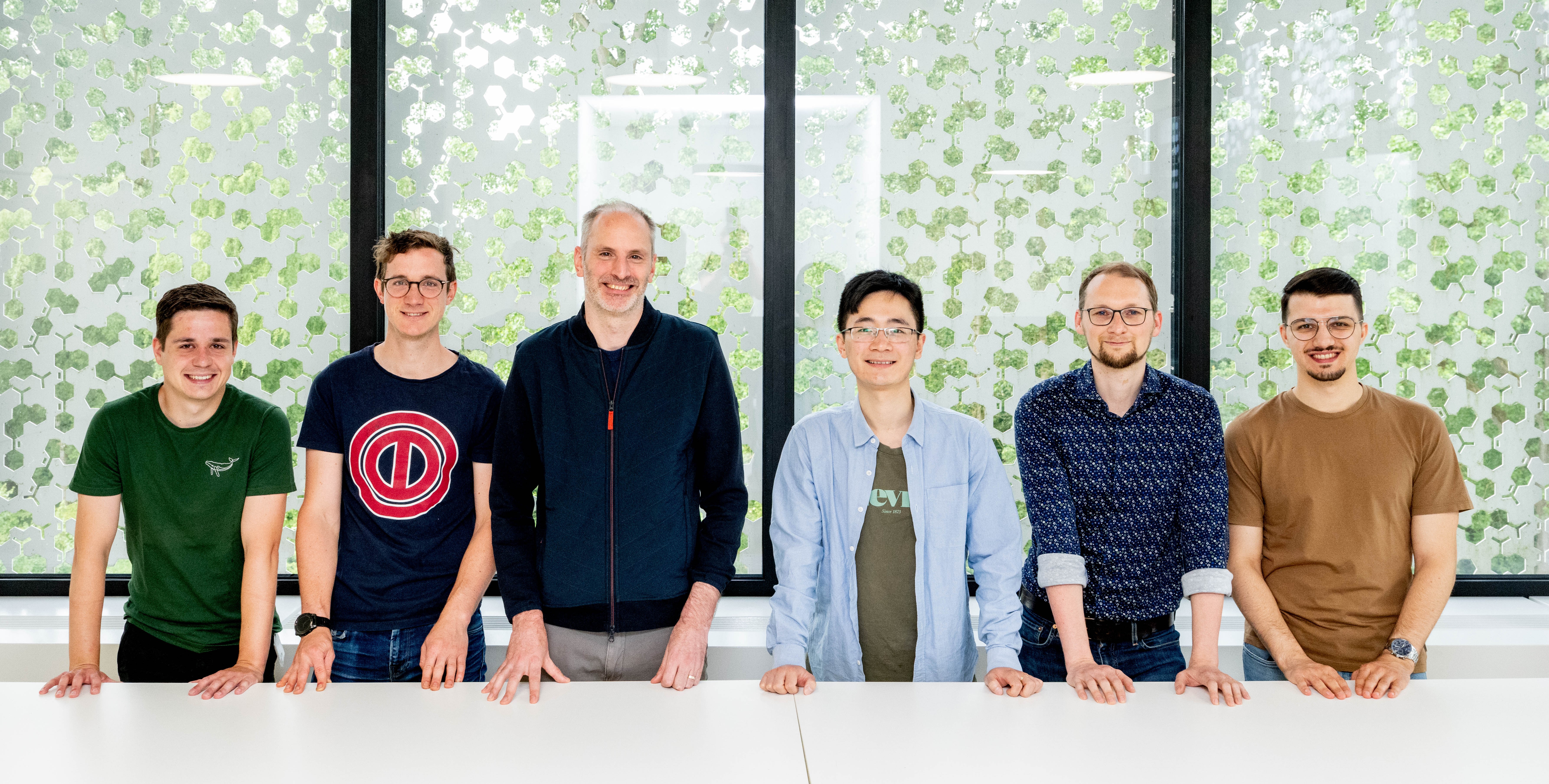
photo: Members of the project team (from left to right): Dr Tom Cardeynaels, Dr Sam Gielen, Prof. Dr Koen Vandewal, Dr Xueshi Jiang, Dr Bernhard Siegmund, and Ferdinando Muraca.
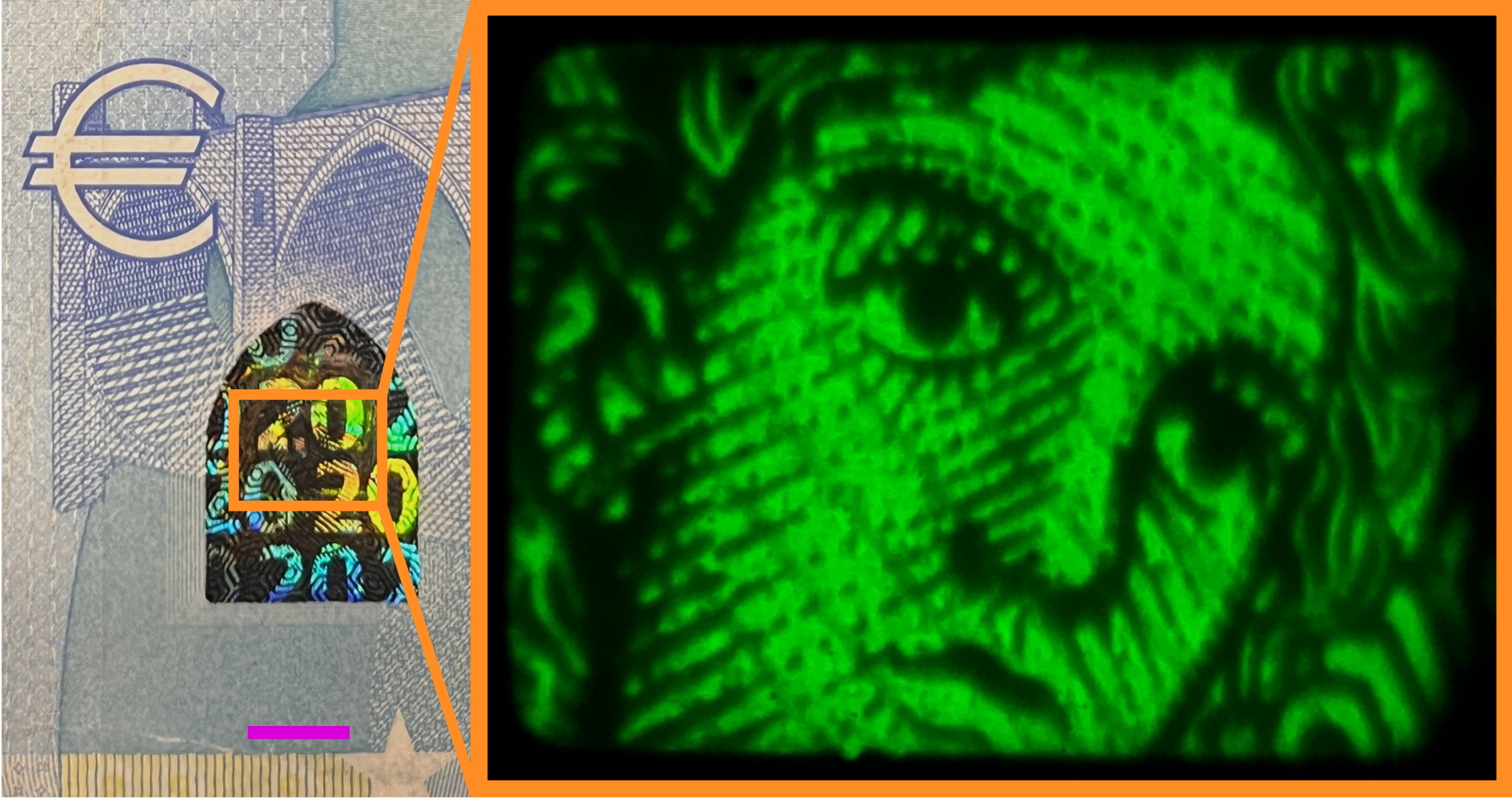
Revealing safety features on a €20 banknote
In one of the laboratory experiments, the device revealed detailed near-infrared security features on a €20 banknote, including the face of the mythological figure Europa and other patterns. The researchers were also able to reveal structures beneath the surface of biological samples, illustrating the potential for future biomedical applications such as advanced monitoring after an organ transplant.
“Our technology opens a new route towards self-powered near-infrared imaging, even at very low light intensities. It could make future monitoring systems more affordable and easier to deploy, for example on farms, in forests, or around remote infrastructure,” says co-project leader Prof. Dr Koen Vandewal.
photo: A section of a 20 € banknote photographed with a conventional camera (left) and its security feature revealed in near-infrared, using the new device (right).
The research has been published in Communications Materials, a leading international journal in materials science. The study was funded by the Research Foundation – Flanders (FWO) through grants 12AOC24N, 1266923N, 1284623N, G0A2Q24N and G0D1521N, and by the European Research Council (ERC) through grants 864625 and 101137675.