Wouter Van Gompel wins prestigious ERC Starting Grant
Researcher Prof. Dr Wouter Van Gompel has been awarded an ERC Starting Grant worth €1.7 million. With this prestigious European grant, his team at IUMAT, the Institute for Materials Research of UHasselt and imec, will develop a new generation of materials capable of directly detecting complex light signals.
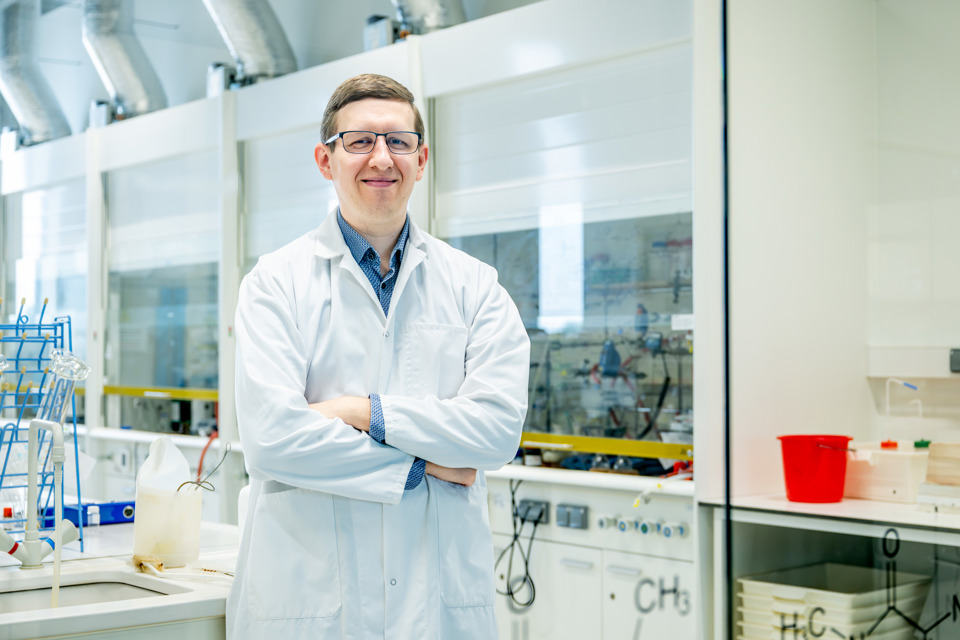
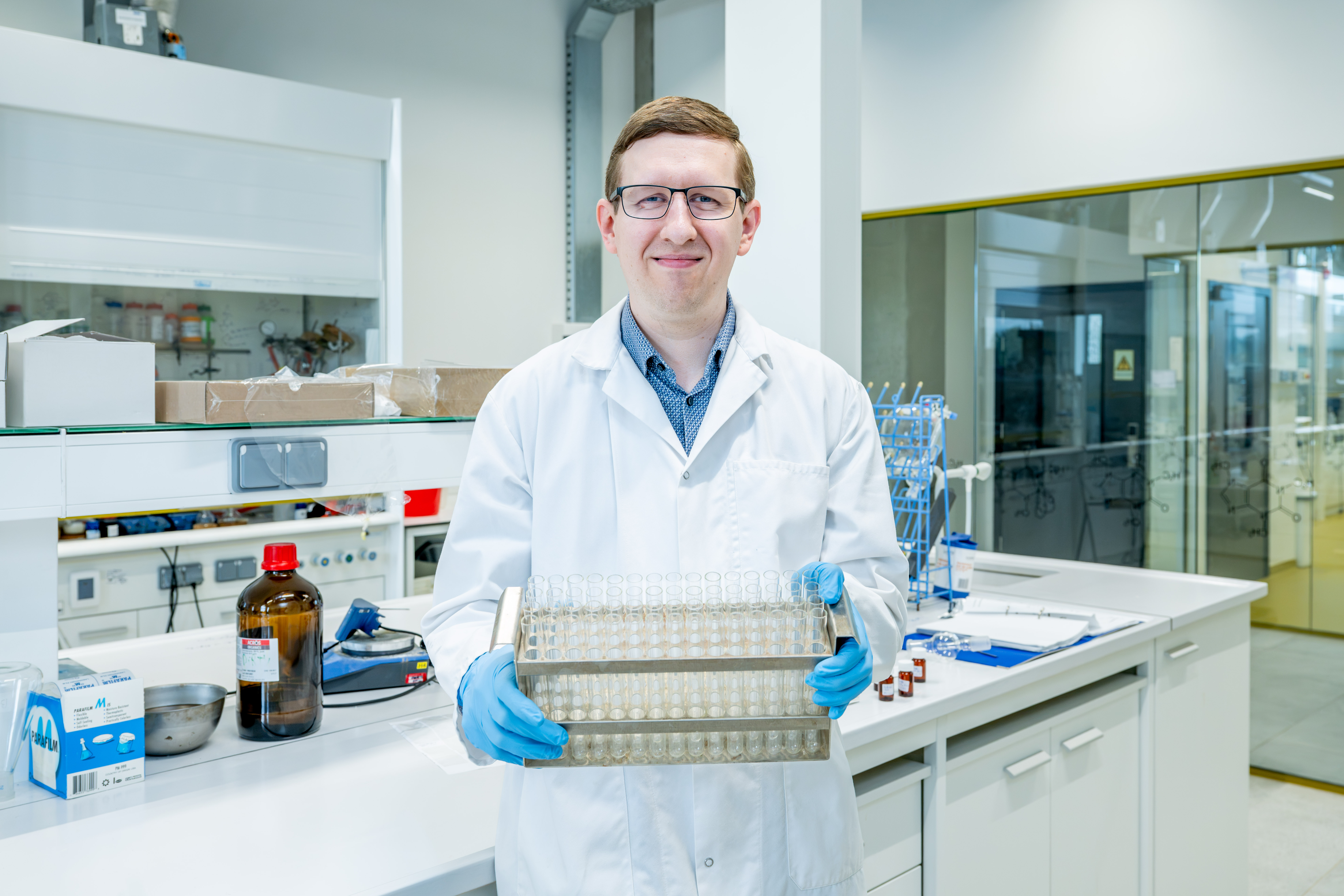
UHasselt researcher Prof. Dr Wouter Van Gompel has been awarded an ERC Starting Grant worth €1.7 million. With this prestigious European grant, his team at IUMAT, the Institute for Materials Research of UHasselt and imec, will develop a new generation of materials capable of directly detecting complex light signals. “In the long term, this could lead to more compact sensors, improved medical imaging and new forms of optical communication,” says Prof. Dr Wouter Van Gompel.
When we think of light, we usually think of brightness or colour. However, light has another property: polarisation. One particular form is known as circularly polarised light (CPL), in which the light travels in a left- or right-handed spiral. Although this property is invisible to the human eye, it carries valuable information that can be used in a wide range of technological applications.
Today, analysing circularly polarised light requires systems with large optical components such as filters and polarisers. This makes these systems relatively large, but above all, complex and expensive. “With our research, we want to gain a better understanding of how we can develop materials that can directly recognise the handedness of light and convert it into an electrical signal,” says Prof. Dr Wouter Van Gompel.
Materials with a ‘left and right hand’
To achieve this, the researchers are looking at chiral materials. Just as a left and right hand are mirror images of each other but cannot be superimposed, molecules can also exist in left-handed and right-handed forms. Such materials respond differently to left- and right-handed light and can therefore extract information from the polarisation of light.
“Within this ERC project, we are focusing on chiral versions of hybrid perovskites, a promising class of semiconductors that our research group has been working on intensively for several years,” says Wouter Van Gompel. “These materials have great potential, but they are currently still insufficiently stable, while their electrical conductivity and optical performance also need to be improved.”
New imaging and communication technologies
The new research project, called CONCePT, takes a completely novel approach to improving these chiral perovskites. To do so, the team will precisely modify the material's organic building blocks to achieve more efficient charge transport, improved detection of circularly polarised light, and greater material stability.
“This is fundamental research into exactly how this material works, but in the longer term, the technology could contribute to a wide range of applications,” says Wouter Van Gompel. “In medical imaging, circularly polarised light could provide
additional contrast to make complex biological structures more visible. In optical communication, the polarisation of light can be used to transmit more information. Chiral materials also offer interesting prospects for new forms of light-driven electronics, advanced image recognition, and energy-efficient information processing.”
International recognition
“This ERC Starting Grant is a tremendous recognition of our research,” says Prof. Dr Wouter Van Gompel. “We have known for several years that chiral materials offer unique opportunities to detect and process light in an entirely new way. Until now, however, their performance has remained too limited for real-world applications. With CONCePT, we want to overcome these fundamental barriers and lay the foundations for a new generation of materials that can directly exploit hidden information in light.”