PV RESILIENCE
PV RESILIENCE, short for Photovoltaics Re-options for Socially Inclusive Life-cycle Innovations Enabling a Circular Economy, produces local and circular solar panels.
TRANSITION TO CIRCULAR ENERGY
The energy transition requires large-scale solar power generation. However, current solutions have limitations:
- they mainly come from China
- are difficult to recycle
- have a significant carbon footprint.
PV RESILIENCE, short for Photovoltaic Re-options for Socially Inclusive Life-cycle Innovations Enabling a Circular Economy, is developing circular solar power products that are demountable. Using innovative materials, local production and designs without permanent glues, valuable raw materials such as silver and silicon remain available, and CO₂ emissions are drastically reduced.
OBJECTIVES
The project develops, tests and demonstrates circular innovations:
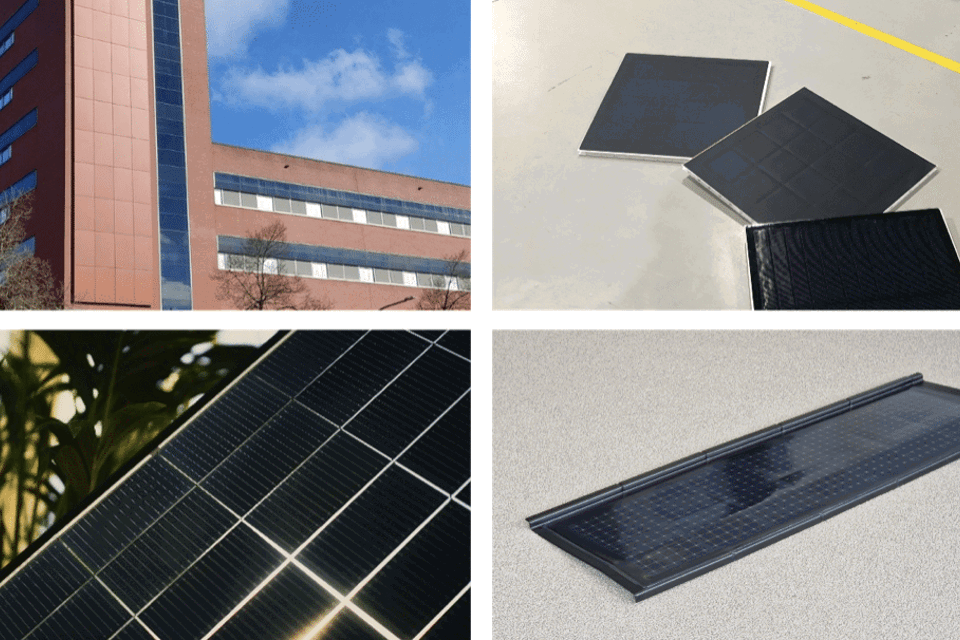
- Flexible solar panels integrated into roof elements and polymer panels
- Encapsulant-free, modular solar panels that are easy to disassemble and reuse (on a pilot scale)
- Aesthetic façade panels with colour and pattern variation, with minimal loss of efficiency
The knowledge gained from this leads to the final demo, “Ultra-circular panels”, constructed from parts of the dismantled encapsulant-free solar panels. In this way, we close the chain and go all out for circularity.
In addition, the partners are examining how these products can be produced, maintained and reused in a circular manner. Everything is also being tested and demonstrated in practice, including in social housing and research areas. This allows interested parties to become acquainted with these innovations.
PARTNERS AND FUNDING
The Interreg project is co-financed by the European Union. This project boosts circular and sustainable PV innovations in the border region. Together, the 11 project partners are developing methods and processes related to dismantling, repair, upgrading, reuse and increased sustainability. By bringing together knowledge of among others circular materials and the integration of solar products, a true European value chain for sustainable solar energy can be created
Project coordinator: TNO
Project partners: Kamp C, Biosphere Solar, BouwhulpGroep, imec, Paneltim, Roartis, Soluxa, Stichting Zuyd Hogeschool, Technische Universiteit Eindhoven en Universiteit Hasselt
Granted subsidy Interreg: € 2.056.743,27 (50%) Theme: “Een groener Europa. Klimaat, milieu en natuur”.
CONTACT
Do you have a question? Contact Filip.Duerinckx@imec.be (imec) or Michael.Daenen@uhasselt.be (UHasselt).