
Green artificial-Intelligence based Modelling of Lignin for sustainable bio-based chemistry of the future
The GIMLi project strives to link different lignin structures to specific properties by making use of machine learning models with a focus on sustainability.
The GIMLi project strives to link different lignin structures to specific properties by making use of machine learning models with a focus on sustainability.
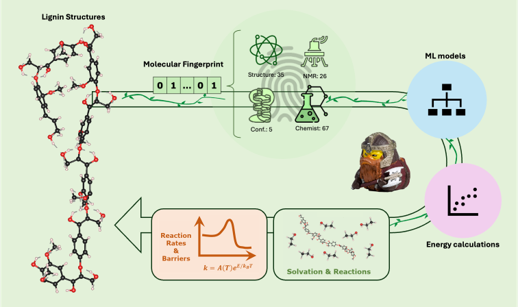
Lignin, the second most abundant biopolymer, is a potential source for renewable and sustainable aromatic building blocks in polymer chemistry, contributing to a circular and sustainable industry. The problem, lignin being a complex organic polymer group instead of one well-defined molecule, is a lack in understanding of the specific properties of lignin linked to all its potential structures. Quantum chemical (QC) modelling provides the most accurate results of the structure-property relationship, be it at a tremendous computational cost and thus ecological impact.
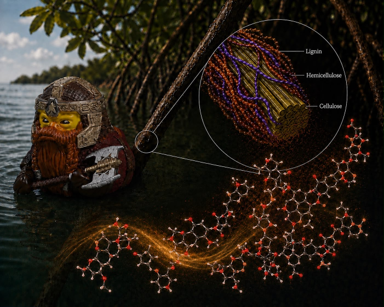
This project focuses on developing an AI model, partially trained on QC data to provide the highest quality, allowing for low cost, more sustainable, modelling of lignin properties. The model will then be applied to study solvation and reaction rates. With this, the resulting AI model hopes to give insight into functionalization, purification and depolymerization processes to allow future polymer chemists to design more rational and focused strategies for both lignin depolymerization as well as synthesis strategies.

 |
 |