HR Excellence in Research @ UHasselt
HR Excellence in Research at UHasselt – building an excellent research environment.

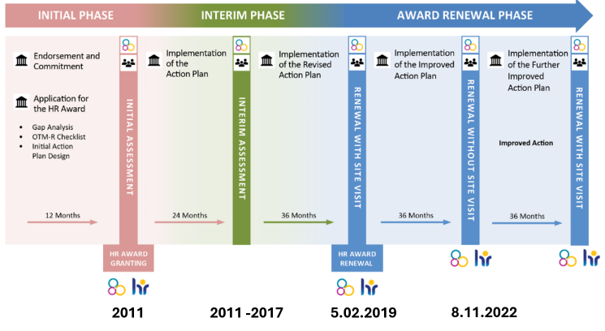
UHasselt is committed to creating an open, inclusive and stimulating environment in which researchers can develop their talent, conduct responsible research and build sustainable careers. Since 2011, Hasselt University is granted the "Human Resources Strategy for Researchers" (HRS4R) award by the European Commission. This award is granted to research performing organisations that are progressing in the implementation of the principles of the European Charter for Researchers in their policies and practices.
Through the Human Resources Strategy for Researchers, we continuously improve our recruitment practices, working conditions, research support and career development opportunities. Institutions who obtain this label work with action plans and periodic assessments to demonstrate continuous improvement in their policies and practices for researchers.
Download the 2026–2028 Action Plan
What is HRS4R?
The Human Resources Strategy for Researchers, or HRS4R, is a European framework that helps research organisations translate the principles of the European Charter for Researchers into their HR policies and everyday practices. The strategy focuses on fair and transparent recruitment, attractive and inclusive working conditions, research ethics and integrity, career development and lifelong learning, and effective support throughout the researcher journey.
Principles of the European Charter of Researchers.
The European Charter for Researchers is a set of principles underpinning the development of attractive research careers to support excellence in research and innovation across Europe. The focus of the European Charter for Researchers is the rights and responsibilities of researchers, employers, funders and policy makers; it consists of 20 key principles. These are classified under the following four pillars:
- Ethics, Integrity, Gender and Open Science;
- Researchers’ Assessment, Recruitment and Progression;
- Working Conditions and Practices;
- Research Careers and Talent Development.
HRS4R@UHasselt
Hasselt University was the first Flemish university to obtain the HrS4R label. Since then, UHasselt has implemented the strategy through successive action plans, developed in consultation with researchers and formally approved by the university’s senior management.
Our priorities for 2026-2028
Seven action areas that strengthen the researcher experience.
Our new action plan translates the HRS4R principles into seven areas for improvement. Together, these actions aim to strengthen the researcher experience, from the first contact with UHasselt to long-term professional and career development.
- 1. Broaden the support system for researchers
- 2. Increasing attractiveness as an inclusive employer
- 3. Strengthen our international appeal for recruitment
- 4. Stimulate and maximize objective recruitment and selection (OTM-R
- 5. Developing an appreciative, stimulating and safe (organizational) culture
- 6. Develop effective, efficient and data-informed HR processe
- 7. Embedding lifelong learning and talent development
Implementing and monitoring the actions
Hasselt University has established a formal governance structure to ensure the continuous oversight and strategic alignment of the HRS4R Action Plan. This oversight is organized through a dedicated Coordination Team and a Steering Committee.
Progress is reviewed every three months by the Coordination Team, which consists of representatives from the rectorate, the HR directorate and the directorate of research, library and internationalization. A Steering Committee provides strategic oversight, while researchers and other stakeholders contribute through consultations, working groups, surveys and sounding boards. UHasselt uses a Plan-Do-Check-Act approach to monitor milestones, evaluate results and adjust actions when needed.
The complete action plan was formally approved by the senior management bureau of the university, consisting of the Vice-Rector for research, internationalisation & valorisation, the Vice-Rector for education, the general and academic manager, and the Rector. This ensures top-level endorsement and resource allocation for our continued commitment to researcher excellence.
Researchers participation – your experience matters
The HRS4R strategy is developed for researchers and with researchers. Your input helps us evaluate existing practices, identify new needs and shape future actions related to recruitment, career development, supervision, wellbeing and research support.
Documents and resources
Open, Transparent and Merit-based recruitment.
Learn how UHasselt works toward fair, transparent and competency-based recruitment and selection.
- UHasselt OTM-R-policy (pdf, 50 KB)
- OTM-R-checklist (pdf, 169 KB)
- HR excellence in research (article in Dutch) (pdf, 849 KB)
UHasselt HR strategy for researchers: Action plan 2026-2028
Discover the full set of actions, responsibilities, indicators and milestones.
- Action plan for 2026–2028 (pdf, 692 KB)
- Previous action plans
HRS4R internal review
Read how UHasselt assessed its progress, identified priorities and involved researchers and institutional stakeholders.
European Charter for researchers
Contact
Questions about HR excellence in research?
Would you like more information about the HRS4R strategy, its implementation or a specific action?