
Flow Cytometry Unit
Welcome to the Flow Cytometry Unit of the Biomedical Research Institute at Hasselt University. This website is intended to provide you with an overview of our equipment and in-house expertise. We are happy to collaborate with academic and non-academic partners for all flow cytometry needs. Don’t hesitate to contact us:
For academic partners: bieke.broux@uhasselt.be
For non-academic partners: biomed.bd@uhasselt.be
View the content of this page
Team
The Flow Cytometry Unit (FCU) supports researchers at BIOMED , Hasselt University, and beyond. Our facility enables the high-throughput analysis of human clinical samples and animal disease models using conventional and spectral flow cytometry. Additionally, we provide precision FACS-sorting for downstream cell culture and single-cell capture for advanced RNA sequencing.
Collaborate
If you are interested in our equipment or expertise, a collaboration can be set up according to your needs:
- Fee-for-Service: performing the relevant experiments for you.
- Consultancy and training: guiding your experimental set-up and training researchers at your location or at our facilities.
- Research collaboration: open for joint grant applications when the project is complementary with our own research lines and goals.
Optimization
We have a catalog available of several validated flow cytometry panels for both human and mouse cells. Additionally, using a validated stepwise protocol for panel design and panel optimization, we can provide you with valuable help, support and technical assistance to design a panel that fits your specific needs. We are also happy to help in formulating the optimal set-up and protocols for your experiments, whether this is sample selection, cell isolation, determining the right stimuli for your cells, or any other technical questions you might have.
Equipment and expertise
Acquisition
Acquisition
BD LSRFortessa
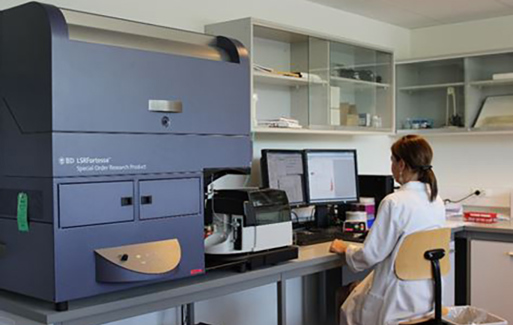
The BD LSRFortessa is equipped with four lasers and can detect FSC, SSC and up to 16 colours simultaneously. It is coupled with a high-throughput sampler (HTS), allowing the acquisition of samples in 96-wells plates.
Cytek Aurora
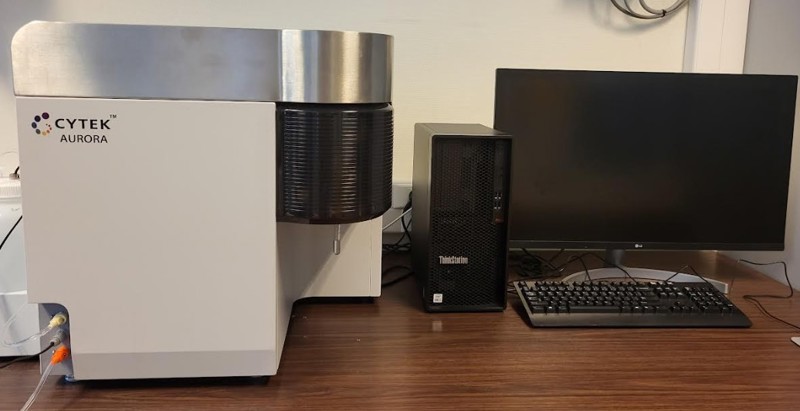
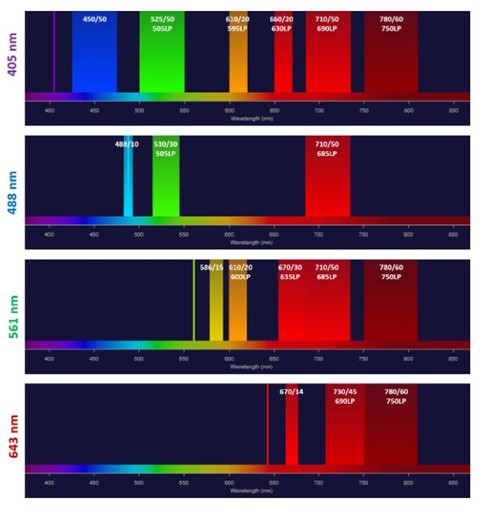
The Cytek Aurora is a spectral flow cytometer, equipped with 4 lasers (V/B/YG/R) and 48 + 3 detectors, which allows for measuring the full spectrum of fluorescent signals. This technology significantly improves sensitivity, resolution, and increases the number of fluorochrome combinations that can be made. This device is also equipped with an ESP module, which allows for small particle detection, down to 70 nm (e.g. extracellular vesicles).
Sorting
Sorting
BD FACSAria Fusion
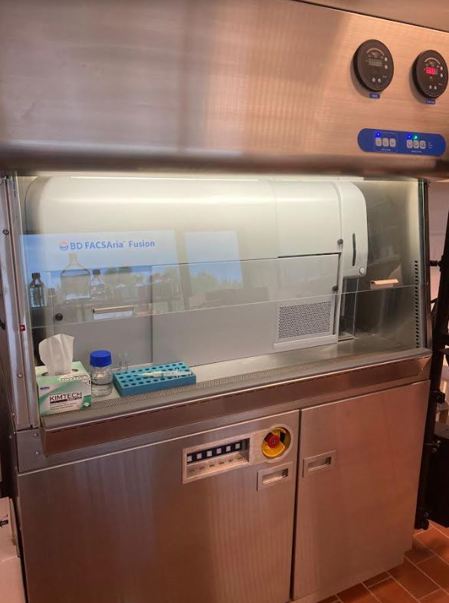
The BD FACSAria Fusion is equipped with four lasers and can detect FSC, SSC, and up to 16 colours simultaneously. The setup of this device is similar to that of our BD LSRFortessa, allowing for the direct translation of your high-parameter phenotyping panel into a sorting panel to isolate your subset of interest. The device is placed within a biosafety cabinet, to ensure sample quality during cell sorting.
Multi-Omics
Multi-Omics
BD Rhapsody™ HT Express System
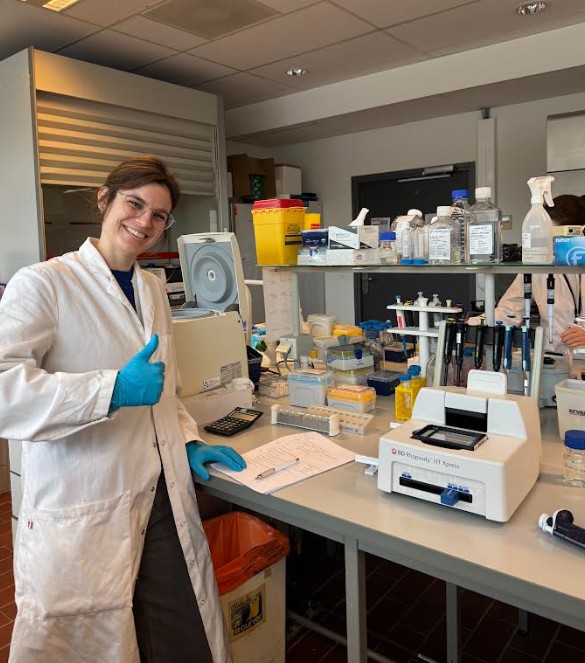
The BD Rhapsody Express enables single cell capture for analysis of genomic and proteomic information. BD offers a range of different options for murine and human multi-omics analysis, including targeted mRNA expression analysis, whole transcriptome analysis, surface protein expression analysis (using the BD AbSeq technology), TCR/BCR sequencing, and nuclei sequencing. This latest version enables users to simultaneous run single-cell capture of 8 individual samples. Additional equipment needed to perform library preparation following single cell capture is also available at the Flow Cytometry Unit. If you are interested in setting up your own single cell multi-omics experiment, please contact the Flow Cytometry Unit at an early stage so we can help you maximize your results while minimizing your investment.
Analysis
Analysis
Software packages: FACSDiva v9; FlowJo v10 with additional plug-ins; FlowJo v11; OMIQ; SpectroFlo
We have expertise in every aspect of flow cytometry. Therefore we can assist you from start to finish: from panel design and optimization to ensure reliable and reproducible data, to data analysis using manual gating techniques or state-of-the-art clustering algorithms depending on your needs.
Our dedicated expert team ensures the highest standards of research through proactive maintenance and technical troubleshooting. Beyond instrument care, we provide hands-on support for experimental design and analysis, guaranteeing precision and reliability for every project.
Examples of our areas of expertise:
- Manual gating for analysis of complex datasets (up to 18 parameters)
- Manual gating for analysis of rare immune cell subsets
- Cell proliferation and suppression analysis
- Cytometric bead array data analysis
- Clustering algorithms (e.g. FlowSOM, t-SNE, UMAP, …)
Sample Preparation
Sample Preparation
Curiox Laminar Wash System HT2000
The Curiox Laminar Wash System is designed to perform centrifugation-free gentle washing of cells during sample preparation for flow cytometry, FACS, or single cell sequencing. This technique allows for faster and more effective washing of your cells compared to centrifugation. With this system, 96 samples can be processed simultaneously and a full wash cycle (comparable to three rounds of centrifugation) is done in three minutes. See the Curiox website for more details on the Laminar Wash system (link: https://www.curiox.com/).
GentleMACS
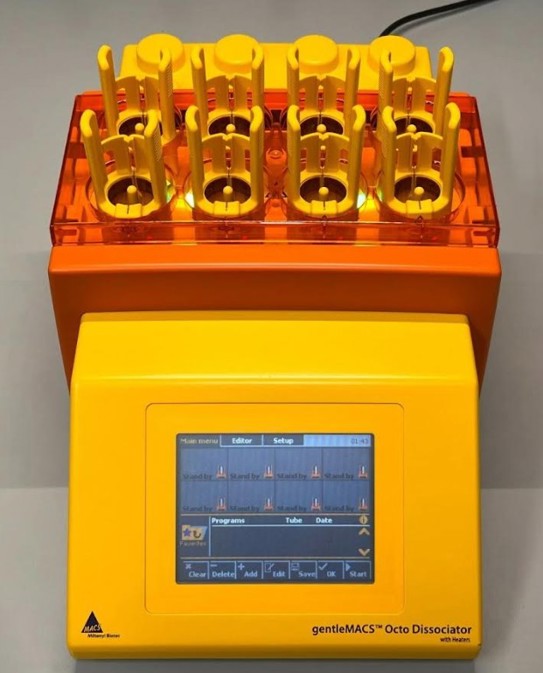
The GentleMACS Octo Dissociator provides standardized, automated tissue processing to ensure optimal cell viability and reproducibility. By streamlining dissociation, homogenization, and perfusion, it delivers the high-quality single-cell suspensions essential for sensitive downstream applications like scRNAseq and multi-color flow cytometry.
Key publications
Cytomegalovirus drives the development of cytotoxic CD4+ T cells in patients with multiple sclerosis
- Hoeks et al. Neurology Neuroimmunology & Neuroinflammation 2026
- High throughput analysis of single cell RNAseq from frozen human PBMCs
- Ceulemans et al. npj Gut and Liver 2026
- Collaboration to process and analyse frozen PBMCs from patients using spectral flow cytometry
- Veeningen et al. Neurology Neuroimmunology & Neuroinflammation 2026
- Process and analyse frozen PBMCs from patients using spectral flow cytometry
- Beckers & Baeten et al., Clinical Immunology 2024
- High parameter panel of innate and adaptive immune cells using dimensional reduction (FlowSOM) for unbiased analysis
Oncostatin M triggers brain inflammation by compromising blood–brain barrier integrity
- Hermans et al. Acta Neuropathologica 2022
- Flow cytometry-based FRET
- Bogie J. et al., Therapeutic Advances in Chronic Disease 2020
- Fraussen J. et al., Journal of Immunology 2019
- Montes Diaz G. et al., Scientific Reports 2018
Circulating Follicular Regulatory T Cells Are Defective in Multiple Sclerosis
- Dhaeze T. et al., Journal of Immunology 2015
- Claes N. et al., PlosOne 2014