Frederick van Amstel - workshop
On April 28th we invite you to the workshop by Frederick van Amstel: Theater of the Techno-Oppressed.
This immersive workshop uses the body to deconstruct how modern technologies - from social media to mass surveillance - can globalize fascism, sexism, and "userism." By "impersonating" algorithms and interfaces through the Theater of the Oppressed method, participants shift from passive users to critical actors capable of dismantling digital oppression and imagining liberating alternatives.
A day prior, on April 27th, you're also invited for his lecture.
Dit event is reeds afgelopen
Abstract
Despite all the hype and hope around it, the technologies developed by universities and research institutions were not necessarily always good for society. Many of those have been instrumentalized to globalize fascism, xenophobia, sexism, and racism. Theater of the Techno-Oppressed is an outreach activity that brings universities closer to their surrounding communities to publicly question, prevent, regulate, and dismantle technology-amplified oppression. In this short workshop, participants have a first experience with the outreach approach, learn by doing how to impersonate a technology using their bodies, express their algorithms and mechanisms using body movements, and generate a productive debate about their negative social impact and possibilities to avoid them. Theater of the Techno-Oppressed can scrutinize FOMO (fear of missing out), cyberbullying, algorithmic discrimination, tragedy of the commons, infrastructure deserts, mass and intimate surveillance, quantified-self coercion, and other technology-mediated oppression. The workshop is recommended for policy makers, philosophers of technology, design activists, researchers, and practitioners concerned with the role of technology in society. People who do not see themselves as techno-oppressed can still join as allies of the oppressed users in their fight for freedom.
Goal
This activity raises critical body consciousness on the role played by technology in everyday lives, particularly how it constrains human bodies to specific physical and/or political postures that accept oppression as an inevitable reality. For example, dating apps, ride-hailing apps, work platforms, video streaming, and social networks depend on users lingering at specific postures several times a day. The anti-social habits shaped by these apps have caused historical damage to mental health, worker rights, LGBTQIAP+ identities, and democracy in many nations.
As an outreach activity, Theater of the Techno-Oppressed is targeted at users, not technology designers. Designers can participate, but they must also enter the stage as users to understand userism, the specific user oppression discovered by Dr. Van Amstel and his research collaborators. This activity helps people realize that critical users need to fight for user rights, just as consumer fought for consumer rights since the 1970s. Designers can by allies in this process, but they cannot be its protagonists.
Definition of oppression
Technology critics often use concepts such as bias, prejudice, discrimination, injustice, redlining, stereotyping, and exclusion to account for the negative impacts of technology in society. This activity does not preclude these terms. Instead, it incorporates them under the larger concept of oppression.
Oppression is a body-based concept of inequality characterized by an intersubjective relationship in which a social group claims bodily superiority over another social group that, by its token, resists being treated as an inferior body. Oppression takes many forms, depending on the difference at stake. The classical form of oppression is authoritarianism, in which a state and its ruling class oppress its subjects. In modern capitalist societies, oppression takes the form of classism, which justifies worker exploitation due to their lack of an entrepreneurial mindset. Sexism is the oppression of a group differentiated by gender and sexual orientation. Racism, the oppression shaped by the categories of race. Ableism corresponds to the negative connotation of psychological or physical disability. The most evident oppression in the Theater of the Techno-Oppressed is userism, which reduces human beings to merely users of a technology, denying their potential growth as co-designers. Oppression may intersect and transect in each situation.
Technology’s role in mediating oppression
Technology mediates social groups' interactions in a way that, despite appearing completely transparent, is rather opaque to what is really going on at the structural level. For example, an oppressor who doesn't want to be an oppressor might use a particular technology, unaware of its harms to an oppressed group. The harm comes from the not-so obvious fact that using an oppressive technology entails using another human being, for instance, a courier, a content moderator, a miner, and other workers treated as a thing.
The following mediation processes can be unpacked and scrutinized by Theater of the Techno-Oppressed:
- FOMO (fear of missing out)
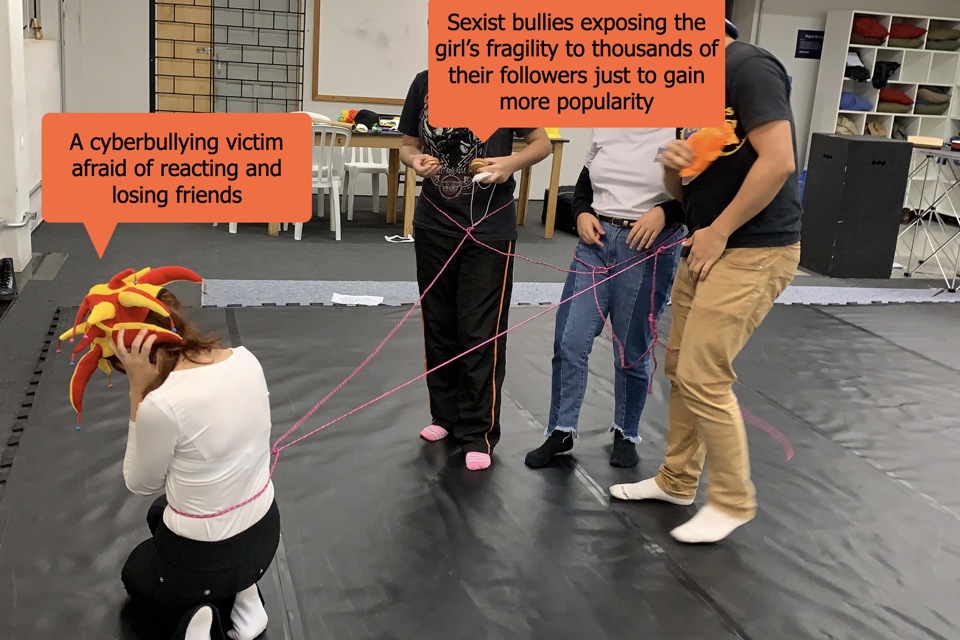
- Cyberbullying
- Body image disorder
- Occupational diseases
- Psychosomatic disorder
- Algorithmic discrimination
- Digital redlining
- Reputation-based gatekeeping
- Tragedy of the commons
- Infrastructure deserts
- Mass and intimate surveillance
- Data colonialism
- Platform labor precarity
- Disinformation amplification
- Biometric exclusion
- Normative body assumptions in design
- Assistive tech paternalism
- Quantified-self coercion
- Accessibility neglect
Theater of the Techno-Oppressed is a hopeful activity, nonetheless. It departs from the assumption that even a technology designed to oppress can be subverted, appropriated, and redesigned by the oppressed groups for their liberating ends. Distinguishing between technology-mediated oppression and technology-mediated liberation helps to overcome the false assumption that technology is the oppressor and liberation is a personal state of technology independence. Liberation in Theater of the Techno-Oppressed means changing the role of technology in society and the people who design and use that technology.
Why theater?
Scholars across many fields have produced critical discourses on technology, including Science and Technology Studies (STS), Philosophy of Technology, Critical Data Studies, Algorithm Studies, Feminist Technoscience, and more. These discourses, as relevant as they are to social movements, are largely communicated through academic texts and other channels with limited reach into everyday life. Theater of the Techno-Oppressed addresses that limitation by bringing body language to this dialogue. It draws primarily on Theater of the Oppressed, a method developed by Brazilian dramaturg Augusto Boal in the 1970s that has been tested in many worlds beyond Latin America. Dr. Van Amstel adapted this method by incorporating Embodied Interaction Design practices, typically used to conceptualize wearable devices, ubiquitous computing, robot interaction, and digital services. By enacting self and other bodies in action, Theater of the Techno-Oppressed fosters critical body consciousness and the collective will to design alter/native technologies for the liberation of the oppressed people.
Impersonating technology
Theater of the Techno-Oppressed works primarily by impersonating technology on stage. The actor impersonator acts toward the other actors like a scripted robot, a virtual assistant, or a physical machine. They, in turn, interact with the technology through the metaphorical body interface: they retrieve information from the technology (inter)face, pull their arms as if they were levers, press their chests as if they were buttons, and talk to the technology as if it accepted voice commands. The oppressive nature of the interaction typically becomes more apparent when the actor playing the designer steps onto the stage and reveals the intentions behind the design. Impersonating technology deconstruct from inside out both the discourse of neutrality and the technological determinism that depoliticize technology development. Technology impersonation builds upon Embodied Interaction Design techniques such as bodystorming, Wizard of Oz, and iterative prototyping.
Workshop structure
The workshop lasts for 4 hours and is structured as follows:
1. A very short introduction to Theater of the Oppressed and Embodied Interaction Design
- Workshop complicators' introduction
- Why having a dialogue with the whole body (including body language) is so crucial for dealing with body-based oppression and designing alter/native embodied technology
- The tree of Theater of the Oppressed (overview of its major techniques)
2. Warming up and demechanizing the body by playing dramatic games
- Participants' introduction through "ice-breaking" games
- Activating touch
- Activating listening
- Activating all senses
- Activating collective body sensing
- Forming groups by shared experiences of oppression
3. The theater technique (in this case: Image Theater)
- Choosing a technology to question
- Creating images of that technology in use
- Rehearsing an improvised quick play that conveys a story of technology-mediated oppression in an ambivalent way
- Presenting and interacting with the audience
- Explore the design space of alter/native technologies
4. Debriefing dialogue
- What have you learned today?
- What are the challenges of tackling technology-mediated oppression?
- What can we do against oppression beyond this workshop?
Body requirements
This activity is open to all human bodies, including those who think they have no talent to act. Special accommodations can be provided for people with disabilities, people with limited movements, racialized people living with racial trauma, survivors of sexual assault, and other people who would like to disclose special needs to the complicator prior to or during the workshop. The suggested clothing is casual and flexible.
The theater technique relies on improvisation and everyday body language and does not require professional training or an extroverted personality. There are no written scripts or memorized lines, as it relies mainly on silent acting. Because of that simple setup, people who usually do not feel confident acting on stage can feel confident acting against oppression as part of a collective work.
At every step in the activity, participants can choose to be on stage or in the audience. What they cannot do, from an ethical standpoint, is to remain neutral in the face of oppression. Extending the Brechtian tradition of theater and Freirean education style, in Theater of the Oppressed, the audience is constantly invited by the complicator to discuss and decode what is happening on stage. Staying in the audience is a relevant and valuable contribution for those who don't feel comfortable acting with the whole body.
The workshop proponent acts as a complicator, the opposite of a facilitator. This role provides examples of using theater techniques to discuss technology-mediation issues, and the participants copy and develop them further. What is most difficult in Theater of the Techno-Oppressed is not the challenge of acting but the challenge of thinking through the oppressive aspects of technology that go largely unnoticed, and that produce privilege and complicity. The complicator's primary goal is to keep the group focused on problematizing this troubled reality.
About Frederick van Amstel
Dr. Frederick (Fred) van Amstel (he/him/his) is Assistant Professor of Service Design and Experience Design at the Industrial Design Academic Department at UTFPR. From 2023 to 2025, he was a tenured Associate Professor and Director of Graduate Studies in the Design & Visual Communications (MXD) Master of Fine Arts at the University of Florida, USA. The institutionalization of techno-fascism in the United States of America forced Dr. Van Amstel to prematurely end his tenure and flee back to Brazil, where he grew up. At UTFPR, the first Brazilian technical university, he co-founded the Design & Oppression network and its local hub, the Laboratory of Design against Oppression (LADO). He also played a pivotal role in establishing UTFPR’s graduate program in Prospective Design, the first of its kind in the nation. From this position, Dr. Van Amstel serves as co-editor of Design Issues and sits on the editorial board of CoDesign, two of the most prestigious journals in design research. Besides being a design scholar, he is also a Theater of the Oppressed joker trained by the Center for Theater of the Oppressed (CTO) in Rio de Janeiro. In his outreach activity, he uses Theater of the Oppressed to raise awareness for the cultural implications of technology design.
Date and location:
- Tuesday April 28th 2026
- Begijnhof Hasselt, Kapittelzaal (house #2 / 1.4)
- 09h00 - 13h00: workshop
- Spots are limited - first come, first served.
For PhD students and postdocs, we would like to draw your attention to the cancellation and no-show policy of UHasselt.
Registration
Please register via this form.
More information