Day 1: Education
The first day will address glocalisation within the context of higher education.
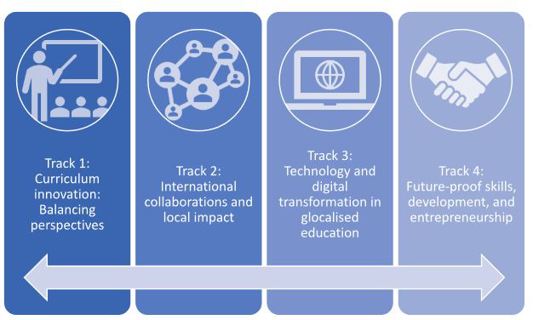
Track 1: Curriculum innovation: Balancing perspectives
Curriculum innovation requires a dynamic balance between local and global perspectives. By integrating international best practices while preserving local relevance, educational programmes can foster a more inclusive and globally aware learning environment. Key aspects include:
1. Multilingual and multicultural education
- Encouraging diversity and cross-cultural competencies to prepare students for a globalised world.
2. Diversifying knowledge systems
- Expanding beyond traditional frameworks to include a broader range of perspectives in curricula.
3. Flexible curriculum design
- A response to the differences between students, making learning more personal, relevant and effective and better aligned with changing societal and labour market needs. For example, Universal Design for Learning (UDL) can be considered to ensure accessibility and inclusivity in education.
Track 2: International collaborations and local impact
In a changing world, building strong international partnerships is more important than ever. These partnerships should encourage mutual learning, support sustainable development, and connect different fields of expertise. Key aspects include:
1. Strategic, impactful partnerships:
- Exploring equal partnership models and addressing power imbalances in international collaborations
- Overcoming challenges in joint curriculum design
- Evaluating the impact of international partnerships on local communities
2. Student and staff exchanges with benefits for the local community
- Emphasising the transformative potential of exchange programs
- Exploring service learning and community-based programmes
3. Interdisciplinary collaborations in education for regional development
- The interplay of glocalisation and interdisciplinary collaboration for addressing global challenges at a regional level
- Exploring the development of interdisciplinary curricula which address regional challenges
- Embedding internationalisation: Within curriculum development through initiatives such as Collaborative Online International Learning (COIL), student and staff mobility, and cross-border academic partnerships.
Track 3: Technology and digital transformation in glocalised education
In a rapidly changing society, the transformative potential of technology, which can bridge the gap between global educational resources and local needs within European universities, becomes key to remaining globally connected while still being locally connected. It focuses on how digital tools can encourage collaboration and inclusivity and increase accessibility.
1. Expanding access and customisation: online learning, MOOCs, COILS, virtual classrooms and digital platforms
- Moving beyond just offering courses online to exploring how digital platforms can be used to curate and adapt global educational content to the local context
- Discovering the potential of virtual exchange programmes and collaborative co-learning environments which encourage intercultural understanding and global citizenship with the use of technology
2. AI-Powered language translation and cultural adaption
- Exploring the potential AI has to create personalised learning experiences by diminishing language barriers, and facilitating intercultural communication in an (online) learning environment
- Critically discuss the ethical considerations and challenges of using AI for glocalisation within education
Track 4: Future-proof skills, development and entrepreneurship
How do European universities equip students with the skills, knowledge, attitudes and values they need to thrive in a constantly changing world while contributing to sustainable development and social well-being at both a global and local level?
1. Embedding entrepreneurial skills for social and sustainable innovation within the curricula to cultivate innovative solutions to global and local challenges
- Fostering the development of incubators, accelerators and mentorship programmes that support and encourage student-led social and sustainable ventures (e.g. Green Offices)
- Discovering how to create interdisciplinary entrepreneurship and innovation hubs within universities that foster collaboration between students, faculty (academia), local community industry, and civil society and the environment (quadruple helix)
2. Developing entrepreneurial mindsets and transversal skills needed to make a global impact
- Going beyond technical skills by emphasising the development of transversal skills such as: critical thinking and problem-solving; intercultural communication and innovation; adaptability and resilience and ethical reasoning