
Retail Design PhD's over the years
From the impact of store lighting on buying behavior to the study of interior architecture with a focus on customer well-being and the search for the true value of store experience for optimal ROI... Within our research group, many doctoral students have conducted fascinating research in the field of retail design.
View the content of this page
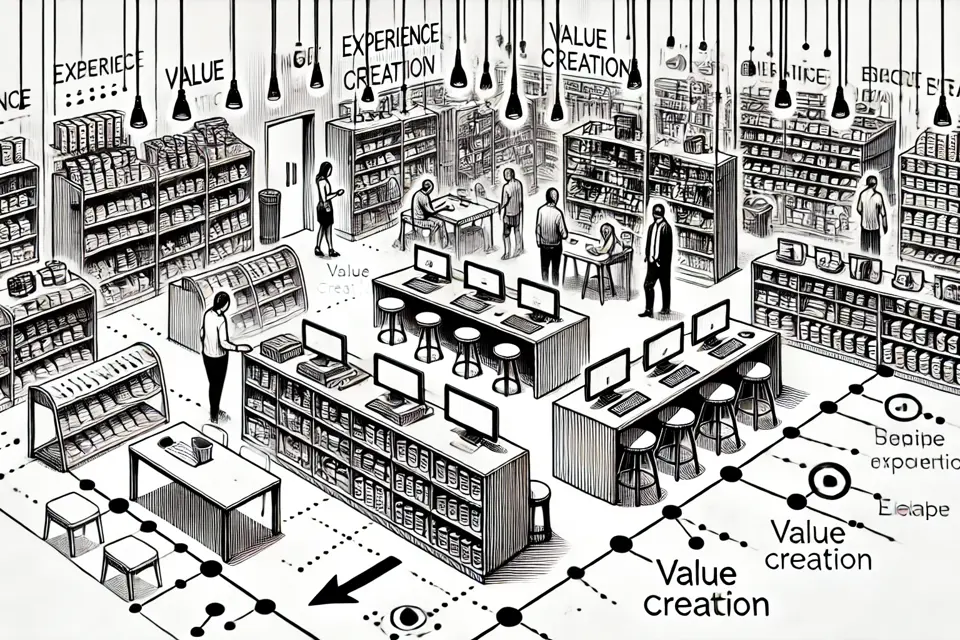
The (added) value of Experiential Retail Environments (EREs)
- Dr. Elisa Servais
- 2021 - 2025
- Promotor: Prof. dr. Katelijn Quartier
- Co-promotor: Prof. dr. Jan Vanrie
Over the past decades, technological advancements have transformed shopping, shifting expectations for physical stores. Consumers now expect in-store experiences that go beyond online shopping, pushing retailers to create engaging "experiential stores" like Apple and Nike flagships.
This shift presents challenges for retail designers, who must craft valuable in-store experiences amid growing competition. While experiential retailing has been studied academically, little research explores it from the retail designer’s perspective. This PhD fills that gap by defining what constitutes a valuable in-store experience and how it should be designed.
The research follows a structured three-step process:
-
Exploratory Study: Interviews with retail designers, retailers, and customers identified a need for better integration of customer experience in retail design.
-
Tool Development: A "Retail Design Kick-off Platform" was created to help designers and retailers collaboratively define in-store experiences at the pre-design phase.
-
Testing & Impact Assessment: The tool was tested in a small-scale experiment, showing potential benefits in design processes and customer perceptions.
The dissertation takes an unconventional format, balancing academic rigor with practical application for retail designers. The conclusion reflects on contributions, limitations, and future implications for retail design, academia, and education.
Retail Design: Lighting as a Tool for the Retail Environment
- Prof. Dr. Katelijn Quartier
- 2006-2011
- Promotor: Prof. dr. Koenraad Van Cleempoel
- Co-promotor: Prof. dr. Henri Christiaan, TUDelft
This thesis consists of three parts: Retailing, Retailology, and Experimental Research. The first examines retail design, exploring its evolution and significance in shaping shopping environments. A historical analysis covers retail architecture and management across three store types: department stores, chain stores (including boutique chains), and supermarkets. A graphical timeline illustrates trends, innovations, and their mutual influences. Definitions of key retail design concepts and its multidisciplinary nature are also provided.
The second part focuses on the emerging academic foundation of retail design. Two main challenges are addressed: effective communication with designers and stakeholders, and establishing a unified research framework combining design, environmental psychology, and marketing. A theoretical model is introduced to support the experimental research in the final section. Within this framework, lighting is examined as a case study, with a historical overview, key concepts, and justification through expert interviews and literature review.
The third part details five experiments on the impact of lighting on food retail. These explore how lighting affects product appearance, preference, and sales, as well as customer perception of atmosphere and affect. The research transitions from product photography to a controlled lab-supermarket and then a real supermarket. Findings suggest a correlation between perceived atmosphere, affect, and behavior. Due to contrasting results, only guiding principles are proposed, followed by a discussion on limitations and implications.
Retail design in the experience economy: conceptualizing and 'measuring' customer experiences in retail environments
- Prof. Dr. Ann Petermans
- 2007-2012
- Promotor: Prof. dr. Koenraaad Van cleempoel
- Co-promotor: prof. dr. Wim Janssens
Since the late 1990s, retailers like Apple, Nike, and PRADA have strategically designed stores to differentiate from competitors. They collaborate with architects, artists, and designers to create unique shopping experiences, often blending functions like fashion with dining. These efforts fall under "experience design" or "experiential marketing," yet academic literature lacks clarity on what "experience" truly means in retail and how to study it.
This PhD thesis addresses these gaps in three parts. Part 1 explores the evolution of the experience economy and its impact on retail. It examines flagship, concept, and pop-up stores and traces retail design’s development within interior architecture. The section also discusses the emerging field of retail design research, proposing three guidelines: a holistic approach, incorporating tacit knowledge, and pragmatic reasoning.
Part 2 conceptualizes "customer experience" through literature review and introduces "The Experience Web," a visual model of 20 interconnected aspects of experience. Two studies analyze real-world retail practices: one through visits to 61 stores across Flemish cities, categorizing their approach to experience, and another through interviews with retailers, designers, and consumers, revealing differing perspectives on experience design.
Part 3 shifts focus to consumer perspectives, employing qualitative, mixed-methods, and quantitative approaches. Study 3 uses photo-elicitation, where respondents photograph elements that shaped their store experience. Study 4 explores emotional responses, finding that mixed methods provide richer insights. Study 5 examines how different representation modes (photos, videos, or real-life visits) affect consumers’ perception of retail spaces, concluding that actual store visits yield the most reliable insights.
The thesis concludes with a general discussion on research limitations, future directions, and implications for retail theory and practice.
Retail-Reuse: an interior view on adaptive reuse of buildings
- Prof. Dr. Bie Plevoets
- 2009-2014
- Promotor: Koenraad Van Cleempoel
- Co-promotor: Prof. dr. Annemie Draye
Adaptive reuse—modifying buildings for new functions—has become crucial in architecture and interior design. In retail, many historic buildings are transformed into commercial spaces, a practice we term "retail-reuse." While this offers opportunities, it also poses challenges for both heritage conservation and retail success. Existing studies focus on isolated aspects like sustainability or urban renewal, but none examine retail-reuse from an interior perspective. This study addresses that gap by exploring its benefits, challenges, and the need for a specialized interior-focused lexicon.
Part 1 develops this lexicon by analyzing adaptive reuse concepts, differentiating it from related terms like renovation and refurbishment. It traces adaptive reuse theory’s evolution, identifying four existing approaches—typological, technical, programmatic, and strategic—while introducing a fifth: the "interior approach." This perspective, emphasizing a building’s soft values, is explored through three Renaissance art concepts—translatio, imitatio, and aemulatio—as strategies for reuse. Sustainability and genius loci are also examined from an interior design perspective.
Part 2 focuses on retail-reuse, outlining the legal framework for heritage protection in Flanders and analyzing its impact on adaptive reuse. A SWOT analysis highlights opportunities and threats for both the retail and heritage sectors. Case studies from Flanders and the Netherlands explore stakeholder roles, while policy recommendations propose measures to improve retail-reuse projects, balancing conservation with commercial needs.
The study concludes with reflections on education, emphasizing the importance of adaptive reuse in architectural and interior design training. It suggests further research into reusing historic interiors and finding suitable programs for vacant heritage buildings.