
After the Swim @begijnhof
Part of the programme:
VIENNA, Social Architecture and the Legacy of Red Vienna
Curated by Veronika Eberhart, PhD Candidate in Architecture
A swimming pool is a peculiar kind of architecture. It is built around movement, yet asks for repetition. One enters, swims, turns, swimsback. The body follows a line already given by the spatial order.
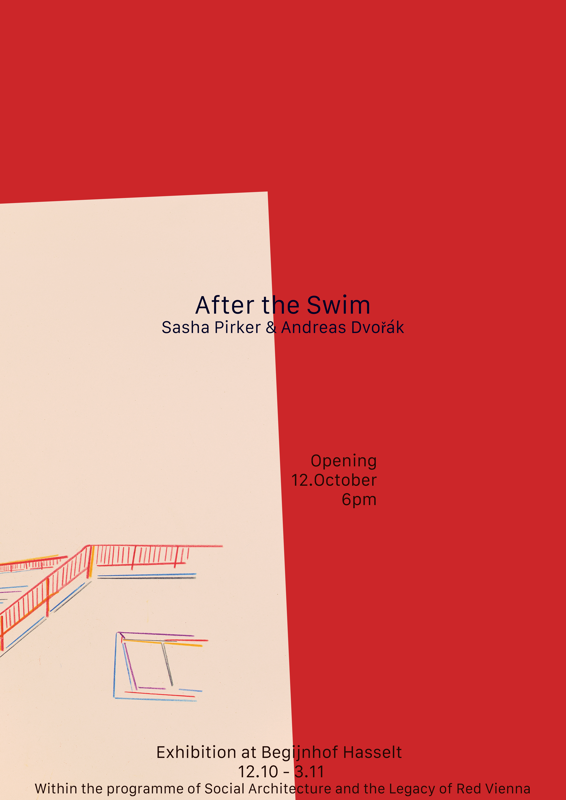
After the Swim brings together works by Viennese artists Andreas Dvořák and Sasha Pirker. Both are concerned with architecture, but neither approaches it as a stable object. Instead, they follow what happens to buildings when bodies move through them, when they are used, remembered, or filmed.
Dvořák’s drawings begin with the Stadionbad in Vienna, built in 1931 for the Second Workers’ Olympiad. The pool belonged to a different understanding of sport: not primarily spectacle or competition, but collective physical activity and leisure. In his drawings, the architecture dissolves into colours and rhythms. The diving tower, tiles, and surrounding structures become traces of movement. Pirker’s works move between private and public space. Her film of the apartment of artist and architect Heinz Frank observes walls an surfaces as they gradually reveal themselves. Badeschluss, by contrast, takes the swimming pool into another register, as a sculptural work situated somewhere between construction and memory. A photograph of the cinema at Belvedere 21 introduces a further space: a place designed for looking together. Originally designed in 1958 by Karl Schwanzer as the Austrian Pavilion for the World’s Fair in Brussels, the cinema was later dismantled and transported to Vienna, where it opened in 1962 as part of the Museum of the 20th Century, the 20er Haus. Today, the cinema remains part of the museum, with film still integral to its artistic programme.
Kafka’s Der große Schwimmer, written during the Olympic Games in Antwerp, offers another point of departure. Its protagonist returns home as a celebrated swimming champion, only to confess that he cannot swim:
“Honoured guests! I admit that I have set a world record, but if you were to ask me how I achieved it, I could not give you a satisfactory answer. The truth is, I cannot swim at all. I have always wanted to learn, but there has never been an opportunity. How, then, did it happen that my country sent me to the Olympics? That is precisely the question that concerns me."
The exhibition extends these questions through lectures, discussions, and participatory formats exploring Red Vienna, social architecture and embodied forms of knowledge.
Open lectures & PhD workshop
Swimming: A Daily Routine
Lecture by: Andreas Dvořák
Monday 12th of October: 15:00 - 16:00 Kapittelzaal H2/1.04
Beyond the Façade, Architecture and the Social through the Lens of Filmmaker Sasha Pirker
Lecture by Sasha Pirker
Tuesday 13th of October: 12:00 - 14:00 Kapittelzaal H2/1.04
Red Clocks and the Modern Metropolis: Municipal Housing in Red Vienna (1919–1934) as a Counter-Hegemonic Politics of Time
Lecture by Jerome Becker
Tuesday 27th of October: 14:00 - 15:00 Kapittelzaal H2/1.04
Situated Methods: Listening, Walking and Narrating Architecture
Workhop with Rebekka Hirschberg und Veronika Eberhart
Tuesday, 3rd of November 13:00-17:00 Kapittelzaal H2/1.0
Information:
- Free entrance
- Opening hours: Monday - Friday, 12.00 - 17.00
- Location: @begijnhof, Zuivelmarkt 33, 3500 Hasselt (visiting adress)
- Registration for the lectures - opening soon
- Website Sasha Priker
- Instragram Andi Dvořák
- About Jerome Becker
- About Rebekka Hirschberg
- Website Veronika Eberhart