This holds debris together
Dit event is reeds afgelopen
This holds debris together
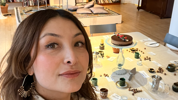
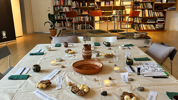
Thu 26/02, 14:00 — Fermentation as Deep Time Practice with Inês Neto dos Santos
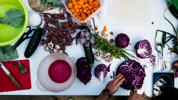
Since the beginnings of life on Earth, microorganisms have been performing their collaborative dance—bacteria, yeasts, and moulds transforming what’s around them through relation. In this session, we learn the basic principles of fermenting vegetables, while approaching fermentation as a deep-time practice: a marker of slow time that depends on ongoing symbiosis between living beings. We’ll end with a gentle writing exercise, using speculative thinking and imagination to link past, present, and possible futures.
Inês Neto dos Santos is a multidisciplinary artist whose work engages food through its socio-political, cultural, and ecological dimensions, creating frameworks for collaboration, generosity, and care.
Tue 03/03, 13:00 — Making Time for Wool with Merve Bektas
Wool–derived from sheep, one of the first animals domesticated by humans around 11,000 years ago–is relational and ancestral. Entangled in ecological, social, and cultural fabrics, it carries values of slowness, interconnectedness, seasonality, cyclicity, kinship, and reciprocity–giving and receiving in continuous loops.
This session invites us to felt with wool from mountain sheep of the Italian Alps, exploring and reflecting on its cyclical and seasonal aspects, connecting past and present, and imagining contemporary wool futures. We will start with a sensorial encounter with the sheep, and engage in felting as a site of inquiry, exploring matter, the sheep and the more-than-human world.
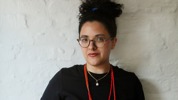
Merve Bektaş is an inter- and transdisciplinary designer, artist, and researcher based in the Italian Alps. Her work engages critical, speculative, and more-than-human perspectives, exploring multispecies relationships, materiality, crafts, and technologies for circular design and production.
Wed 04/03, 13:30 — Ritual and Conversation: Gathering Around Secrets with Juliana Restrepo-Giraldo
We gather around a shared centrepiece of secrets—quiet truths, wishes, frustrations, achievements, and dreams that often remain unspoken. Through ritualised dialogue and attentive listening, this session creates a temporary space for trust, vulnerability, and care. Secrets are held not as confessions, but as seeds: offered with intention, protected collectively, and allowed to transform.
Juliana Restrepo-Giraldo, PhD (she/her), is a Native Latin American designer, researcher, and educator based in Sweden. Grounded in Sumak Kawsay (Buen Vivir) and decolonial feminist perspectives, her work explores embodied and performative ways of knowing, designing, and learning.
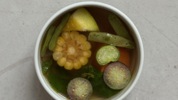
Thu 05/03, 13:00 — Venezuelan Sancocho: Recipes as Living Archives with Rebeca Morreo
We prepare a Venezuelan sancocho together, folding in the ferments made earlier in the week. As the pot simmers, we move between cooking and writing, treating recipes as living, unstable archives. Through attention to smell, texture, sound, and gesture, we explore how cooking carries memory, longing, anticipation, and the possibility of tasting something new—each time.
Rebeca Morreo is an editor, writer, and fermentist whose practice revolves around food, recipes, and editing, using fermentation as both metaphor and method. She lives and works in Berlin.
Practical information:
- Alive Programme: Thu 26/02 - Thu 05/03
- Exhibition opening: Thu 05/03, 17h30
- Collective exhibition: Thu 05/03 - Thu 13/03
- @begijnhof, Huisje #5-6, Zuivelmarkt 33, 3500 Hasselt
-
You can register for one or more events using this form
-
Please note that not all activities in the program are Doctoral School workshops.
- Events with limited capacity will be filled on a first‑come, first‑served basis.
- Click here for a full programme (pdf, 706 KB)




Credits and links
Inês Neto dos Santos:
www.ines-ns.com
https://www.instagram.com/inesns/
Photo credits:
Workshop image: Daniel Duarte Pereira, festival Forma da Vizinhança, Braga’25
Portrait: Adriano Ferreira Borges, festival Forma da Vizinhança, Braga’25
Merve Bektaş:
https://www.instagram.com/floresdegeneradas/?hl=en
https://www.instagram.com/becaboca/?hl=en
concordiapress.substack.com/
Photo credits of portrait: Miriam Millán Arjona