Call for Abstracts + Drawings – Drawing Narratives Symposium
- As Found Network
- Host: Trace research group
- Symposium: 14 - (15) April 2027
- Location: Faculty of Architecture and Arts, Campus Hasselt, Beguinage
- Submission Deadline for abstracts + drawings: December 21, 2026
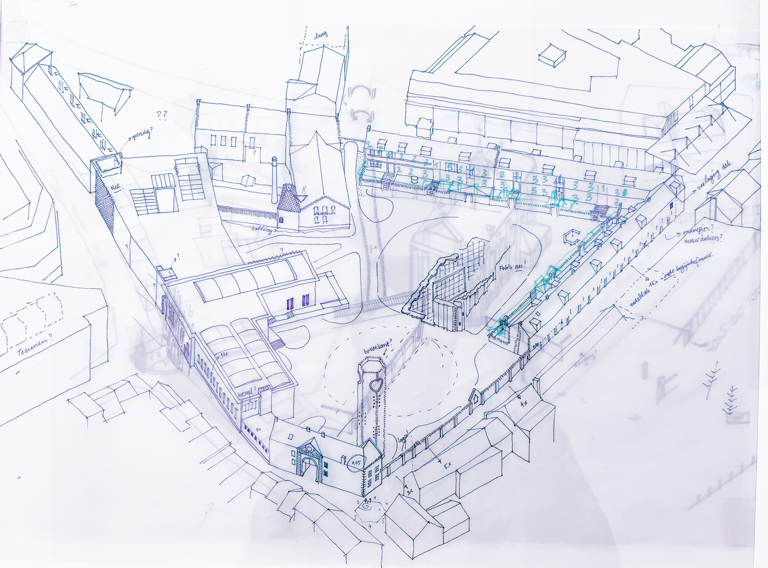
Drawing Narratives Symposium
When words become difficult to follow, and photographs don't fully convey the layers of a story or the time in a place, we, as (interior) architects, designers, and researchers, often turn to drawing as a means of communication – to our own and others' understanding. Ranging from quick sketches to more detailed annotated sections or perspectives, these drawings can communicate both an idea in the midst of conversation and the slow unfolding of a study.
In the process of drawing, we move between observation, memory, and interpretation. We portray temporality through traces of change and map relationships between artefacts, bodies, and spaces. We explore the interiority that emerges through drawing. In doing so, we find ourselves on a journey to construct a biography of a place in pursuit of broadening our perspective and understanding of it, later returning to the drawing to refine our thoughts and question its provenance across material, social, and cultural histories.
Drawing Narratives Symposium explores the role of drawing as an instrument for reading existing environments and tracing narratives of change across places and over time. Situated within the Read.Adapt.Reuse Scientific Research Network, the symposium aims to bring together contributions from (interior) architecture, adaptive reuse, heritage studies, and design research. It asks how the process of drawing – the act – generates knowledge about the as found, and how drawings – the result – make that knowledge accessible to others.
The symposium foregrounds drawing as an analytical practice through which elements are assembled, layers are made visible, and interpretations are challenged. We invite original contributions as well as reflections on existing techniques on drawing as an instrument: how are choices made while drawing, how are viewpoints selected, and how are details annotated? This opposes the drawing as mere quick digestion of representation and visualisation and rather activates the act of drawing as an analytical instrument, evidentiary, and differential. By focusing on the visible translation of architectural layers, we seek research in drawing that raises questions about time, meaning, and memory.
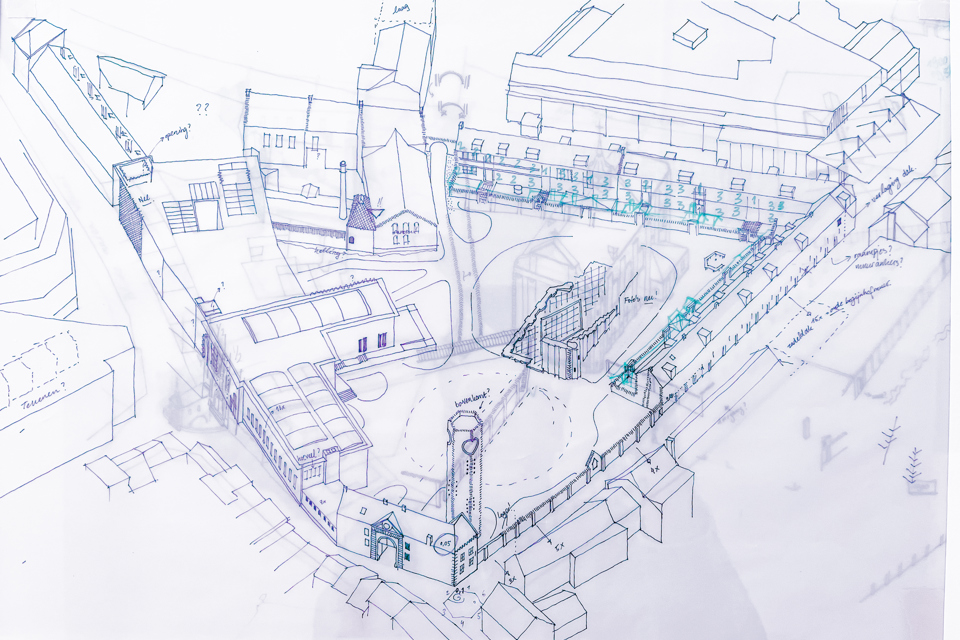
The first day of the symposium will consist of presentations addressing the themes. A full-day workshop on the second day will invite participants to collectively explore the mapping of the Hasselt Beguinage through drawing. Further information regarding the workshop and registration will be communicated.
Themes
We invite PhD candidates, senior researchers and practitioners who work across (interior) architecture, (critical) heritage studies, and design research who use drawing as an instrument to make accessible different narratives of existing places, create new understandings and interpretations of these places, and foster discussions on the duality between (in)visible and (in)tangible layers and aspects of temporality in (interior) architecture.
Contributors are invited to submit an abstract with drawings that address the symposium's themes in creative and innovative ways by critically rethinking and responding to the following themes, yet we are open to original interpretations within the call's scope.
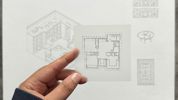
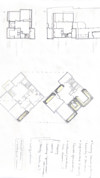
I. Vernacular Interiority In the process of research, drawing can trace the personal narratives of a domestic interior, revealing the often overlooked practices and relationships that shape daily life. Through attention to the human scale and the spatial dynamics between people, furniture, artefacts, culture, and craft, drawing can make visible the social and ecological relationships embedded in how spaces are inhabited. It can explore how vernacular knowledge is carried through everyday practices of use, care, and adaptation, and how inherited arrangements meet contemporary needs within processes of adaptive reuse. Drawing becomes a storyline through which these relationships can be read and communicated. Vernacular Interiority questions how human dwelling can be portrayed through drawing and how choices about what to reveal and what to leave implicit shape our understanding of a personal, lived interior.
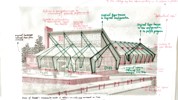
II. Temporality, Movement, Change In the process of research, drawing can be used as an anatomical instrument: investigating a site, cutting open a building, tracing and revealing hidden material layers, and visualizing beginnings and endings of a place's life. In the complex, modern-day context of reuse practices, drawing can help understand cycles of construction and demolition; fragmental and/or material reuse through the introduction of elements from different contexts or in situ reuse; and the occupation and appropriation of places by existing and new users. Capturing these movements and changes challenges the conventional notion of the drawing as a static object. Temporality, Movement, Change questions how we can capture these different temporal layers when drawing becomes a sensitive means of combining objective and subjective knowledge, based on archival and on-site research, personal narratives, observations, and interpretations. Balancing between tangible and intangible aspects, a biography can be constructed on the scale of a site, building, interior, or fragment.
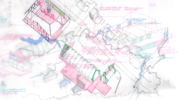
III. Observing Otherwise In the process of research, drawing can become a means of exploring how we perceive, experience, and interpret existing environments. Beyond measured documentation, artistic and experimental drawing practices can redirect attention towards overlooked details, unexpected relationships, and subjective experiences. Through acts of fragmentation, layering, association, and assemblage, drawing can bring together perceptual and embodied observations, personal memories, and interpretations, revealing aspects of a place that may remain absent from conventional forms of representation. These practices challenge the drawing as a neutral record, foregrounding instead its role in shaping how we observe and understand the existing. Observing Otherwise questions how artistic drawing practices can expand our ways of seeing and how subjective and situated forms of observation can generate alternative readings of architectural environments. This track deliberately invites contributions from outside architecture, such as art, anthropology, literature, film, or the sciences, and welcomes interdisciplinary dialogue as a way of seeing otherwise.
Submission
We invite submissions that discuss and reflect on original work produced in research and/or educational contexts, and in artistic and/or professional practice. Submissions must position the problem statement within the social significance of adaptive reuse, critical heritage studies, experimental preservation, and/or (interior) architectural practice.
Selected submissions will be either invited for presentation or exhibited in the symposium's accompanying exhibition, where contributors have the opportunity to discuss their work informally, focusing on both drawing processes and outcomes.
Submissions must include:
- Written abstract, limited to 500 words, with a maximum of five keywords
- Up to 3 original drawings, labeled and referenced appropriately within the document
- Author information, including full name and affiliation (institution, department, location)
- Author bio, limited to 100 words for each author
Submissions should be compiled in a single PDF document (max. 20 MB) and sent to asfound.network@uhasselt.be with the subject line "Drawing Narratives Abstract Submission" no later than December 21, 2026.
For questions about the Call for Abstracts or its submission guidelines, feel free to reach out to the organisers by sending an email to: asfound.network@uhasselt.be.
Timeline
- Call for Papers: October 21, 2026
- Submission Deadline: December 21, 2026
- Notification of Acceptance (presenters and exhibitors): January 31, 2027
- Symposium: 14–(15) April 2027
Organising Committee:
- Drs Joshua Kempen
- Dra Malinde Valee
- Dra Zeynep Selvi
Scientific Committee:
- Prof. Dr Bie Plevoets (UHasselt)
- Prof. arch. int. arch. Saidja Heynickx (UHasselt)
- Prof. Dr Caroline Voet (KU Leuven)
- Prof. Dr Els Van Meerbeek (KU Leuven)
- Prof. Erik Langdalen (AHO, Francqui Chair)
- Prof. Dr Stephanie Van de Voorde (VUB)