
We award Erik Langdalen with the Francqui Chair and invite him to conduct a Doctoral School course
This year, the Faculty of Architecture and Arts is awarding the Francqui Chair to Erik Fenstad Langdalen from the Oslo School of Architecture and Design. Erik Fenstad Langdalen is giving the opening lecture of our academic year 2026 - 2027.
Erik Fenstad will conduct a Doctoral School course based on his current research: "Provenance Projected, traces the hidden history of building materials, from extraction to social context."
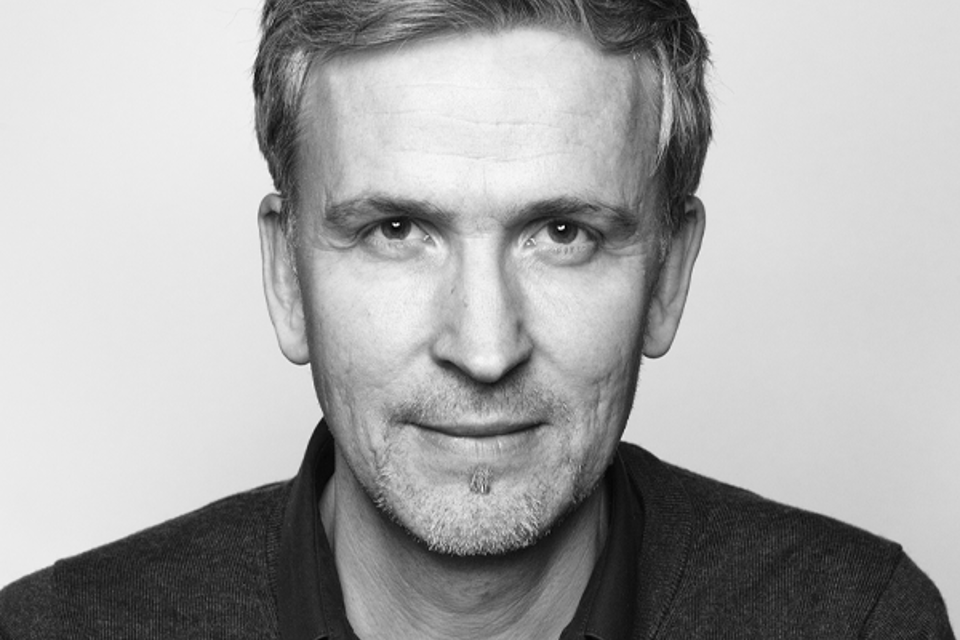
About Erik Fenstad Langdalen
Prof. Erik Fenstad Langdalen, Oslo School of Architecture and Design, is a leading voice in modern and recent heritage, focusing on concrete architecture and building components, and author of books including Concrete Oslo. His current research, Provenance Projected, traces the hidden history of building materials, from extraction to social context. Alongside his academic work, he runs his own architecture practice, specializing in preserving and transforming historic buildings such as the PoMo Museum in Trondheim. In 2026-2027, he holds the Francqui Chair at Hasselt University.
Provenance Projected
According to Merriam-Webster's Collegiate Dictionary (eleventh edition) the term provenance is defined as "the history of ownership of a valued object or work of art or literature,” tracing its derivation from the French provenir (to come forth). Provenance was coined in the 1780s to document the chronological history of ownership, legitimacy, and circulation of artworks, manuscripts, and antiquities. Today, provenance research continues to be important within art history to establish property claims. Some high-profile cases regularly engage larger audiences with breaking news on looted, stolen, smuggled or forged art works
The idea of provenance is circulating in everyday lingo in multiple industries with reference to the sustainable sourcing of materials (fair trade woods, lowering carbon footprints of production and distribution), the ethics of food production (“food miles”, “slow food”) and the clothing industry (child labour, transportation).
By transposing the term into architecture, we need to rethink provenance on a different scale (buildings are big), with a different spatial logic (buildings are seemingly sitting still) and with alternate temporalities (buildings are ever-changing entities).
Provenance in art and archaeology typically implies that the integrity of an artefact relies on endurance, even permanence. Architecture is all about fluctuating interests, change, use, the passage of time, deterioration, maintenance, alteration, and multiple temporal regimes. Here, questions of autonomy, authenticity, authentication, movement, migration, and circulation need to be explored on a different plane, employing diverse epistemologies. In the field of architecture, provenance should be understood as a cyclic and multi-trajectorial phenomenon rather than as a linear, retrospective documentation. Buildings are not static objects but flexible, networked, and co-authored entities with rich social biographies and complex afterlives
Provenance enables the idea of a building as a nexus of cultural, material, social, technical, and geopolitical practices, and prompts a re-examination of topics spanning from material procurement and real estate to historical reconceptualization and practical transformation work. Buildings are living archives; repositories of material history and social life, and sources to understand the origins, elements, material fabrics, use, sentiment, and public debates that make up a building’s provenance.
Provenance might prove to be a highly creative and enlightening concept when pursuing the reuse, preservation and transformation of the existing.
Students that wish to participate in this Doctoral School event are obliged to do the assignment stated below, and be present on the dates stated below.
ASSIGNMENT
The assignment is three-phased:
- Select an object, a structure or a building you are familiar with and that you can visit for a survey. Identify physical traces of use, ownership (labels), production methods, transformations, accidents/events or other clues that indicate the provenance of your case. Choose one trace that you find particularly interesting and document it through photos, measured drawings, film or other methods you find relevant.
- Conduct an archival search for information that can cast light on the trace you have found (constructors, owners, users, thieves, politicians etc.). Compile the information as images (photos, screenshots, documents) to be included in your presentation.
- Write a short text (max 1000 words + illustrations) where you present your findings and contemplate on how/if they affect your/the established, preconceived ideas of your case and how this affects its future. Submit your assignment in PDF-format that are suited for presentation on a screen at the review.
TIMING
- 21 September, 16.00: inaugural lecture Erik Langdalen “Provenance Projected”, Campus Diepenbeek
- 12 October, 10.30 – 12.30 + 13.30 – 15.30: lecture & introduction assignment, Campus Begijnhof auditorium Poortgebouw
- 19 October 10.30 – 12.30 + 13.30 – 15.30: tutoring assignment, group discussion, Campus Begijnhof auditorium Poortgebouw
- 16 November, 10.30 - 12.30: online tutoring assignment
- 7 December, full day: presentation assignment, Campus Begijnhof
Registration
- Open for PhD students and postdocs - please note the cancellation and no-show policy of UHasselt.
- To participate in this workshop send your motivation to Bie Plevoets (bie.plevoets@uhasselt.be).
READINGS
- Anne Higonnet, “Afterword. The Social Life of Provenance”, in Gail Feigenbaum and inge Reist, Provenance. An Alternate History of Art, (Los Angeles, Getty Research Institute), 2012, 195-209
- Chris Goshden and Yvonne Marshall, “The Cultural biography of objects”, World Archaeology vol.31, No.2 (Oct.1999), 169-178
- Uwe Fleckner and Mari Lending, “Introduction” in Provenance in Architecture. A Dictionary, (Berlin, Hatje Cantz, 2025)
REFERENCES
- Provenance Projected. Architecture Past and Future in the Era of Circularity.
- Provenance in Architecture. A Dictionary by Uwe Fleckner & Mari Lending

About Francqui Chair
In 1932, Emile Francqui and Herbert Hoover jointly decided to set up a Foundation, to which they entrusted an important capital. This Foundation was intended to « promote the development of higher education and scientific research in Belgium ». It was Herbert Hoover who insisted that this Foundation should bear the name of Emile Francqui in order to make the memory continue to the man who had done so much for his country and for science.
On proposal of the Universities, the Francqui Foundation attributes each year some "Francqui Chairs".