Reworlding Spring School: Re-institutioning
The Reworlding Spring School (May 5th - May 8th 2026) brings together researchers, practitioners and students to explore the role of re-institutioning in socio-environmental transitions. Through this lens, we will examine how institutions can be rethought and reshaped in times of ongoing socio-environmental crises. The programme focuses on the relationships between communities, institutions and more-than-human actors, and explores new forms of inclusive and collaborative governance.
The Spring School is structured around three thematic lenses: Politics of Institutions - exploring power dynamics and roles within institutional change - Embodied Institutions - understanding how institutions are experienced and lived - and Institutions in Dialogue - examining how communities and institutions engage with one another.
These themes will be explored through keynote lectures, participant-led workshops and interactive sessions.
Reinstitutioning Webinar on April 21st 2026
How can institutions be rethought in times of socio-environmental transition?
On Tuesday, 21 April 2026 (12:00–13:00 CET), the Reworlding project hosts an online webinar on Reinstitutioning, bringing together Prof. Maurizio Teli and Prof. Dr. Tom Børsen. In this session, they will explore how the concept of institutioning informs both design research and educational practices.
The webinar also serves as an introduction to the Reworlding Spring School on Reinstitutioning, taking place in May 2026 at UHasselt. It is aimed at researchers, practitioners, and students interested in participatory design, collective imagination, and socio-environmental transitions.
Participants can expect short inputs on institutioning in research and education, followed by an interactive Q&A session. The webinar will be recorded for inclusion in the Reworlding MOOC; contributions during the Q&A may be anonymised or edited.
Registration
👉 fill in this form to get your invite for the webinar
Keynote lectures - open for everyone interested
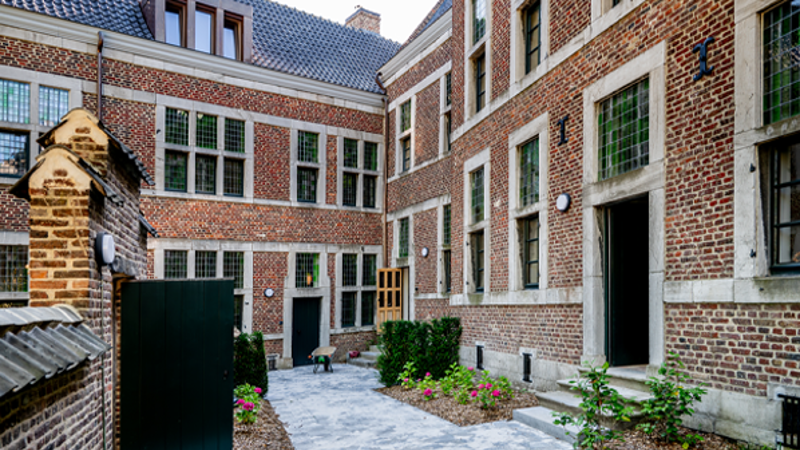
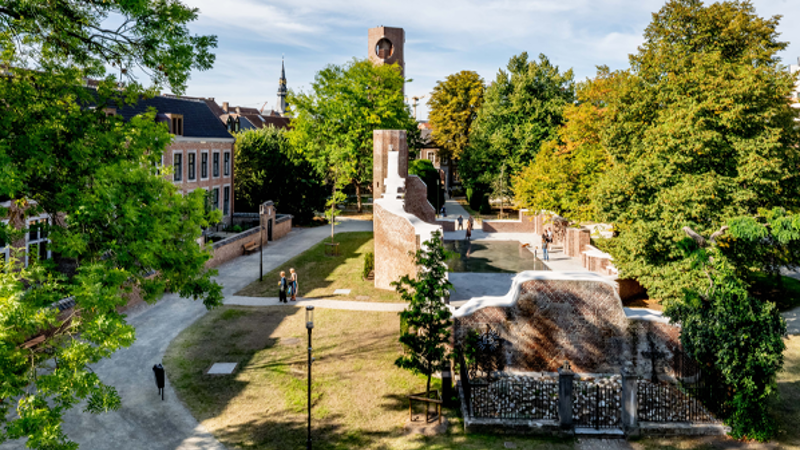
These lectures will be organized at the historic beguinage in Hasselt (Belgium). They are open for everybody to attend, but you need to register (you can register for more than one lecture of course).
-
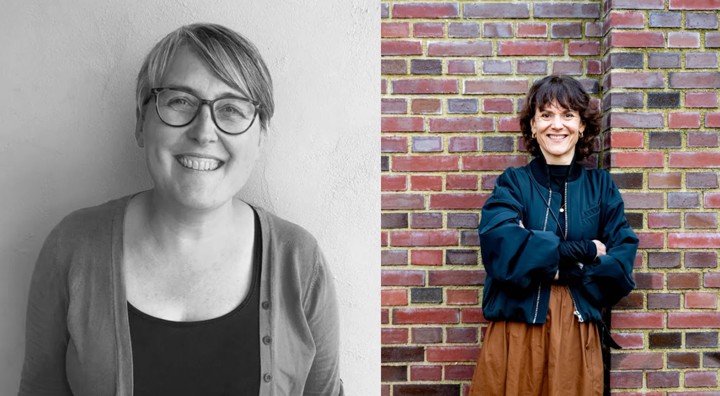
4 May 2026 – Re-institutioning & Governance | Liesbeth Huybrechts & Rachel Clarke
-
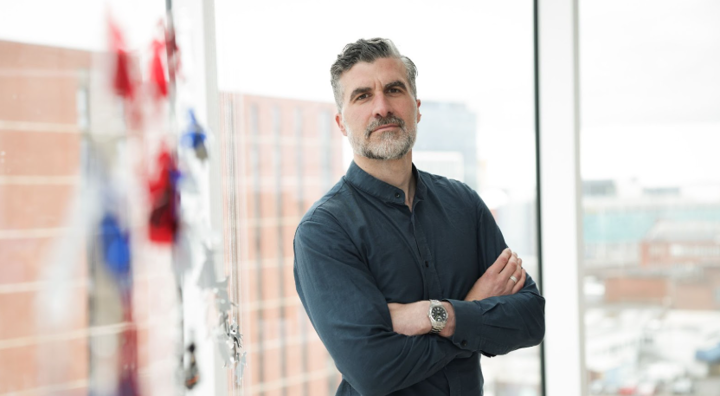
5 May 2026 – Democratic Innovation through Co-Design | Brian Dixon
-
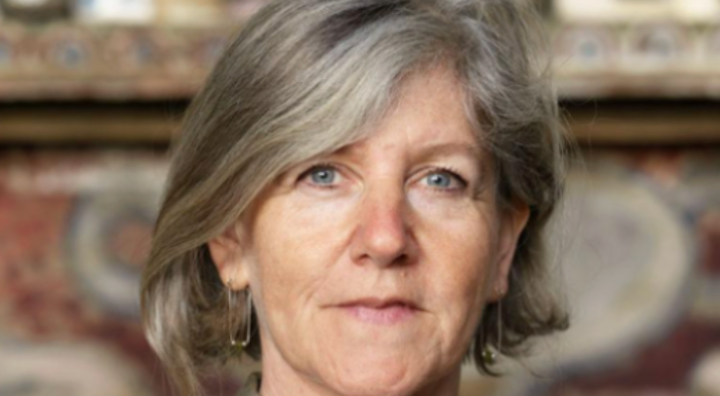
6 May 2026 – Eco-social Change & Participatory Practice | Ann Light
- 7 May 2026 – Design & the Civic Economy | Martijn de Waal
click below for more information on the speakers.
Workshop programme for participants
- Tuesday, May 5th 2026: Friction and Flow: Mapping the Emotional and Institutional Reality of Urban Wisdom, Ask your body: practising constellations in systemic inquiry, Embodied place-making: Costuming in eco-social spatial transitions Reinstitutioning Work (ongoing: May 5th - 7th), Ephemeral Institutions - a patchwriting manifesto and the art of dissent (ongoing: May 5th - 7th)
- Wednesday, May 6th 2026: Legends of the (Under) Ground, Inclusive methodologies: The roles of waiting & non-speaking communication, Cloudwalk Beguinage, Collaging policies
- Thursday, May 7th 2026: Participatory data visualisation for public participation, Re-institutioning energy practices in community-led transitions, Institutioning with Care: Lessons from grassroots communities
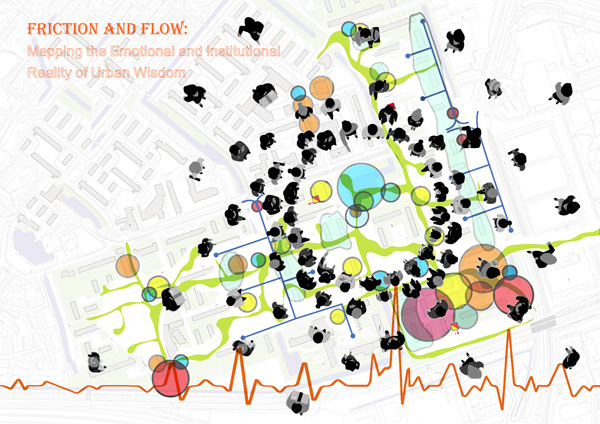
Friction and Flow: Mapping the Emotional and Institutional Reality of Urban Wisdom
This collaborative workshop explores the collision between emergent, context-rooted wisdom and rigid institutional path-dependencies. By weaving together material-based emergence simulation (Sahar Rokh) and temporal emotional landscape mapping (Asli Kolbas), we make visible the invisible: the embodied knowledge, affective labour, and emotional friction that arise when communities co-create urban interventions, only to crash against bureaucratic constraints.
Participants will collaboratively grow a "wise" urban environment from a vacant space using tactile materials, and map the emotional trajectory of this creative process using the TELM Kit. We then introduce institutional stressors (regulations, zoning, property laws) to observe where emergent solutions fail to fit administrative templates, identifying "participation gaps" where rigidity blocks resilience. A second emotional map captures the affective friction caused by this institutional crash.
Comparing these 'Before' and 'After' landscapes reveals the hidden emotional labor of urban transition. The resulting 3D models, both material and emotional, become the foundation for co-designing "Wise Protocols" that allow institutions to shift from owners of space to active agents of co-creation. This workshop provides actionable insights for practitioners, researchers, and policymakers seeking to respect and value, rather than instrumentalize, the local wisdom and feelings of a community in transition from smart to wise cities.
Sahar Rokh (she/her) is a PhD candidate at Poznan University of Technology and a member of Global Urban Development (GUD) under the Driving Urban Transition (DUT) project. Her research focuses on regenerative urbanism and "Wise City" frameworks, centering on community-driven transformations that synergize spatial and ecological layers. Sahar explores the "Organizing Paths" of institutions, developing roadmaps and protocols to transition collaborative urban scenarios into reality, ultimately fostering resilient, inclusive, and co-productive spatial environments.
Aslı Eylem Kolbaş (she/her) is a Marie Skłodowska-Curie PhD Fellow at Hasselt University, Belgium, within the Reworlding network. Working at the intersection of architecture, art, and academia, she employs interdisciplinary methods—such as storytelling and crafts(wo)manship. Her current research contributes to the project “Reworlding social housing estates,” where she investigates the integration of social and ecological practices in the conceiving, using, and maintaining of collective space.
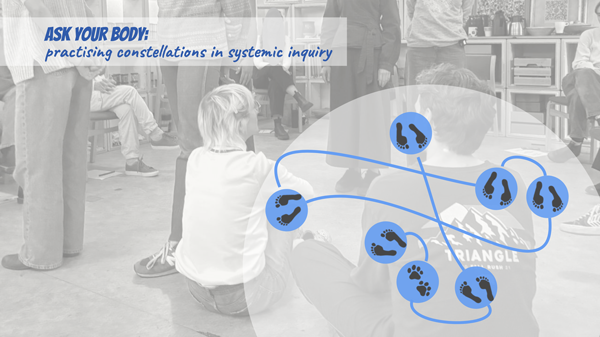
Ask your body: practising constellations in systemic inquiry
Imagine naming the different parts of the system that shape the situation you are investigating — organisations, communities, more-than-human participants, even conceptual or processual forces. Imagine inviting them to step into a shared space and position themselves in relation to each other. Their arrangement, and the emotional qualities it carries, might reveal alliances, tensions, and ambivalences usually hidden within the system. What might we notice if the system could reflect on itself — not through conceptual debate, but through embodied positioning?
Drawing from ‘systemic constellations’, this workshop allows us to explore embodied positioning as an onto-epistemic practice – a way of knowing through being with(in) a system. The constellation(s) we’ll create together will become a hybrid space between relational inquiry, sensemaking, and collective exploration — both as a replicable research practice and a shared experience of the system, from within.
The workshop is process-oriented and immersive, flowing through:
-
Opening and warm up — Grounding in bodily and emotional awareness through playful and mindfulness-based activities
-
Constellating — Co-creating a meta-constellation to explore how embodiment shows up in and shapes design research and then practising constellating for our own research
Closing reflections — Surfacing insights, tensions, and new questions how embodied ways of knowing could take more space in research and how constellating approach could be used in our research
Ilma Stankeviciute (she/her) is an action researcher, circular economy expert and a facilitator who draws from her experience in nature connection, storytelling, yoga, martial arts, and conscious dancing. In her PhD research within the CoD4T doctoral network, Ilma positions herself within the relational paradigm from which she seeks to re-examine the scaling approaches to place-based small-scale regenerative food approaches.
Eugenia Rosina (she/her) is an interdisciplinary design researcher with a background in integrated product expanded through multidisciplinary studies across different contexts. Drawing on strategic and participatory approaches, her work spans multiple disciplines – from psychology and human perception to media and communication design. As a PhD candidate within the CoDesign4Transitions network, she currently investigates how Participatory Futuring Processes can evolve into embodied, self-organised systems of anticipation for just climate transitions.
Reinstitutioning Work
What is work? Why do we work? Who defines work and who creates it? Increasingly, the answers are shaped by dominant neoliberal narratives of business and labor, and by the institutions created within capitalist societies. As a result, many of us are alienated from both the purpose and the consequences of our labor, to the detriment of ourselves, society, and the planet.
The institution of work is central to any socio-economic transition. Organizations act as vehicles of collective action, and the ways they are designed determine both the interactions and relations within them and the broader impacts they have on the world. We already possess the resources and knowledge to address major global challenges, from the climate crisis to poverty, but we lack the means to collectively exercise the decision-making power that would direct our labor toward these ends.
In this workshop we will first try to surface the norms and myths embedded in the current institution of work, around entrepreneurship, ownership, value, work-life balance, and careers. Building on this reflection, participants will collaboratively imagine alternative visions of work and re-write the narratives surrounding business-as-usual, exploring how these can be re-institutionalized in the futures of work.
Melike N. Kaplan (she/her) is a doctoral researcher in the Reworlding MSCA Network at Aalborg University, with a background spanning economic and organizational sociology, anthropology, and literature, as well as writing, strategy design, and community care. Her doctoral research explores and maps the cooperative and entrepreneurship ecosystems in Copenhagen, tracing the relations between actors to uncover what stands in the way of cooperatives emerging and where the opportunities lie. A key part of this work involves reconnecting diverse actors and fostering collaboration towards a shared goal: enabling more cooperatives to take root and thrive as well as rebuilding the narratives we tell about work, entrepreneurship and business. The project culminates in a Future Jobs Lab, developed through action research and participatory design methodologies, envisioned as a hybrid incubation space for experimenting with solidarity economy business models and cooperative technologies.
Júlia Tena Mensa (she/her) is a PhD student in Sociology and Social Research at the University of Trento and a doctoral candidate within the MSCA Doctoral Network Reworlding. Her PhD research focuses on re-tracing precarious self-employment in the agroecological food production sector, specifically looking at the role of alternative food networks on individual working realities. Her research employs ethnographic approaches. Her main research interests include alternative food systems, sociology of food and social inequalities. Júlia is also interested in political ecology, studying topics such as degrowth, commons and environmental justice.
Embodied place-making: Costuming in eco-social spatial transitions
This workshop proposes costume as both a wearable technology and an embodied method of reflection within participatory design (PD). Through the processes of making, wearing, and collective performing, costuming enables proximate, situated, and affective modes of designing that challenge dominant deliberative, language-centred approaches.
Building on agonistic and embodied design practices, the workshop foregrounds costume and performativity (carnival, open-air festivals) as a means to surface what is often felt yet remains marginalised or silenced, as a place-making process. Through the costume, the workshop seeks to approach places, institutions, and policies not only as topics of discussion but also as phenomena performed, inhabited, and resisted by human and more-than-human actors.
Costume is mobilised as a device for embodied inquiry in institutioning processes in two ways: First, costume enables participants to embody personas, places, institutional roles, policies, or more-than-human entities through practice rather than abstraction, opening up further debates in institutional processes. Second, rather than representation or fashion, costume can be institutionalised as an agentive material practice that re-shapes power dynamics, perception, movement, and spatial experience. Acting as an “independent mediator” in relation to the wearer, costume fosters haptic and relational engagements between body, material, and environment.
Nikolas Kanavaris (he/him) is an architect, performance designer, and researcher working at the intersection of participatory design, spatial planning, and performative practices. He is a PhD candidate at Hasselt University and a Marie Skłodowska-Curie Fellow in the REWORLDING Doctoral Network. He holds degrees in Architectural Engineering and architectural theory from NTUA, with further specialisation in scenography at the NTG. He is a founding member of the BpM cultural group, where he works as a set and costume designer.
Guus Vandeweerd is a designer and researcher based in Brussels, currently pursuing a PhD in Arts and Humanities. His research looks at how digital systems translate the world, and what gets changed in that process. Working through speculative design, he focuses on non-human avatars and ecological environments in digital space.
Elien Stouten (she/her) is a doctoral researcher in sociology (FWO/KU Leuven), having a background in sociology (KU Leuven) and urban studies (4CITIES). Her research explores alternative urban mobilities through the lens of social justice. Through speculative co-design, citizens are invited to challenge and advance ‘sustainable mobility’ for the inclusion of more varied experiences into planning and design. Her recent master's thesis in urban studies explored the ambiguities of tourism on homelessness and addiction in contexts of European ‘liveable cities’.
Bram Tack is an urban planner and Spatial & Living Environment Coordinator at Leiedal in Kortrijk, Belgium. He coordinates a multidisciplinary cluster focused on urban design, environment, water and energy, and landscape, combining project management with expertise in spatial planning and area-based development processes. He holds degrees from Ghent University in Spatial Planning and Geography.
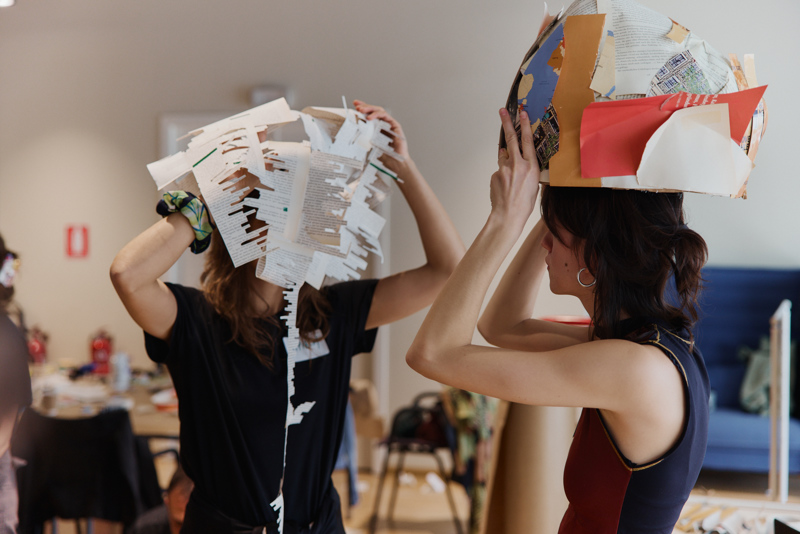
Ephemeral Institutions - a patchwriting manifesto and the art of dissent
Academic institutions shape how knowledge is produced and shared, reinforcing hierarchies, pressure for productivity, and asymmetrical power relations. But institutions are not absolute; they are held together by habits and tacit agreements that can be disrupted and recreated.
This workshop begins with anger. What makes you angry about how academic knowledge is produced, shared, and recognised? We will treat that anger as a compass that will point us toward injustice. It tells us what needs to change and drives us to do something about it. From there, we sit with the emotions that desire otherwise, and let them lead us to the question of what we actually want.
Treating the Spring School as an ephemeral institution, we use its space and time to both break and build. We believe alternative ways of organising knowledge require rituals of rupture –deliberate acts that break internalised norms and open space for something else to emerge.
That something else takes shape through patchwriting: collectively assembling fragments of our own experiences, frustrations, and desires into a shared manifesto. In doing so, the act of gathering and composing itself becomes a form of prefiguration - an archive of what we know needs to change, and a first gesture towards what we want to build. From this, we devise small practices that travel beyond the Spring School.
In a final reflection, we ask: what remains once this temporary institution dissolves? What lingers, and what do we carry with us?
Andy Perrucon (he/him) is an MSCA PhD researcher based in Malmö, working at the intersection of Participatory Design and performative practice. His research explores the topics of re-imagination and re-enchantment - how design can shift the way people perceive and relate to reality - through the curation of immersive and temporary experiences integrating performativity and participatory design methods. These unfold within grassroots festivals, artistic residencies, and experimental gatherings, where everyday routines dissolve and alternative futures become prefigured. Through ethnographic fieldwork and design-driven methods, Andy investigates how such temporary worlds are made, sustained, and what they reveal about living and organising differently.
Melike N. Kaplan (she/her) is a doctoral researcher in the Reworlding MSCA Network at Aalborg University, with a background spanning economic and organizational sociology, anthropology, and literature, as well as writing, strategy design, and community care. Her doctoral research explores and maps the cooperative and entrepreneurship ecosystems in Copenhagen, tracing the relations between actors to uncover what stands in the way of cooperatives emerging and where the opportunities lie. A key part of this work involves reconnecting diverse actors and fostering collaboration towards a shared goal: enabling more cooperatives to take root and thrive as well as rebuilding the narratives we tell about work, entrepreneurship and business. The project culminates in a Future Jobs Lab, developed through action research and participatory design methodologies, envisioned as a hybrid incubation space for experimenting with solidarity economy business models and cooperative technologies.

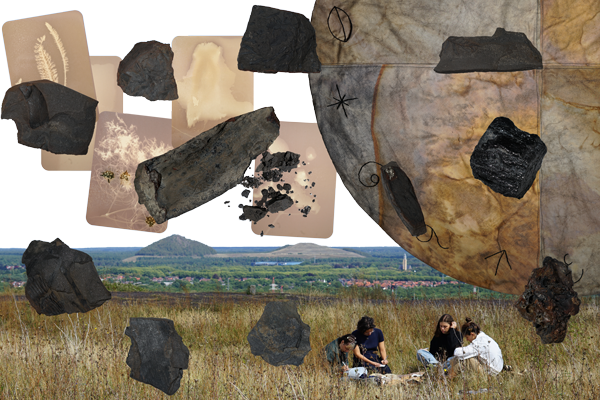
Legends of the (Under)Ground
This art-led co-design workshop proposes to re-enchant and reimagine our relationship to the (under)ground by misusing core sections and working with the matter of mine’s debris and anthropic soil archives. The counter prospective practice will offer participants a co-creative critical cartographical design tool and method.
Spanning across the Belgian Campine’s (under)ground coal landscapes, this workshop addresses how the geotechnical grammar of geological cores’ representations neutralises and dominates the imaginaries and narratives of the (under)ground through the lens of technocratic, (neo)capitalist fossil fuel regimes. Indeed, geological knowledge has rendered the (under)ground a subservient body, politically, legally, and economically charged, inscribing it under extractive control. This workshop seeks to subvert dominant geological imaginaries, the mine’s narratives and the knowledge held in institutional surveys’ archives through a speculative art-led design practice of speculative misuse that attunes to the stories and wisdom held in soil archives.
Together, we will counter prospect a fictitious geological core with matter evidence gleaned from the post-extractivist landscape, drawing signs and patterns into a co-created Sandcarpet. Then, through the fabulation of our Netherstories, we will pour non-extractive meaning into the sand map symbols, assembling together a counter legend for re-enchanting with the (under)ground.
Steffie de Gaetano (she/her) is a Dutch-Italian interdisciplinary researcher and PhD candidate at the Faculty of Architecture and Arts, UHasselt, Belgium. Her art-led design research practice bridges the present polycrisis breakdown to colonial and modern legacies by tracing material systems, matter flows and beyond-human indices.
Her doctoral research investigates the mutation of naturecultures produced by fossil fuel industries through the conjunction of (sub)surface landscapes of extraction, while envisioning collective futuring ways forward through art-led counterprospecting that re-enchants the (under)ground.
Inclusive methodologies: The roles of waiting & non-speaking communication
Across the years, participatory design has greatly focused on building more representative, inclusive and democratic spaces. However, verbal communication is still clearly predominant (Wilson et al., 2019). This concept of communication, often based on fast interaction, can be seen as a source of power over marginalized groups (Pyre, 2021), such as non-speaking autistic communities, where self-expression needs and temporalities remain systemically unconsidered.
This session aims to explore alternative forms of expression, in both our daily lives and research practices. We will reflect on the ways in which we may better acknowledge different styles of communication and temporalities, through readings, doodles, movement, or even silence.
By way of a facilitated conversation circle, taking from the notion of circles as a metaphor in research design (Nind et al., 2025), we will question the prevalence of verbal communication over other forms of expression. Similarly, we will collectively explore the importance of waiting for self-expression and mutual learning (Spiel et al., 2018), reflecting on past experiences and imagining future methodologies.
Carolina Carvalho (they/she) is a PhD student, based in Ireland, with a background in design and multimedia. Their research interests center on topics such as accessibility, digital literacy, and the intersections of design and activism.
As part of the Reworlding MSCA Doctoral Network, their PhD at the University of Limerick focuses on autism and inclusive environments, particularly how best practices developed within autism communities may inform more inclusive practices within participatory design.

Cloudwalk Beguinage
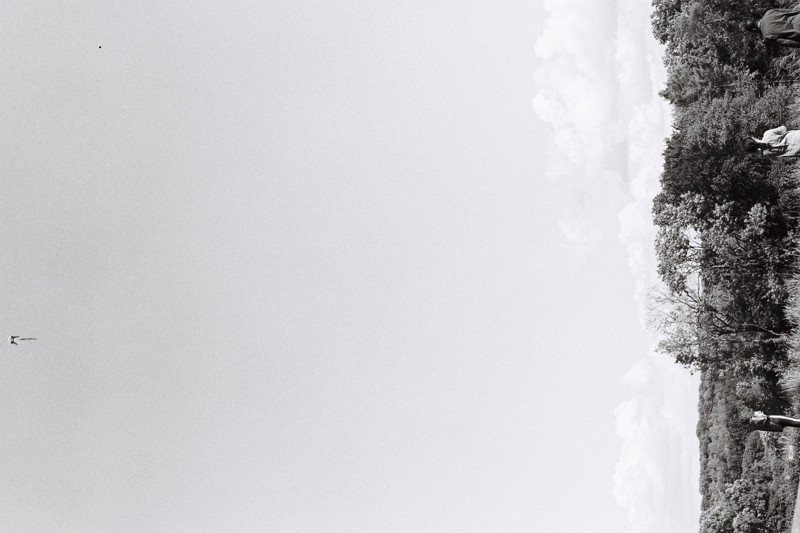
On 30 October 2025, nine capacity builders joined a Cloudwalk at the Beguinage to attune to their surroundings and treat the sky and weather as active collaborators rather than mere backdrops.
This second gathering invites previous participants and newcomers to return in spring to collectively explore how shared attention during a walk to the atmosphere - the clouds - can support new forms of belonging and environmental sense‑making.
We will also experiment with participatory design approaches that invite broader engagement and amplify voices not always heard in climate conversations.
Xinquan Wen (they/them) is an interdisciplinary researcher from China, driven by a passion for ecological shifts observed through pluriversal, critical, and ethical lenses. With an MA in Collaborative and Industrial Design from Aalto University, he has embarked on a journey to unravel the complex interplay between humans and nonhumans, advocating for more-than-human design perspectives and embracing pluralist approaches to knowledge and action.
His current work delves into the intricate relationship between Malmö's inhabitants and its marine environment, striving to cultivate transitions that support the flourishing of all life by fostering cultural shifts. He relishes engaging in dialogues exploring innovative ways to interact with more-than-humans, while contemplating the intricacies of temporality and scale.
Collaging policies
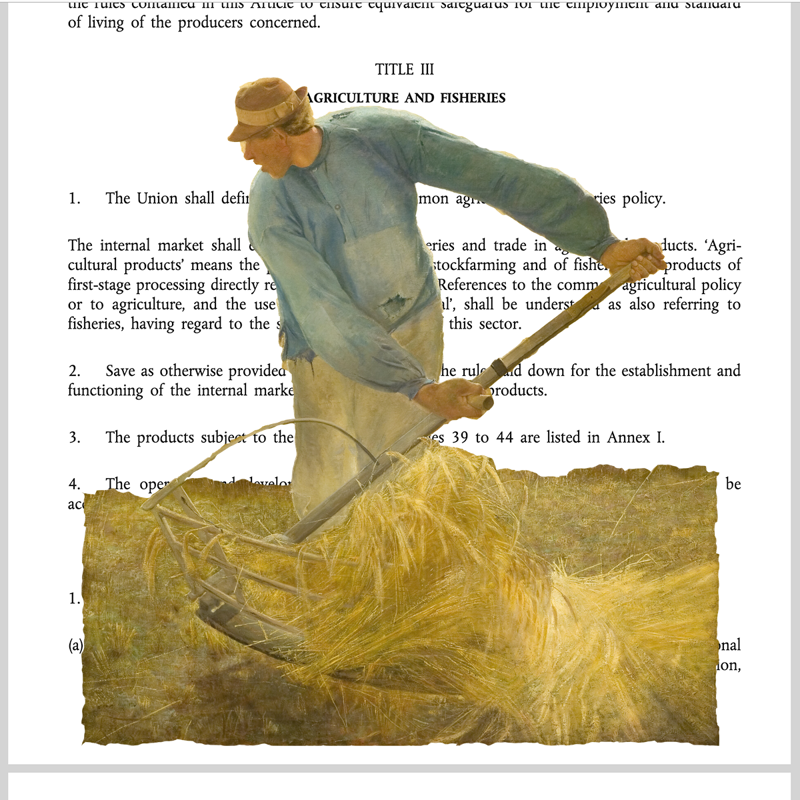
This workshop will attempt to rethink policymaking processes within ecosocial transitions by experimenting with textual and visual collage.
Our research, situated in agricultural contexts in Belgium and Denmark, reveals the often grave discrepancies between imagining and living with policies, which, paired with their substantial impact on day-to-day routines, prompts one to wonder how decision-making processes might take into account situated experiences and everyday realities.
How might policies better reflect relationality between humans, more-than-humans, and worlds they live in, while providing clear and structural support? During the workshop we will experiment with (re)writing techniques, exploring different structures and alternative, visual formats for policy through various means such as ecopoetic writing and collage.
Weronika Kozak (she/her) is a researcher, architect and visual artist exploring ways in which architecture could address current ecosocial issues. Within her PhD at Hasselt University as part of the Reworlding programme she works with artistic methodologies and more-than-human participatory design to understand ways of living with transitions and climatic uncertainty among farming communities in Flanders, Belgium.
Martin Abildgaard Padalak (he/him) is a PhD Fellow at the IT-University of Copenhagen’s section for Human/Computer Interaction (HCI) & Design working out of IxD Lab. His research explores prospective farmers’ preferable futures and the role of technology in sustainable future food-production. In part, this work happens with a purpose-built design game. The project gathers his practical and educational training in architecture, farming and interaction design.
Participatory data visualisation for public participation
This workshop investigates and pokes at some of the power and agency dynamics at play in the relation between data visualisation and knowledge production in public participation processes. More specifically, it aims to explore participatory approaches to data work challenging the binary distinction between scientific expertise and embodied or situated knowledge.
The setting of the workshop simulates a public participation process where citizens are called to make informed decisions. The participants are given a problem, its preliminary definition, and some initial data. They lead an iterative process of interpretation and visualisation, with a visual facilitator translating their inputs and suggestions into digital representations through digital tools. Through these cycles, different perspectives can be articulated and exchanged, collaborative meaning-making can be achieved, and established definitions can be challenged.
The workshop concludes with a space for reflection on how the definition of the issue changed over the workshop, and on how participation in the data work affected the problem ownership of the participants. The discussion can also address broader power dynamics, matters of data literacy, barriers to participation, and in general opportunities and shortcomings of the process.
Daniele Dell’Orto (he/they) is a PhD student with a background in information Design, experience in climate justice activism, and a passion for the political. Their current research is part of the CoDesign4Transitions network, which taps into sustainability transitions and democracy innovation from the design perspective. More specifically, their work focuses on data visualisation as a tool to articulate spaces of debate and conflict inside and around citizens' assemblies on climate.
Christina Lindeberg (she/her) has been working for over a decade within the service design industry and has a background spanning both design and management. During this time, she has developed a specific interest in how design can improve the necessary public services. This intention is at the core of her current PhD, also part of the CoDesign4Transitions network, focusing on replicating and scaling up different public participation practices for circular transitions.
Re-institutioning energy practices in community-led transitions
This interactive workshop explores processes of re-institutioning in socio-environmental transitions, focusing on community-led energy initiatives and emerging governance frameworks. It examines how alternative socio-technical arrangements, such as collective energy practices, cooperative ownership, and shared infrastructures, are developed, negotiated, and become stabilised over time.
Participants will engage with diverse transition contexts, ranging from grassroots initiatives built from scratch to interventions in existing urban and housing environments shaped by legacy infrastructures and regulatory frameworks. Through these comparisons, the workshop highlights how material conditions, governance structures, and ownership models influence pathways of institutional transformation.
Special attention is given to the tensions between experimentation and stabilisation, and to how energy systems are reconfigured as shared socio-material concerns rather than purely individual or market-based assets. The workshop also considers how collective coordination, technological systems, and more-than-human relations are implicated in these processes.
Through guided exercises, small-group reflections, and collective discussion, participants will critically reflect on the dynamics of institutional change, including processes of contestation, adaptation, and consolidation. The session invites participants to explore how new forms of organisation and practice emerge, evolve, and gain legitimacy within broader socio-technical and political contexts.
Petra Žišt is a cultural anthropologist interested in design anthropology, science and technologies studies, ICTs, and emerging technologies for transportation, mobility, health, and energy transitions.
She primarily employs qualitative methods, including ethnographic and participatory approaches, to explore how people’s lived experiences and future visions can inform policy and technology development. Within the Reworlding project, she investigates energy transition and urban renovation in social housing, community engagement, and energy commons.
Her work examines how energy transitions and home modernizations can be more just and balanced, considering social, cultural, heritage, environmental, and economic concerns of people and more-than-human relations.
Institutioning with Care: Lessons from grassroots communities
Anannya and Anastasia approach grassroots community-building from two distinct vantage points. Anannya is an emerging practitioner-researcher laying the groundwork for platform cooperativism in Aalborg, while Anastasia brings a decade of embedded experience navigating the formalisation of creative commons.
Despite these differing temporal perspectives—the inception versus the longitudinal evolution of an initiative—they share a critical observation: standard "institutioning" processes are fundamentally care-blind. As grassroots communities formalise, the drive toward efficiency tests the relational and reproductive bonds that sustain them.
This session explores how care operates as a vital reproductive mechanism: Both facilitators are devoted to moving beyond care as a mere affect, introducing it instead as a tangible, socio-material practice of maintenance. By sharing their contrasting insights—from founding a new cooperative to navigating the challenges of established commons—they invite participants into a collaborative reflection. Through this interactive workshop, they aim to cross-pollinate their lived experiences, utilising the collective dialogue to produce robust epistemic validation for centring care in the future of institutional design.
Anannya Bhowmik Paul (she/her) is a service designer and has worked for several years in design and management consulting firms, where she had the opportunity to experience the relationship between technology and people’s lives. Hence, “Technology for Social Good” has been her interest area. At Aalborg University, she would be working on developing platform cooperatives tailored to the needs of the local community, including marginalised groups. Anannya holds a bachelor’s degree in design from NIFT, India, and a specialisation in service design from Politecnico di Milano, Italy.
Anastasia Dourida (she/her) is a sociocultural engineer, blending backgrounds in civil engineering, restoration of monuments and cultural management with her artistic practices. Her work with Communitism, was a proposal for the revival of Athens' 11,000 abandoned heritage buildings through creative commoning. During a decade, she developed methodologies that led to the founding of the first independently-run sociocultural centre and resulted in diversifying the perception of open public space throughout the city. Her research questions whether we can institutionalise thirdspace without petrifying it, hypothesizing that care-led models can resolve the riddle.
REWORLDING network




This kick-off event is part of the Marie Curie project REWORLDING that deals with how ecological issues are experienced differently by different actors, communities and organisations, leading to societal polarisation and inhibiting urgently needed actions around these issues. It is coordinated by UHasselt and has seven partners (Aalborg University, UniTrento, University of Limerick, Malmö University, ETH Zürich, Architecture Workroom Brussels, UHasselt). However, we welcome everyone to become part of our network by taking part in our lectures and seminars in the coming years.
This project has received funding from European Union's EU Framework Programme for Research and Innovation Europe Horizon Europe (HORIZON) Marie Skłodowska-Curie Actions Doctoral Networks (MSCA-DN) under the grant agreement 101119451.
