Ecotron
Curious how ecosystems meet experimentation?
Browse or download our brochure to explore our advanced research facilities and collaboration opportunities.
Ecotron mission
Our mission is assessment and counteracting climate change mechanisms.
Our work is framed across five pillars:
-
Fundamental understanding of ecosystem functioning and impacts of climate change thereon
-
Understanding interactions of climate change with other environmental drivers
-
Testing new technologies to adapt to climate change
-
Development of land management pathways to counteract climate change
-
Public education and raising awareness of biodiversity and environmental change
Introduction
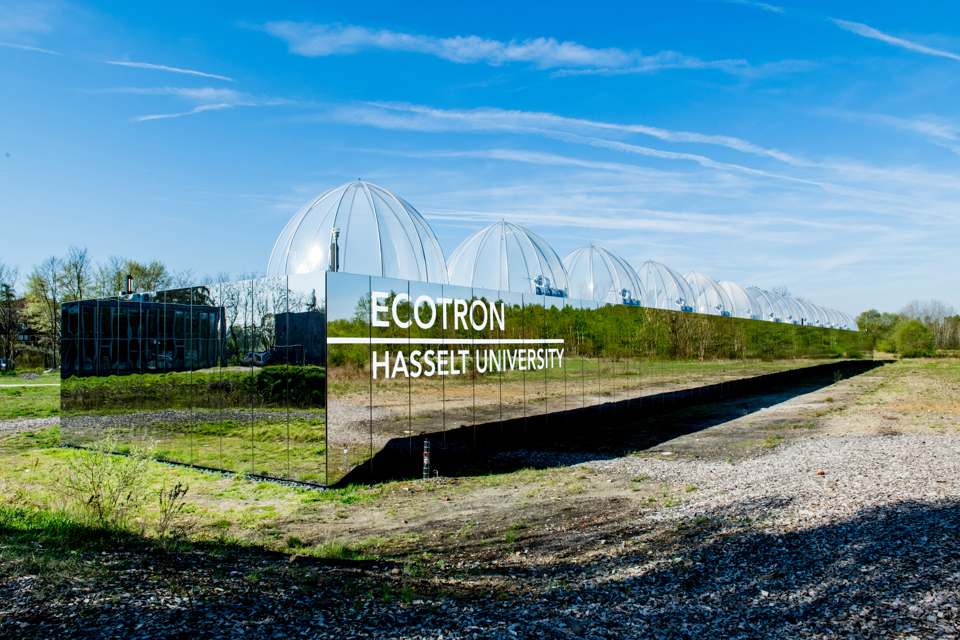
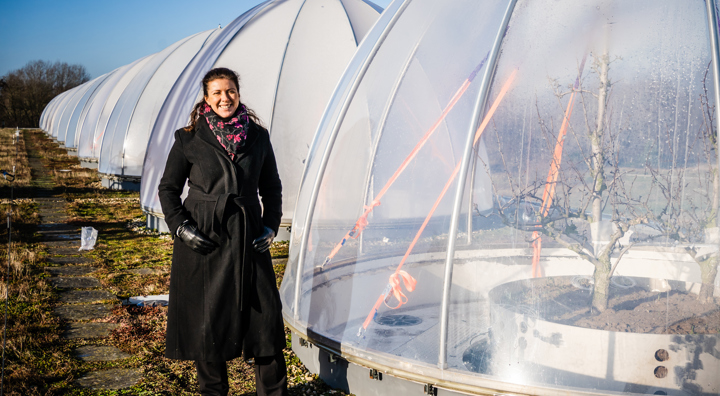
The Ecotron is part of the Field Research Centre, located in the Hoge Kempen National Park. The UHasselt Ecotron is a large scale research infrastructure that allows for sophisticated state-of-the-art controlled climate experiments, to study the effects of climate, and climate change on ecosystem functioning. It provides insight into the impact of climate on a given ecosystem that cannot be gained by field experiments (too complex) neither controlled laboratory experiments (too reductive).
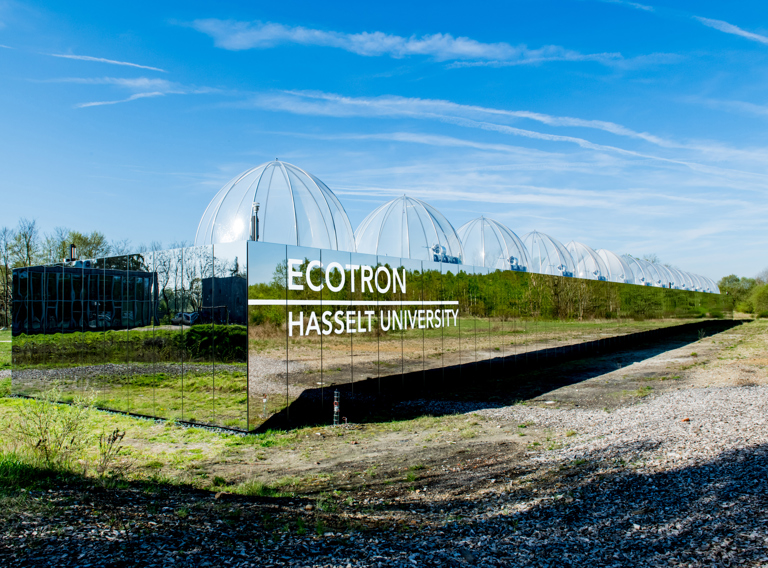
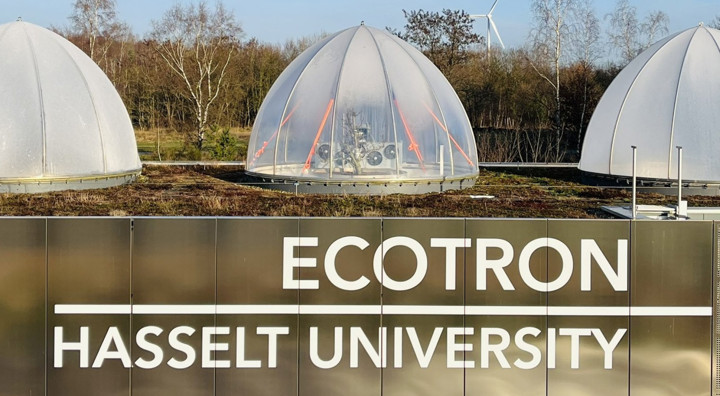
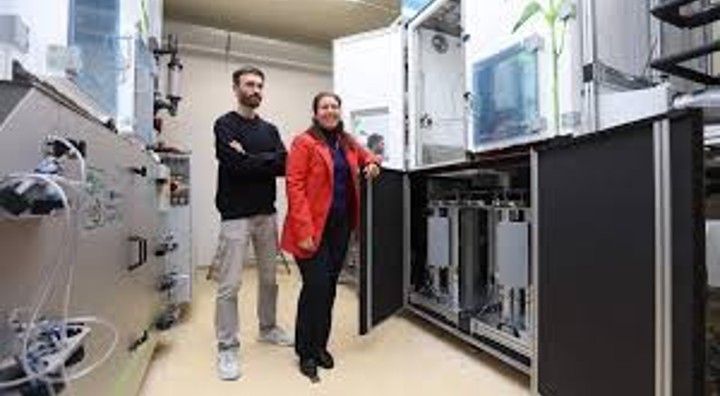
The UHasselt Ecotron consists of 12 closed sun-lit units, where environmental conditions can be separately controlled. Each unit hosts a lysimeter with soil-canopy column of 3.14 m2 and 1.5 m deep, where ecosystem processes can be monitored all in real time.
- The following variables can be controlled: air temperature, air relative humidity, air CO2 concentration, precipitation, soil water tension, and soil temperature.
- The following variables are monitored every 1 to 30 min: air CH4 and N2O concentrations, air pressure, net radiation, photosynthetically active radiation, soil electrical conductivity, soil water content, soil weight, and soil leachate weight.
- All soil parameters are measured at 15 positions: 5 depths (10, 20, 35, 60, 140 cm) and at 3 spatial positions per depth.
- Additionally, suction cups are sampling soil water at the same 15 positions per unit.
From these variables, net ecosystem exchange, evapotranspiration, as well as CH4 or N2O emissions can be calculated with high resolution and frequency.
Science at the Ecotron
For researchers, companies and other stakeholders, we offer the opportunity to conduct a project in our long-term Ecotron experiments.
Click here to learn more about the climate change scenarios and ecosystem functioning assessments in the Ecotron.
Click here to learn about the connection between Ecotron and ICOS.
Ecotron for public
Visitors can make use of a matching observation tower located next to the Ecotron, the Tronton, which makes it possible to take a look through the domes of the Ecotron. Two outdoor classrooms have been set up in the vicinity of the Ecotron where the educational programs Ecotron Mystery and Ecotron Behind the Scenes take place. In the publicly accessible area of the Ecotron, there is an exhibition, including an experience stand with smartboard (in collaboration with Jo Klaps of the Department of Architecture and Art of Hasselt University).
Would you like to visit the Ecotron? This is possible under the supervision of a Ranger of the Hoge Kempen National Park. Please contact Dr. Hanne Vercampt (hanne.vercampt<at>uhasselt<dot>be)
Watch here a VLOG of Chloë Vercauteren about soil research within QPear project
Support Ecotron Research
As a company or individual you can support our research for sustainability. Click here to donate to the Ecotron fond.
Rapid Assessment Units
In 2025, with the support of VLAIO (EFRO) and the private foundation Edaphon, a new set of eight RAU (Rapid Assessment Unit) Ecotrons will be installed, expanding Ecotron Hasselt University in Maasmechelen. These are 8 new climate-controlled domes where we can expose ecosystems for several weeks or months to different environmental change phenomena such as nitrogen deposition, climate change or different types of soil conditioners. In this way, we are expanding our long-term research, which runs over several years in the Ecotron, to include more pressing shorter-term research questions.

Mycotron - A soil lighthouse
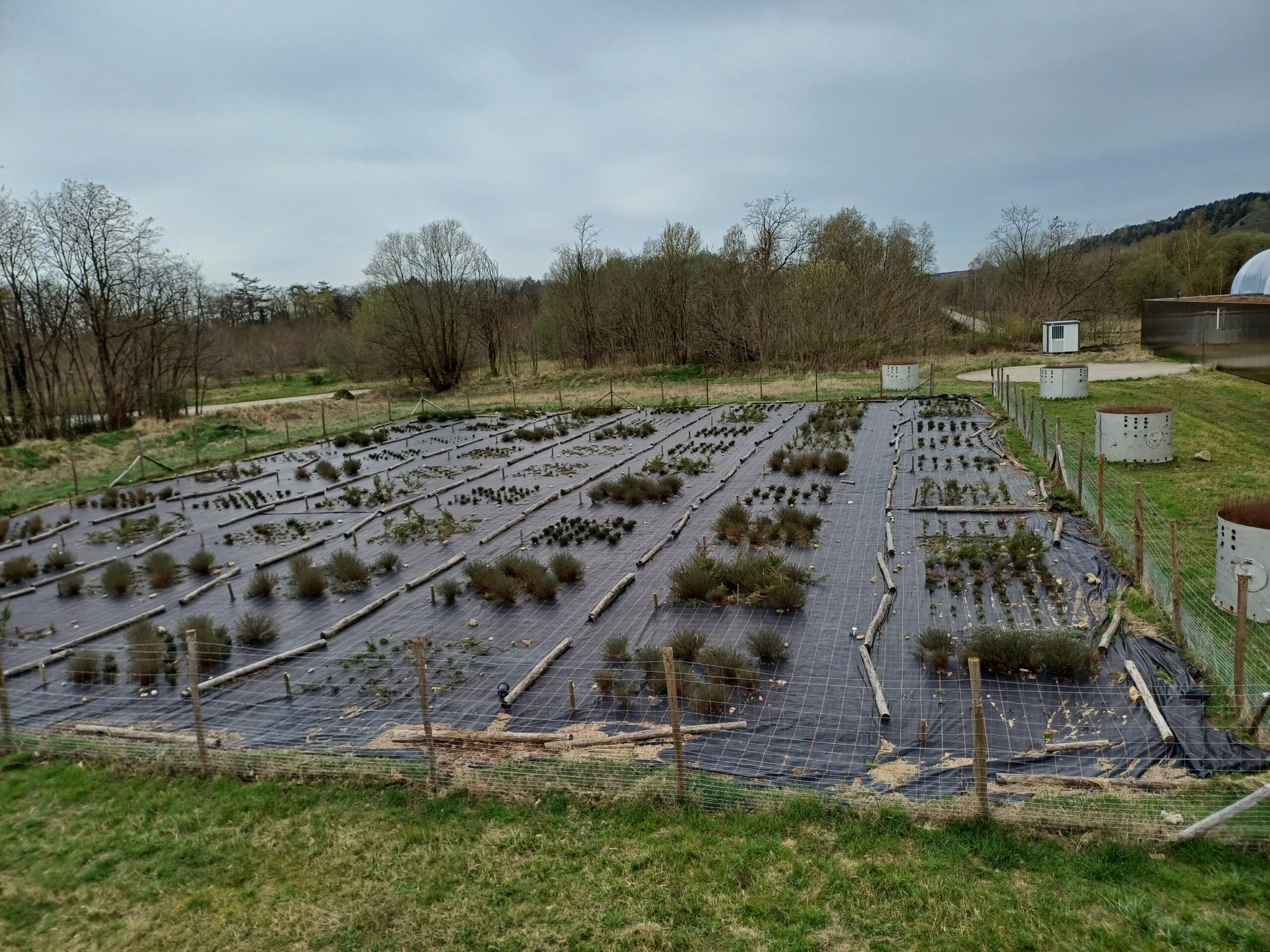
The Mycotron is a new, long-term field setup established in 2023 to assess impacts of microbial consortia formed by different types of mycorrhiza (plant-fungal symbiosis) on soil health, functions and biodiversity. The Mycotron has 60 2×2 m plots where gradients of mycorrhizal fungal colonisation by arbuscular, ecto-, and ericoid mycorrhizal fungi are created by using combinations of plant species featuring these 3 mycorrhizal types in different proportions: 18 plots of purely arbuscular, purely ecto-, and purely ericoid-mycorrhizal plants (6 of each mycorrhizal type), 36 plots featuring ⅓ x ⅔ mixtures of two mycorrhizal types (6 plots of each mixture), and 6 plots featuring ⅓ x ⅓ x ⅓ mixture of all three types. Plants have maximally similar ecophysiological traits (all evergreen shrubs) and are planted on the same soil, minimising differences in soil microbial communities, and enabling a focus on impacts of mycorrhizas on soil processes.
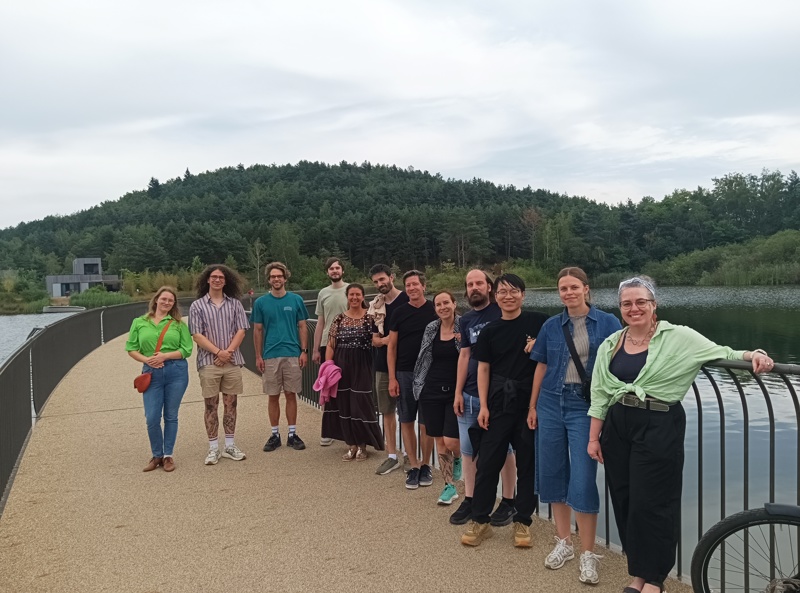
Team
Prof. dr. Nadia Soudzilovskaia
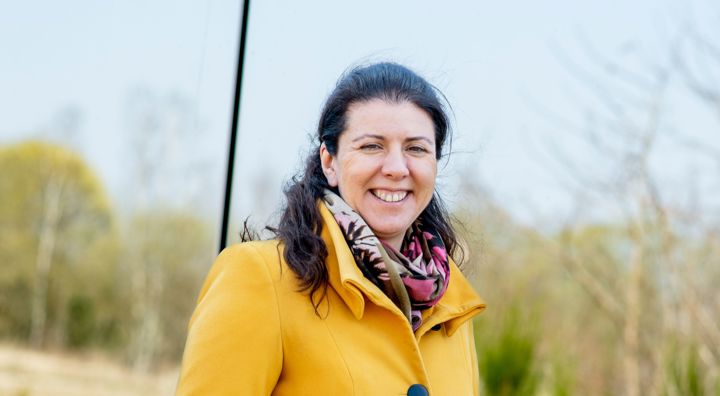
Head of the Ecotron | Lead Ecotron Research Team
Prof. dr. Francois Rineau
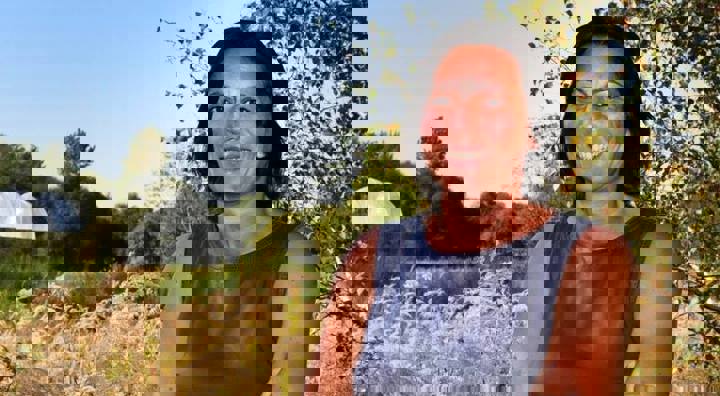
Prof. dr. Natalie Beenaerts
Xander Swinnen
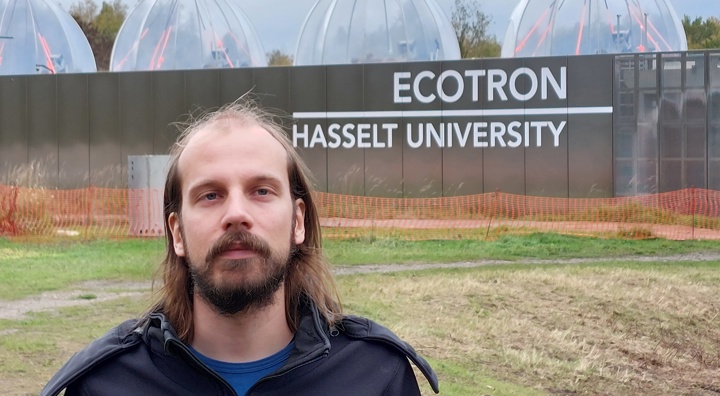
Dennis Matijasic
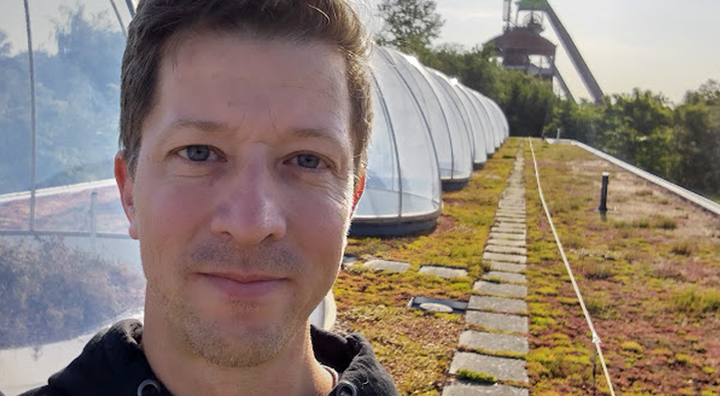
Technical manager Ecotron
Olivier Nouwen
Scientific communication and education manager | PhD student
dr. Mili Barcelo
Postdoc
dr. Pauline Rummel
Postdoc
Maria Moreno-Druet
PhD student
René C. Shaeffer

PhD student
Shenglei Hao

PhD student
Vera Claessens

PhD student
Chloë Vercauteren

PhD student
Birk Auwerkerken

PhD student

How to get there
Postal Address of Ecotron and Field Research Centre of UHasselt: Zetellaan 52, 3630 Maasmechelen (Belgium)
Driving Directions: GPS coordinates: Latitude 51.0000457, Longitude 5.7042895
The Ecotron and Field Research Centre (FRC) of UHasselt are located at Terhills, the main gate of the National Park Hoge Kempen. To reach it, take exit 33 on the E314 highway (Brussels - Aachen) and follow the signs ‘Maasmechelen Leisure Valley’ on a route that follows the canal for some kilometers. Keep following this road across tree roundabouts until the signs 'PARKING EUROSCOOP' and 'TERHILLS' indicate the parking lot. Continue the rest of the way (300m) walking through the French Garden. You'll find the Field Research Centre on your left side. The Ecotron facility is located directly behind the Field Research Center. Offices of the Ecotron researchers and technicians are located in the Field Research Center."
Getting Here by Bus: Bus line 44: Hasselt – Maasmechelen. Bus line 44 runs approximately every 30 minutes. Your final destination is the Eisden Kunstacademie stop.
Bus Boarding Locations and Departure Times:
- Hasselt Station: approximately 59 minutes travel time; Departs: :29 and :59 past the hour, for example 11:29 and 11:59
- Hasselt Dusart: approximately 51 minutes travel time; Departs: :07 and :37 past the hour, for example 11:07 and 11:37
- Diepenbeek Agoralaan: approximately 45 minutes travel time; !! Temporary stop: Diepenbeek Universiteit Parking; Departs: :15 and :45 past the hour, for example 11:15 and 11:45
- Genk Station: approximately 29 minutes travel time; Departs: :01 and :31 past the hour, for example 11:01 and 11:31
Bus Arrival Information:
- End stop: Eisden Kunstacademie — View bus stop on Google Maps
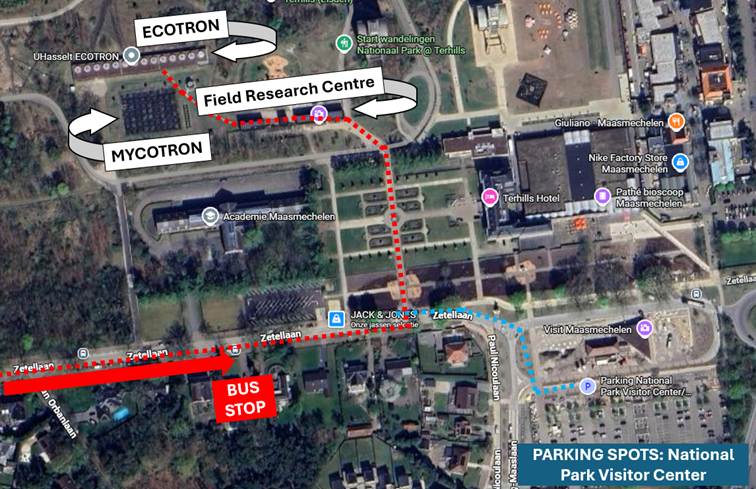
- Walking Instructions: It is just a short 5-minute walk from the bus stop to our location. Please follow the walking route shown on the map below:
Jobs and internships
Below you can find currently open positions at the Ecotron and field research center. However, we are also open for new ideas for MSc/BSc projects and we welcome PhD and postdoc students interested to obtain own funding.
- Obtaining your own PhD or postdoc funding: graduating PhD and MSc students with an idea for a research in the fields of climate change, biodiversity, soil biota and biogeochemical cycles (experimental, observative, modelling or global scale study) are welcome to contact our team. We will help you to develop a competitive application for PhD or a postdoc funding for Flemish research council (FWO) programs or international funds, including Marie-Curie and Chinese scholarship council (CSC). We are especially eager to support application to work at our Ecotron QPear project.
- MSc and BSc projects are available in the fields of soil biota, vegetation functioning and mycorrhiza.
Contacts and collaborations
General Inquiries Contact: CMK@uhasselt.be
Partners interested in collaborative projects with Ecotron or LTER, including scientists, prospective PhD candidates, BSc and MSc students
Journalists interested in Ecotron Research
Questions related to the Field Research Centre
Support our climate change research
Visiting Ecotron for public (groups and individuals)
Telephone Ecotron Facility: +32 489 34 04 21