
The UHasselt Student Codex | A unique reference work
The law programme at UHasselt is the result of a collaboration between UHasselt, KU Leuven, and Maastricht University. It started in the 2008–2009 academic year. UHasselt chose to publish its own Student Codex each year.
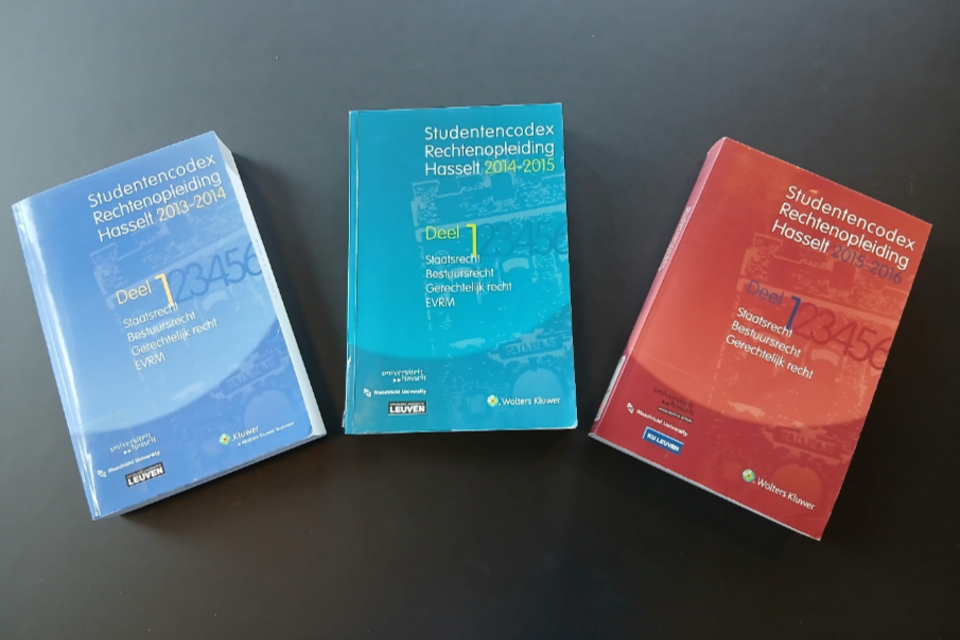
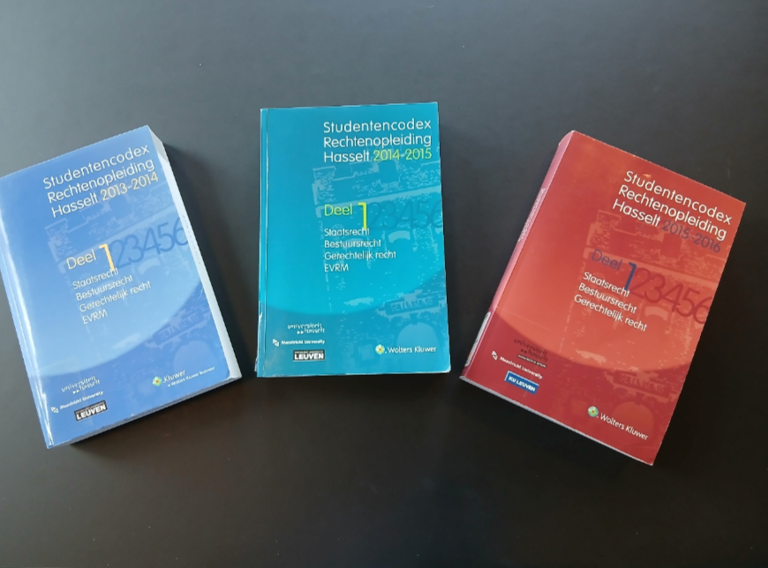
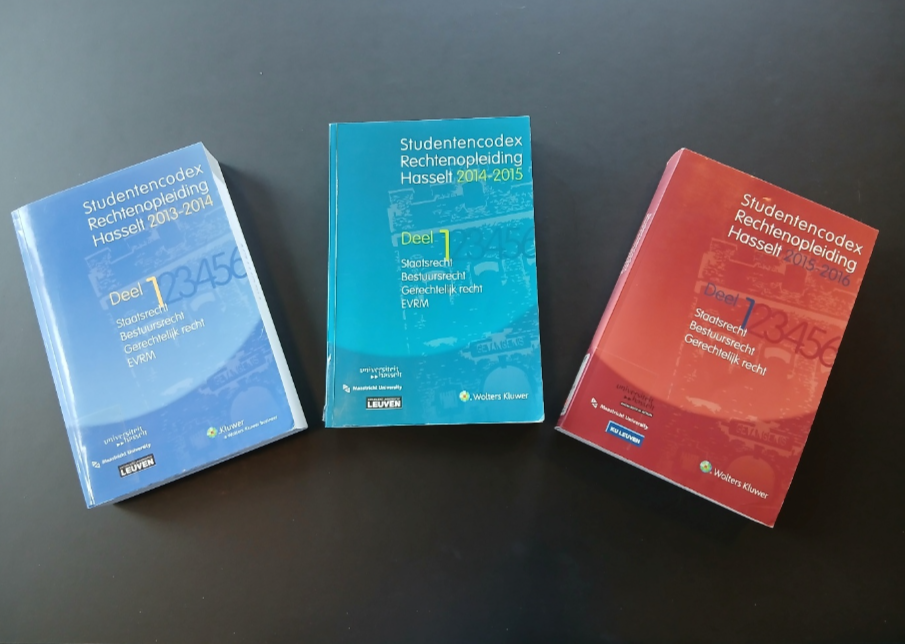
This codex offered students a convenient overview of current legislation, upcoming laws, and insights into legal history. As Dean Prof. Dr. Anne Mie Draye wrote in the foreword to the 2014–2015 edition: '“A good lawyer doesn’t memorize legal texts but knows where to find them.'
The UHasselt Codex consisted of six volumes:
- Part 1: Constitutional law, administrative law, procedural law, and the European Convention on Human Rights
- Part 2: Treaties, civil law, and property and contract law
- Part 3: Corporate law, diversity law, and Dutch law
- Part 4: Criminal law
- Part 5: Labour and social law
- Part 6: Tax law
A playful annual tradition was the choice of cover colour: students could vote for one of four colours proposed by the editorial team. The story goes that in 2015–2016, some commotion arose when the colour red was chosen — a choice a few students, for unclear reasons, found unfit for a codex.
However, producing an in-house codex required a major effort. After the 2015–2016 academic year, the faculty decided to discontinue its publication and refer instead to the already existing VRG Codex. So what made the UHasselt Codex different?
Its uniqueness lay in its thematic precision and depth. Unlike the VRG Codex, which was divided into three volumes, the UHasselt Codex comprised six, and it often included older laws that had been absorbed into newer codes. Moreover, UHasselt published separate volumes for labour law, social law, tax law, and criminal law — subjects combined into a single, broader but less detailed volume in the VRG version. For courses focusing on these areas, students typically used specialized codices.
Today, the Law Library still holds the editions from 2013–2014, 2014–2015, and 2015–2016. The very first edition from 2008–2009 is still missing from the collection - but the search continues.