
LUC Herbarium: Plants in Folders, Knowledge in Layers
Imagine you are standing in a nature reserve and come across a plant you cannot immediately identify. Today, an app on your smartphone will quickly point you in the right direction, but a few decades ago you would have turned to a plant guide with photographs or drawings. Anyone wishing to go further—asking questions about characteristics, growing conditions, or distribution—needed something more substantial than an image: physical comparative material with contextual information. That is why herbaria were assembled, including at the former Limburgs Universitair Centrum.
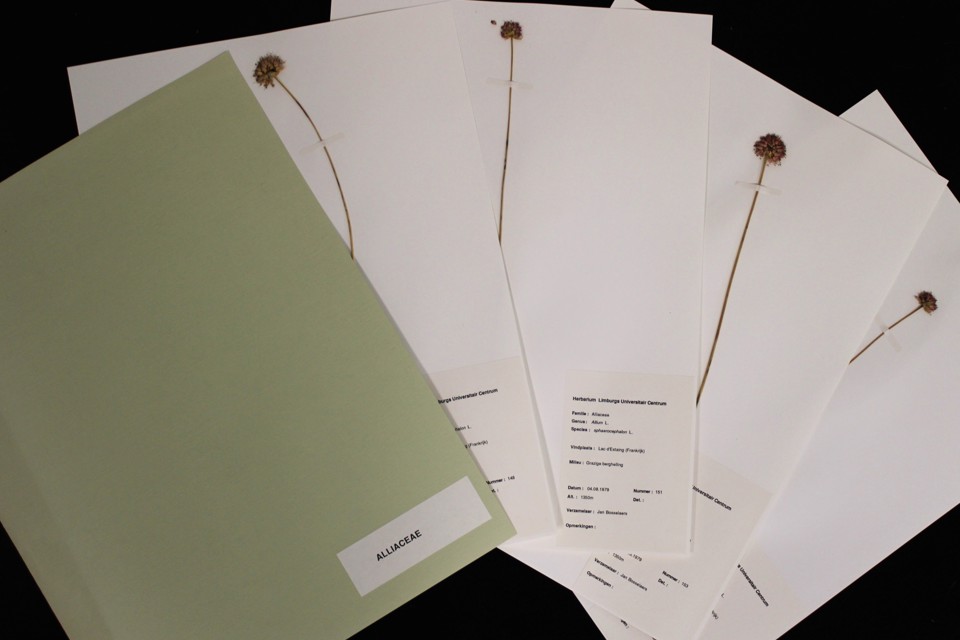
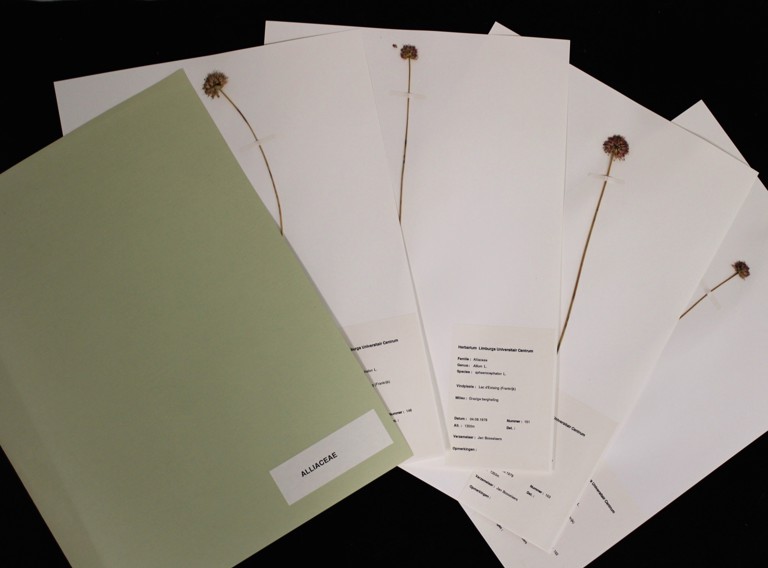
The herbarium now preserved in UHasselt’s heritage collections consists of folders containing dried plant specimens, each accompanied by metadata such as family, genus, species, place of collection, habitat, date, and collector. These details make every sheet usable as a reference: you can verify identifications, compare species, and return to concrete examples when questions arise about distribution, habitat, or variation within a species. Each specimen is thus a small but well-documented source that can be consulted again and again.
Rooted in teaching
The herbarium collection took shape in the early years from 1975 onwards. At the time, Jan Bosselaers supervised the practical sessions for Professor Marcel Vanpoucke’s course *Morphology and Systematics of Plants*. In that teaching context, the herbarium had a clear function: students learned to identify plants by studying different families and groups side by side. In doing so, they practised skills that remain fundamental to much work in botany: close observation, comparison of characteristics, accurate identification, and consistent recording. The herbarium was therefore not only a repository, but above all a teaching tool: a tangible reference collection through which names and characteristics acquired practical meaning.
New possibilities
After Jan Bosselaers’s departure, care for the herbarium was taken over by Professor Jaco Vangronsveld, now also emeritus. Today, the herbarium is no longer actively used in practical classes. This reflects broader shifts in research and teaching practice: students and researchers now work more often with digital tools and with standardised recording of field data. Traditional herbaria are being replaced or supplemented by digital specimen records with clear overview and detail photographs, linked to the same core information: species name, location, habitat, date, and collector. In teaching, identification is increasingly carried out using digital keys, apps, and image databases, which help users compare and rule out possibilities on the basis of characteristics. In the field, GPS coordinates, photographs taken according to set guidelines, and short, consistent habitat descriptions make observations immediately useful for both teaching and research. Where necessary, additional analytical techniques can further support identifications. The foundations remain the same, but the working methods have evolved.
Enduring value
Because of its historical and didactic significance, the herbarium has been incorporated into UHasselt’s heritage collections. In this way, the collection has acquired a new role: no longer as working material, but as a witness to how botany was taught at the LUC and to the competences that were considered central in that context. The carefully recorded metadata also ensure that the specimens remain valuable as reference material: every sheet continues to represent a verifiable observation and a strong example of good documentation. At the same time, the herbarium makes visible a principle that still holds true today, with or without digital tools: sound teaching and reliable research depend on careful observation and clear contextual information.


