
Measuring with Pencil and Ruler: A Spectrophotometer from UHasselt’s Pioneering Years
When UHasselt was founded in 1975, a well-equipped laboratory was far from a given. Research and teaching had to be built up at the same time, and of course the right equipment also had to be acquired. That demanded not only scientific ambition, but also perseverance. In those pioneering years, staff actively sought funding through a range of channels, including external funds and initiatives, even support from the National Lottery. The purchase of the spectrophotometer perfectly reflects the spirit of that early period: an investment in quality and versatility. It was not a disposable device, and certainly not the cheapest option, but an instrument built to perform reliably for many years - the “Rolls-Royce” of spectrophotometers.
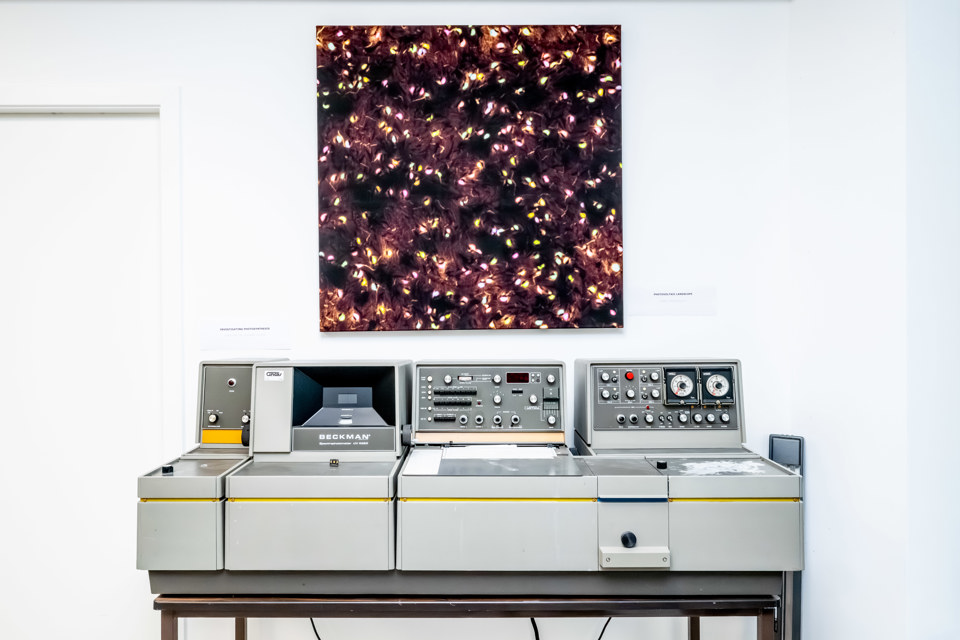
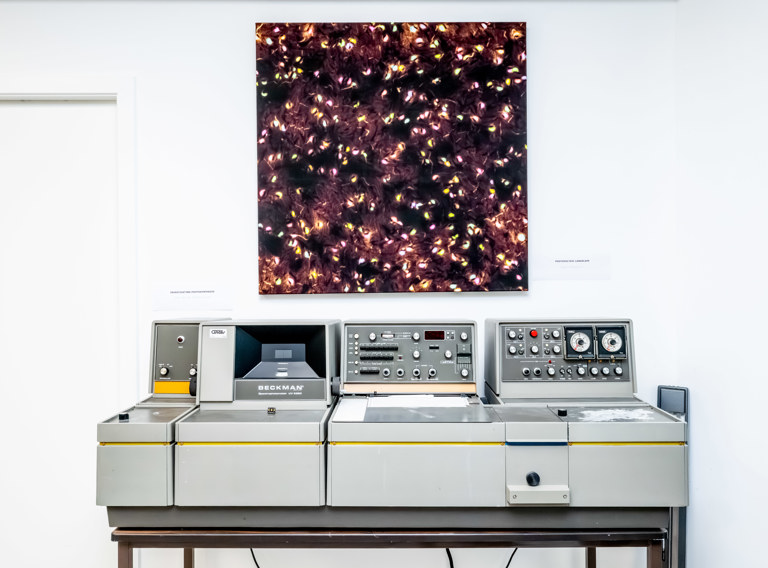
What does a spectrophotometer actually measure?
A spectrophotometer does something both simple and brilliant: it measures how much light a sample absorbs. This can be done at one specific wavelength or across a whole range of wavelengths. That is precisely where its power lies. Many substances, including pigments, do not absorb light at random. They “prefer” certain colours and let others pass through. If you map this carefully, you obtain an absorption spectrum: a characteristic curve that often functions like a recognisable fingerprint.
For research on photosynthesis—one of the main areas of Professor Roland Valcke’s work—such a spectrum is especially valuable. Pigments in plant tissue absorb light energy; by measuring their spectra, you can compare which pigments are present, how mixtures change, and how light absorption relates to the processes that ultimately lead to chemical conversions within the plant. In this way, a single instrument builds a bridge between biology and chemistry: from chlorophyll and incoming light to measurable patterns and explanations.
A logical measurement chain
Its operation follows a clear sequence. A light source produces light, one component selects a particular wavelength, the light passes through the sample, and a detector measures how much light remains on the other side. By comparing that result with a reference, it becomes clear exactly how much the sample absorbs. Today, such results appear in an instant as a perfect graph on a screen. But this instrument belongs to a different era: one of meticulous manual work.
Measuring means drawing
The spectrophotometer was operated entirely by hand. Setting the wavelength, zeroing the instrument, measuring the reference, measuring the sample: every step had to be carried out manually. The results, too, were recorded by hand on paper. Data points were carefully entered into tables and then plotted as a graph. With pencil and ruler, a spectrum gradually took shape, point by point, until it became a curve. It was slow, but it had a major didactic advantage: it made the measurement process transparent. You could immediately see the effect of good—or poor—calibration. You learned that even a small difference in preparation, reference, or reading could alter the curve. Measuring was not a matter of simply “pressing a button”, but also an exercise in method, attention, and critical thought.
An instrument for both research and teaching
That is precisely why the instrument was useful not only for research, but also for teaching. It was used for around twenty-five to thirty years, among other things to show students how to move from a physical signal to interpretation. It was the kind of instrument that forced you to ask questions: is my reference correct, is my sample clear, are my measurements consistent, and what does the shape of the curve actually mean? In an age when data seem to appear effortlessly, that lesson feels surprisingly current.
Pioneering spirit on paper
The laboratory now of course has more modern equipment: faster, more user-friendly, and digital in every respect. Even so, this instrument remains important as a piece of academic heritage. It tells a story about UHasselt in the making: about pioneering work, about the search for resources to make research possible, and about a scientific practice in which you quite literally learned by hand what accuracy means.


