
OSCAR-QUBE and OSCAR-QUBE+: Quantum Technology as New Academic Heritage
Academic heritage is not only about instruments from the past; it is also something that comes into being today, whenever a university launches initiatives that push technological boundaries, make abstract knowledge tangible, and inspire new generations of students to help write a shared scientific journey. At UHasselt, the OSCAR team (Optical Sensors based on CARbon materials) embodies precisely that kind of living, evolving heritage.
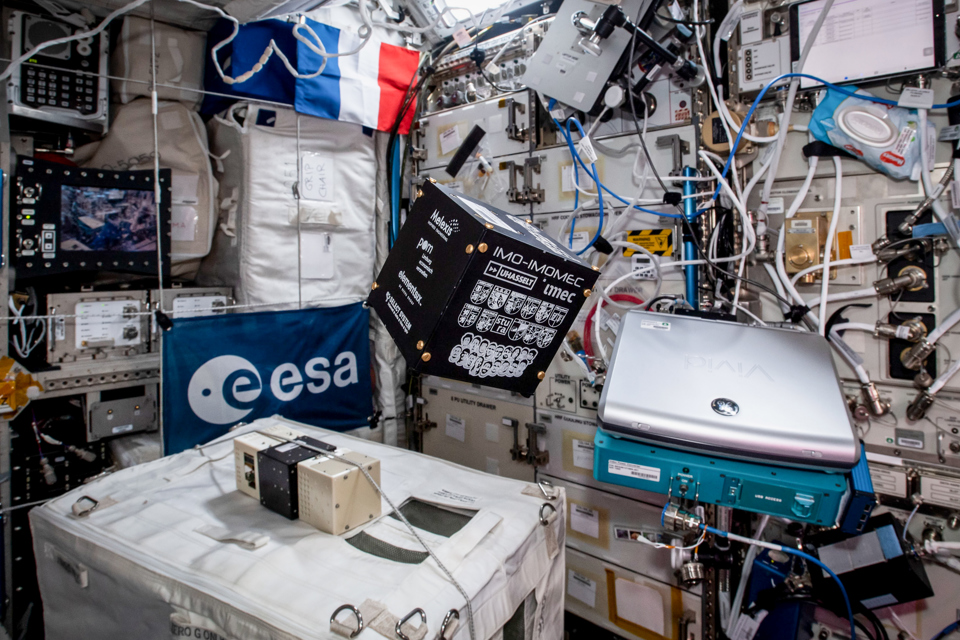
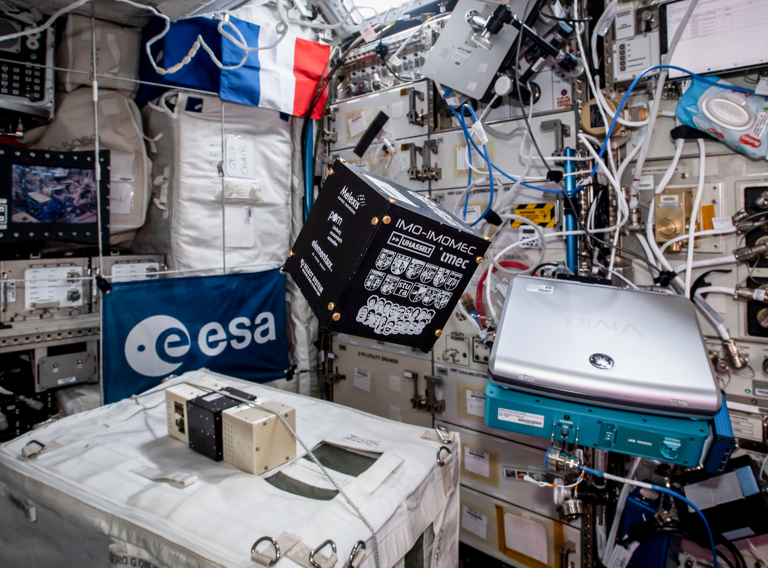
The OSCAR journey began in the 2015–2016 academic year and, over the past decade, has grown into a student-driven ecosystem in which education, research, and technological development come together in a mission-oriented approach. Thanks to the interdisciplinary collaboration of students from a wide range of backgrounds - with support from UHasselt, researchers at IUMAT (formerly imo-imomec), and partners such as ESA and the space industry - the team was able to move from concepts and laboratory ideas to real, fully operational space experiments. Milestones such as OSCAR-QUBE and OSCAR-QUBE+, two diamond-based quantum magnetometers deployed in space, show just how far young, motivated people can go when talent, guidance, and ambition reinforce one another.
What is a diamond quantum sensor?
At the heart of the sensor is an artificial diamond containing so-called NV centres (nitrogen-vacancy defects). These microscopic defects behave as quantum sensors: they function as extremely small magnetic-field detectors within the crystal structure of the diamond. In essence, the sensor works as a highly precise compass capable of measuring magnetic fields in three dimensions, with great sensitivity and stability. Professor Jaroslav Hruby explains: “The measurement is carried out by illuminating the diamond with green laser light. This excites the NV centres, causing them to emit red light. At the same time, a microwave field (MW) is applied to manipulate the quantum states of the NV centres.” The frequency at which these microwaves resonate with the NV centres depends on the surrounding magnetic field. When resonance occurs, the intensity of the emitted red light decreases slightly. “By scanning the microwave frequency and measuring the emitted light with a photodetector, a characteristic spectrum is obtained. The position of the resonance in this spectrum shifts in proportion to the magnetic field. In this way, both the strength and the direction of the field can be determined, much like with an extremely sensitive three-dimensional compass.”


From idea to space project
The OSCAR journey began when the team was selected in December 2015 for a stratospheric balloon flight within the REXUS/BEXUS programme (*Rocket/Balloon Experiments for University Students*) run by SNSA, DLR and ESA. The first project, OSCAR-BEXUS, combined diamond-based quantum sensors with organic solar cells and explored the feasibility of both technologies in a demanding space environment. A second stratospheric balloon mission, OSCAR-QLITE (2017/2018), built on that work and for the first time demonstrated the potential for further miniaturisation of the technology. Through the REXUS/BEXUS programme, the team gained hands-on experience of the full life cycle of a space project. That experience laid the foundations for a strong team culture, characterised by iterative development, careful testing, and the transfer of knowledge between successive student teams. This, in turn, made it possible to take the next steps towards missions in higher Earth orbit.
The road to the ISS
In April 2020, the team was selected for ESA’s Orbit Your Thesis! programme. This milestone marked the transition from experimental prototypes to a fully integrated space experiment. For the deployment of OSCAR-QUBE aboard the International Space Station (ISS), the technology had to be further refined and subjected to strict environmental and safety testing. In the process, the team went through all the development phases of a space project: designing, developing, building, and qualifying the experiment. After this intensive preparation, the instrument was shipped to the launch site in April 2021, ready for use in space.
OSCAR-QUBE on the ISS
The major breakthrough came with OSCAR-QUBE. In August 2021, the sensor was launched to the ISS, where ESA astronaut Thomas Pesquet installed the instrument in the Space Applications Services ICE Cubes facility. From there, it carried out measurements for ten months. The mission combined scientific measurements of the Earth’s magnetic field from low Earth orbit with a technological demonstration. It showed that diamond-based quantum sensors can operate reliably outside a laboratory environment. During the mission, 231 GB of data were collected, resulting in a scientific publication that marked the first demonstration of a diamond quantum sensor in space.
Back to UHasselt
After the space mission, OSCAR-QUBE returned to UHasselt in 2022. At a special event, the device was welcomed back by the team, partners, and a large group of supporters. It was then given a permanent and prominent place near the entrance to building D on the Diepenbeek campus. There, OSCAR-QUBE began a new mission: inspiring the next generation of students. As a tangible result of years of collaboration, the instrument shows what becomes possible when interdisciplinary teams design, test, and build together on knowledge passed down from one generation of students to the next. In that way, a space experiment grew into a piece of living academic heritage at UHasselt.
The successor: OSCAR-QUBE+
The story was soon continued with the OSCAR-QUBE+ mission (2022–2024), a scientific experiment within ESA’s YPSAT mission that was tested during the maiden flight of the Ariane 6 rocket. Building on the lessons learned from the ISS mission, the team developed a more compact and higher-performing sensor: 60% smaller, around 100 grams lighter, and up to ten times more precise than its predecessor. Whereas OSCAR-QUBE aboard the ISS had still operated in a relatively protected setting, OSCAR-QUBE+ was fully exposed to the space environment during its shorter mission. The instrument functioned successfully in space for more than 2.5 hours and completed two orbits around the Earth. At the same time, the mission served as the first test of concepts for magnetic navigation (MagNav). This work continued in November 2025, when an improved OSCAR-QUBE+ sensor was tested aboard the MAPHEUS-16 sounding rocket of the German Aerospace Center (DLR). During that flight, operational data were collected under extreme conditions, with accelerations of up to 16 g (around 160 m/s²).
The innovation journey continues
Taken together, OSCAR-QUBE and OSCAR-QUBE+ show how student-driven innovation can grow into technology that functions reliably in demanding environments such as space. The heritage value of OSCAR lies not only in the hardware, but also in the ecosystem around it: the documentation, test results, project organisation, and the accumulated expertise in quantum sensing and space technology that is passed on from one generation of students to the next. Over the past decade, more than one hundred students have contributed to OSCAR projects. They gained hands-on experience in designing, building, and operating advanced detection systems. At the same time, participation in OSCAR stimulates their professional development: students work in interdisciplinary teams, take responsibility within complex engineering projects, and operate in a realistic mission context. The close collaboration with ESA and partners in the space industry plays a key role in this, through mentoring, technical evaluations, and the opportunity to test new technologies in real missions.
Drawing on the experience gained with OSCAR-QUBE and OSCAR-QUBE+, the programme is now expanding in several directions. New projects are exploring applications of diamond-based quantum sensing for Earth observation (OSCAR-PINQ), space weather, magnetic navigation (OSCAR-MAGNAV), geophysical research, and space science (OSCAR-BLINQ). OSCAR-BLINQ, for example, investigates how NV-diamond technology can be used to study chemical and physical processes in microgravity. Looking ahead, OSCAR aims to continue building an integrated ecosystem for magnetic field measurements, extending from laboratory research and ground-based measurements to applications in low Earth orbit and beyond. In that way, the programme remains both a driver of technological innovation and an inspiring example of living academic heritage at UHasselt.


