Brian Dixon: Co-Design as a Mediator in Governance: The potential of reconfiguring relations between publics, institutions and knowledge
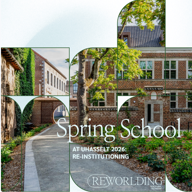
This lecture is part of the Reworlding Spring School that will take place at Hasselt University, at the historic beguinage in Hasselt (Belgium), from 4 to 8 May 2026.
This 5-day intensive programme explores the role of “re-institutioning” in socio-environmental transitions, bringing together researchers, practitioners, and students to engage with new approaches to institutions and governance, for example from more-than-human perspectives.
Dit event is reeds afgelopen
Brian Dixon: Co-Design as a Mediator in Governance: The potential of reconfiguring relations between publics, institutions and knowledge
This talk will explore the intersection of co-design and democratic innovation, focusing on how participatory design practices can shape and are shaped by contemporary governance contexts. Drawing on democratic theory and design research, I will reflect on questions of legitimacy, inclusion, deliberation and power in participatory governance.
Two cases will be presented. One looking at a set of recent design proposals in the context of Scottish Participation Requests, where communities can request local authority consultation. Another looking at a design-led democratic mini-public undertaken in an island context in Northern Ireland. Attention will be directed to how artefacts, processes, and infrastructures enable or constrain democratic participation, with co-design positioned as a mediating practice that can reconfigure relationships between publics, institutions, and knowledge within policy and decision-making processes.
About Brian Dixon
Brian is Head of Belfast School of Art at Ulster University and, partnering with the National College of Art and Design in Dublin, is Co-PI for CO-CREATE—an Irish Government funded North-South Research Partnership which will explore the role of art and design in developing inclusive futures across areas such as healthcare, public service delivery and climate action.
He is also a Co-I on Ulster University flagship Arts and Humanities Research Council-funded Green Transitions Ecosystem project, Future Island-Island, based on Rathlin Island, where he is investigating the potential of community-based policy making processes with a focus on sustainability.
His research interests span a number of domains, including design methodologies and the potential role of design in democratic innovation in the UK/Ireland.

The REWORLDING Network
How do people, places and more-than-human beings make sense of socio-ecological change - and act upon it? REWORLDING brings together researchers, communities and organisations to explore how participatory design can help navigate these complex realities.
We focus on inclusive, careful and situated approaches that create space for unheard voices - human and more-than-human - and foster new ways of learning and acting together.

Date and location:
- Tuesday May 5th 2026
- Begijnhof Hasselt, Kapittelzaal (house #2 / 1.4)
- 17h30 - 18h30
- Lecture open for everyone
Registration
Please register via this form.
For PhD students and postdocs, we would like to draw your attention to the cancellation and no-show policy of UHasselt
More information