Liesbeth Huybrechts and Rachel Clarke: The role of artistic and design methods in Re-institutioning and More-than-Human Governance
This lecture is part of the Reworlding Spring School that will take place at Hasselt University, at the historic beguinage in Hasselt (Belgium), from 4 to 8 May 2026.
This 5-day intensive programme explores the role of “re-institutioning” in socio-environmental transitions, bringing together researchers, practitioners, and students to engage with new approaches to institutions and governance, for example from more-than-human perspectives.
Dit event is reeds afgelopen
Liesbeth Huybrechts and Rachel Clarke: The role of artistic and design methods in Re-institutioning and More-than-Human Governance
Art is increasingly mobilised in climate governance and policy, yet often instrumentalised to serve predefined human agendas of data visualisation, awareness-raising, and science communication. This lecture explores design research’s role as a mediator of more radical art-driven participation that cultivates more-than-human care ecologies – relational configurations that redistribute sensing, accountability, and decision-making across human and other-than-human actors.
Drawing on theories of care and affective politics alongside case studies addressing sustainable transitions on an interregional level, urban air pollution, and disaster recovery, we examine how design research can support art-driven participation to move anthropocentric frames in policymaking towards situated more-than-human co-composition.
We argue that by mediating between artistic practice and governance, design research can foster more open, relational spaces for change, calling for sensitive, tentacular mechanisms to understand and articulate just and resilient more-than-human climate futures. The lecture opens a debate based on a critical literature review combined with accounts of three illustrative cases.
About Liesbeth Huybrechts & Rachel Clarke
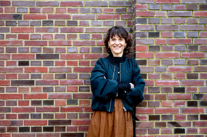
Liesbeth Huybrechts
Liesbeth Huybrechts is Professor in the areas of participatory design, design anthropology and socio-environmental transformation processes in the research group Civic and Policy Design, Arck, University of Hasselt, Belgium. She has developed a research interest in the design for/with participatory exchanges between human and the material/natural environment and the ‘politics’ of designing these relations in just ways.sustainability.
Rachel Clark
Rachel is a design researcher and practitioner based at University of the Arts London. She combines visual communication with qualitative research, performance and storytelling on issues of climate change, sustainability and social inequality.
She has exhibited work internationally and co-authored research papers across design research, human-computer interaction (HCI), and social sciences. She is member of the Climate Emergency Network at UAL, and recently co-edited ‘Designing More-than-Human Smart Cities: Beyond Sustainability, Towards Cohabitation’ with Sara Heitlinger and Marcus Foth in 2024 with Oxford University Press.
She was advisor for the Department for Environment, Farming and Rural Affairs’s Futures Advisory Group between 2022-2025. Example projects include urban soil data kits for citizen scientists to understand environmental quality and health inequalities (funded by NERC), designing more-than-human data interactions in the smart city (funded by EPSRC), and exploring young Palestinians’ responses to housing working with UN Women representatives (funded by the British Academy).

The REWORLDING Network
How do people, places and more-than-human beings make sense of socio-ecological change - and act upon it? REWORLDING brings together researchers, communities and organisations to explore how participatory design can help navigate these complex realities.
We focus on inclusive, careful and situated approaches that create space for unheard voices - human and more-than-human - and foster new ways of learning and acting together.

Date and location:
- Monday May 4th 2026
- Begijnhof Hasselt, Kapittelzaal (house #2 / 1.4)
- 17h30 - 18h30
- Lecture open for everyone
Registration
Please register via this form.
For PhD students and postdocs, we would like to draw your attention to the cancellation and no-show policy of UHasselt
More information