
Sustainability
View the content of this page
Welcome
UHasselt puts sustainability first in its education, research and services as well as in its further development and growth. Join our efforts to make UHasselt more sustainable.
Future Proef Award 2026 Seeks Sustainable Theses
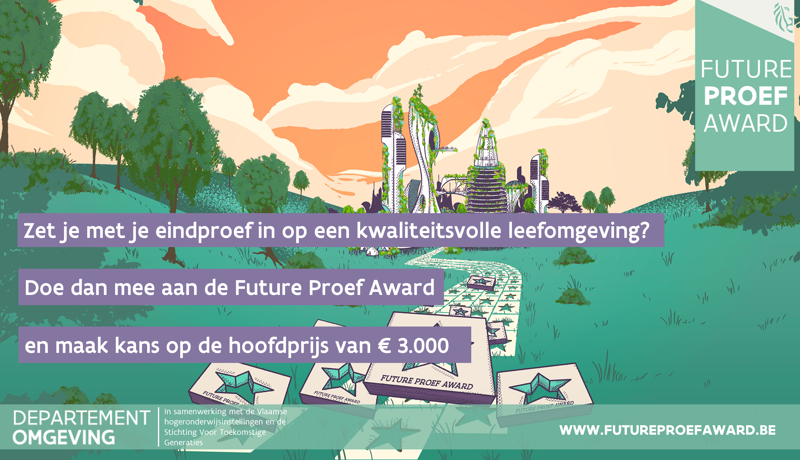
Did you defend a bachelor's or master's thesis on sustainability in 2026? Then the Future Proef Award is an excellent opportunity to showcase your research.
The award recognises UHasselt students whose research contributes to solutions for societal and sustainability challenges. We therefore encourage students, supervisors, promoters and staff to nominate or encourage students with a strong sustainability related thesis to apply.
The jury assesses each submission based on its contribution to a high quality living environment from a broad sustainability perspective, its societal and environmental impact, and its level of creativity and innovation. The Sustainability Compass, available on the Future Proef Award website, can help you determine whether your thesis meets the criteria and support you in preparing a strong application.
Applications can be submitted until 8 October. Visit the Future Proef Award website for the full eligibility criteria, assessment process and the Sustainability Compass.
Join Us!
Building a European Sustainability Charter
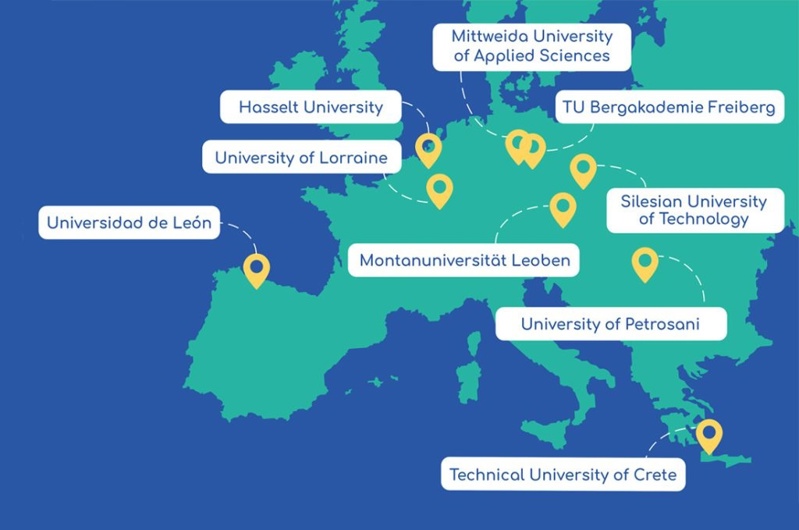
UHasselt is part of EURECA PRO, an alliance of nine European universities committed to responsible consumption and production. Together, we strengthen education, research and innovation while working towards a more sustainable future.
As part of the European University Alliance EURECA PRO, UHasselt is collaborating with eight partner universities on the Compass Charter. This joint sustainability charter brings together shared ambitions on sustainable mobility, procurement, events, communication, inclusion and ethics. By exchanging knowledge and best practices, the partner universities are laying the foundation for stronger and more future oriented sustainability policies. Over the coming years, these ambitions will be translated into concrete actions across the alliance and at each participating university.
UHasselt Contributes to the Sustainability Compass
How sustainable are Flemish universities and universities of applied sciences? The Sustainability Compass brings together inspiring initiatives and good practices from across higher education. The platform aims to accelerate the sustainability transition by encouraging knowledge exchange and showcasing the progress made by participating institutions.
UHasselt has contributed to the Sustainability Compass by sharing examples from education, research and campus operations. In doing so, we share our experiences with other institutions while learning from inspiring initiatives across Flanders. Together, we are helping to build a more sustainable future for higher education.
Biodiversity Working Group
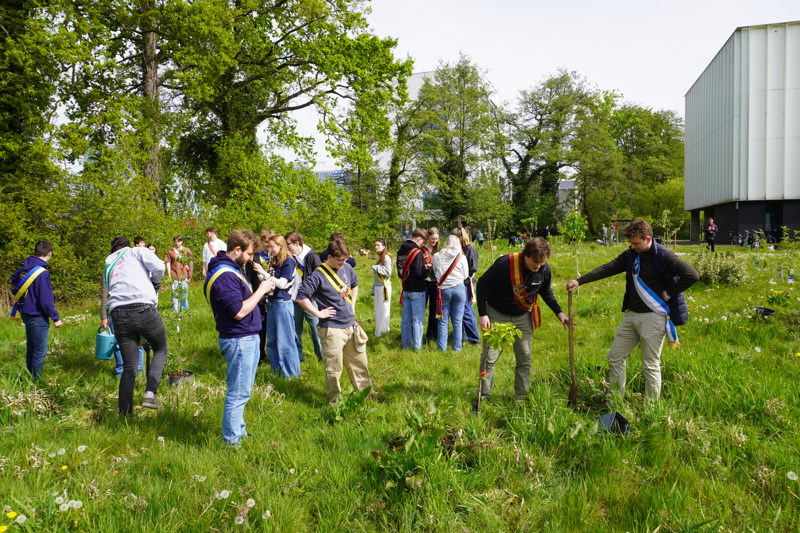
At UHasselt, we see biodiversity as a theme that connects education, research, campus development and collaboration. That is why we established the Biodiversity Working Group in 2025. The group brings together researchers, students, the Campus Development Team, the Sustainability Team, the Centre for Environmental Sciences (CMK) and external partners such as Natuurpunt to create greener and more nature inclusive campuses.
The working group brings together expertise, develops new initiatives and supports the integration of biodiversity across our campuses. In doing so, it strengthens the links between education, research and campus management, while helping to create campuses where nature and biodiversity have a permanent place.
Do you have ideas or would you like to contribute to these initiatives through your expertise? Get in touch with the Sustainability Team.
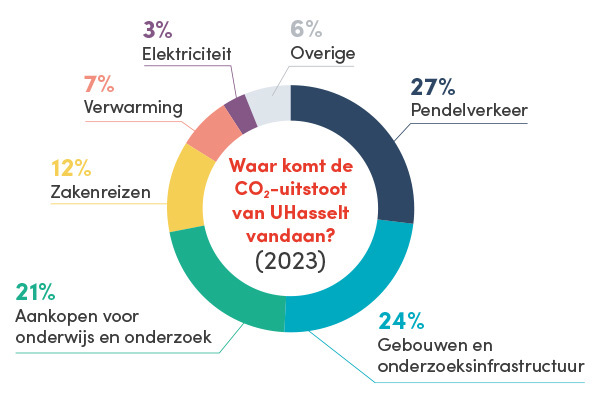
3,000 trips around the world: our carbon footprint
UHasselt has calculated its carbon footprint for the first time. In 2023, the university emitted 22.7 kt of CO₂. This is equivalent to 3,000 trips around the world by car or 9,119 return flights Brussels–New York. How these figures were calculated, which steps we are already taking to reduce emissions, and how you can contribute to a more sustainable university are brought together in a clear report that we aim to translate into concrete action.
For more information, contact duurzaamheid@uhasselt.be.
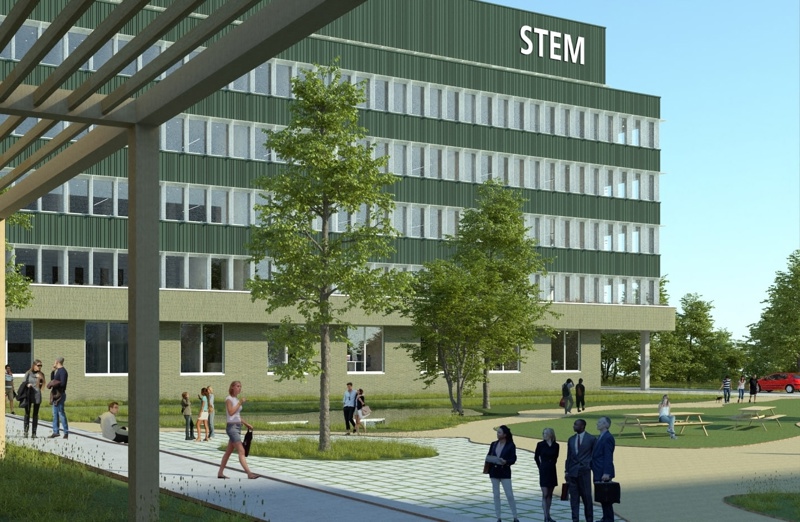
From Insight to Action
UHasselt's carbon footprint provides valuable insight into the university's climate impact. Through a whole institution approach, students, researchers and staff work together on practical solutions for a more sustainable campus.
For example, a Master's student in Industrial Engineering Sciences is currently assessing the environmental impact of a campus building in collaboration with UHasselt's construction team. Projects like these help translate sustainability challenges into concrete improvements for the university.
Are you working on a sustainability topic that could be relevant to UHasselt? We would be happy to explore opportunities for a bachelor's thesis, master's thesis or research project. Contact us at duurzaamheid@uhasselt.be.
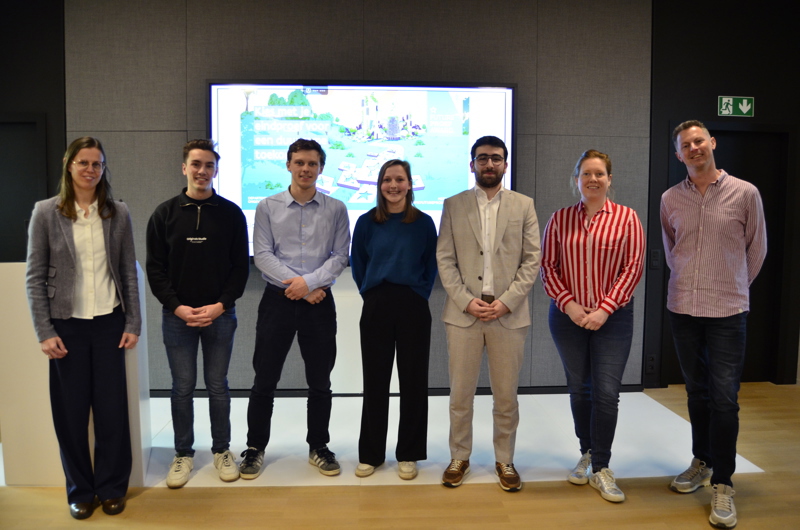
Winners UHasselt Future Proef Award 2025
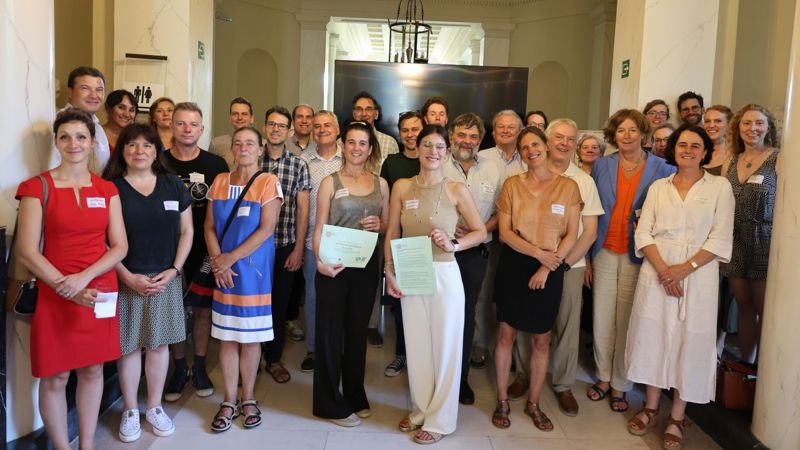
In March 2026, UHasselt celebrated the winners of the Future Proef Award 2025. The award recognises bachelor's and master's theses that contribute to sustainable solutions or inspire new ways of thinking about the sustainability challenges facing our society.
Congratulations to this year's UHasselt laureates: Kato Van Roosbroeck, Noa Florens, Kenneth Dries & Louis Macours, Lucas Ricour, and Reja Trippaers.
Interested in applying for the next edition? Visit the Future Proef Award page to learn more about the eligibility criteria and application process.
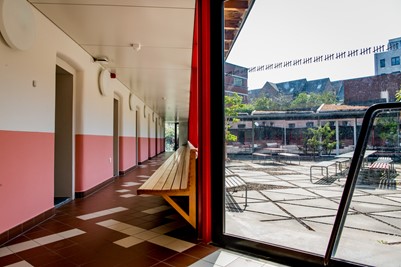
Sustainable suppliers
UHasselt puts sustainability first in its education, research and services as well as in its further development and growth. We ask our suppliers to contribute to a sustainable UHasselt. Read more about the sustainability policy for suppliers here.
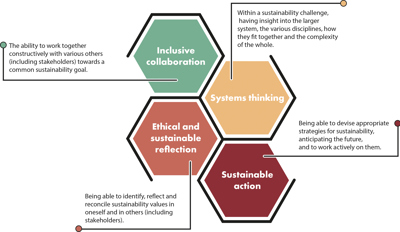
UHasselt Encourages Students to Develop Sustainability Competencies
UHasselt wants to encourage students to commit to sustainability during their studies and after graduation. That is why it is committed to an educational learning environment in which students can develop sustainability competences and a sustainable mindset and thus learn to deal with sustainability issues and act sustainably. Staff can find the toolbox on the intranet.
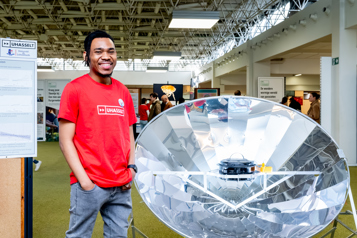
Sustainable research at UHasselt
To address sustainability challenges, we draw on our fundamental scientific expertise and translate this knowledge into societal impact through interdisciplinary co-creation. Find out who all is involved within UHasselt here.
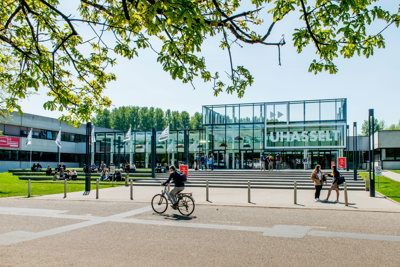
Travelling Sustainably to Campus
UHasselt is committed to making its campuses more accessible in a sustainable and future oriented way. Through our mobility policy, we encourage students and staff to walk, cycle, use public transport or carpool whenever possible.
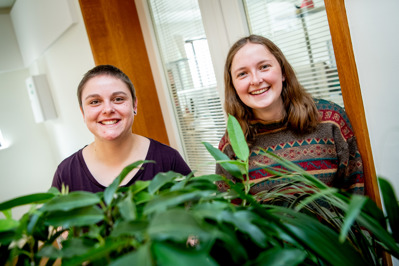
Join the Green Office!
Veggie or vegan, plastic-free, climate, ... Want to get to know other students who are interested in this and want to take action? Want to create your own sustainable initiative? Try the Green Office UHasselt!

Opt for the train for destinations that can be reached under 8 hours by rail
UHasselt encourages staff and students to travel sustainable. Here are some useful sites:
- Calculate the footprint of your trip by train, car, flight, ...
- Find an overview of direct train connections from every station in Europe
- Find out which places you can reach within 8h by train.
- Take the night train through Europe
UHasselt staff can consult the sustainable travel policy here.
Sustainability?
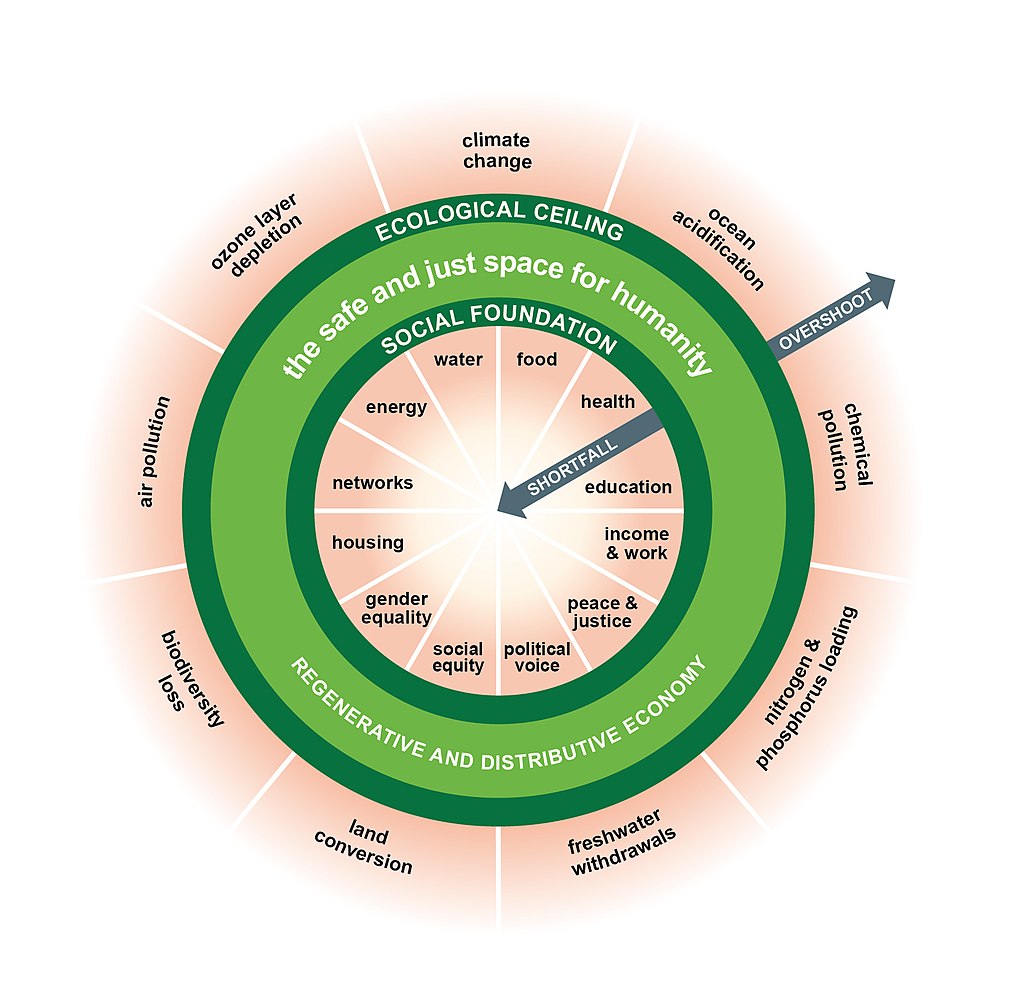
The UHasselt is setting its sights on achieving the Sustainable Development Goals. The donut is our moral compass for our sustainability policy. Read more about it below.

Sustainable Development Goals?
An end to extreme poverty, inequality, injustice and climate change. That is the core of the Sustainable Development Goals (SDGs). UHasselt subscribes to these goals in part by rolling out its sustainability policy.
UHasselt loves donuts
Heard of the donut economy? UHasselt approaches sustainability as follows: providing for everyone's basic needs while respecting the carrying capacity of our planet. No one explains it better than economist Kate Raworth. Want to know more? Watch her TED talk here.
Sustainable goals
To make UHasselt a little more sustainable every day, 6 sustainable goals were formulated. To make this happen, all services of UHasselt are called upon.
- Goal 1. The transition to a carbon-free, circular and climate-adaptive building stock by 2050 is a clear compass and long-term benchmark for every new construction or renovation project
- Goal 2. The Diepenbeek campus and the Hasselt city campus continue to develop according to the vision of a sustainable campus
- Goal 3. UHasselt actively invests in growing a proactive sustainability commitment among students
- Goal 4. The staff of UHasselt is a partner in the realization of an authentic sustainability policy
- Goal 5. Every student at UHasselt develops sustainability competencies
- Goal 6. Through its research, UHasselt creates a lever for a sustainable world in dialogue with social actors
Annual Sustainability Report
UHasselt Sustainability Report 2025
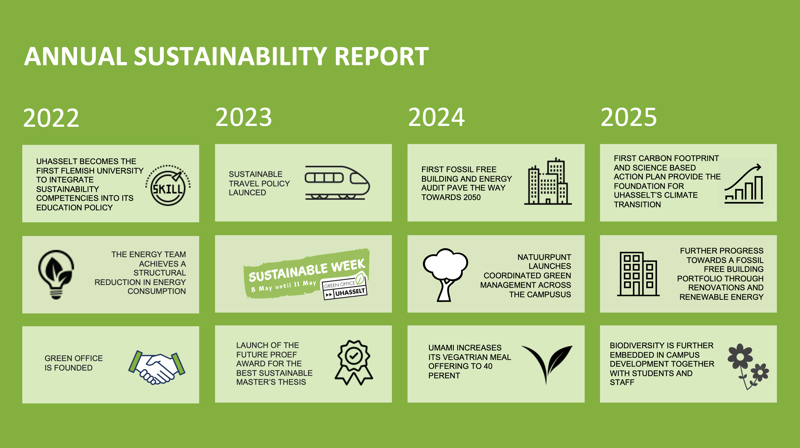
What progress has UHasselt made in sustainability over the past year? The new Sustainability Report highlights the university's key achievements across its six sustainability goals.
In 2025, UHasselt took further steps towards a fossil free building portfolio, strengthened the integration of biodiversity into campus development, and continued to invest in sustainability engagement among students and staff.
Sustainable mobility
Choose for walking, biking, public transport or carpool. Read all about the UHasselt mobility policy here.
UHasselt staff can find more information on mobility on the intranet.
Sustainable travel policy UHasselt
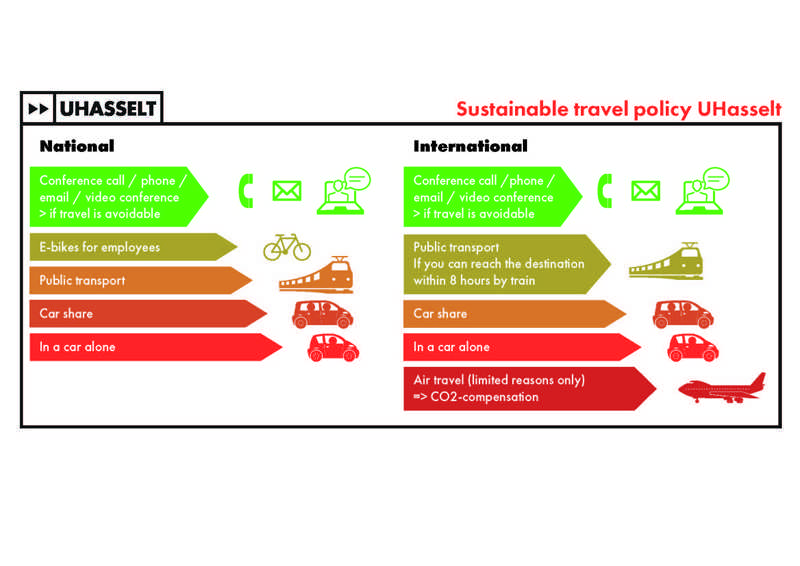
You can read the new sustainable travel policy with all its terms and conditions here. (pdf, 85 KB)
Hasselt University has made a commitment to be CO2 neutral by 2050. Flights are responsible for 3.5% of CO2 emissions in Europe. That share is growing rapidly. This is why Hasselt University is taking the first steps towards a more sustainable travel policy. Discover below what changes are being made to the travel policy.
1. Think carefully about whether it is worth making your journey.
Hasselt University has invested heavily in video conferencing in recent years and our meeting culture has also changed drastically in recent years. Should you meet completely online, in person or in a hybrid format? The choice is yours. But always think carefully about whether or not to make a journey. A few tips:
○ Don’t travel for one-to-one meetings
○ Don’t travel internationally for meetings of less than 4 hours
○ Make agreements with international research partners about your attitude to travel.
2. Short journeys: opt for a bicycle or public transport
A very easy way of reducing your ecological footprint is to use a bicycle or public transport instead of a car for short to medium distances. To give you a bit of extra help, Hasselt University provides free electric bicycles that you can use for a work trip.
If there is no alternative and you really do need to travel by car, you can use a Hasselt University electric car.
Note: you can no longer claim a kilometre allowance when using your own car for journeys of less than 5 kilometres (such as between Diepenbeek campus and Hasselt campus).
3. Opt for the train for destinations that can be reached by rail in under 8 hours.
Taking the train or bus instead of the plane really does make a big difference. Bond Beter Leefmilieu summarises this nicely in this article. For a flight to Vienna, the climate impact of flying is seven times greater than taking the train. That is why we ask every Hasselt University staff member to take the train to destinations that can be reached by rail within 8 hours. We monitor the data available through our travel agency Omnia.
Would you like to know which destinations you can reach by rail in less than 8 hours? The FWO has produced a clear map. These websites can also give you further help: Direkt Bahn Guru (lists direct rail connections from every station in Europe) and Night Trains Europe. Who knows, you might end up having an adventure on a night train.
Share your train photos or train story with Hasselt University’s Green Office: #GreenOfficeUHasselt or greenoffice@uhasselt.be. Inspire others with your travel story.
4. Offset your flight’s CO2 emissions
Hasselt University expects you to offset your flight’s CO2 emissions. This has been a general practice at various other universities for several years now.
- Are you flying using Omnia? Travel agency Omnia offers CO2 offsetting of approximately 25 euros per ton through a partnership with Greentripper. This finances climate projects and is monitored by an independent agency recognised by the UN. Greentripper donates the money to the Ghana project. (pdf, 13.8 MB)
- Are you not flying using Omnia? If you are not flying using Omnia, you can still opt for CO2 offsetting with most providers.
Did you know? We assume that you will use the travel agency Omnia Travel, with which Hasselt University has a framework agreement. Discover the benefits here.
Did you know? That most research funds and funding bodies accept CO2 offsetting as an expense? See the overview here.
5. Some final guidelines if you do take the plane
- You must travel economy class
- Avoid stopovers and transit flights, replacing them with the train where possible
- No creative ticketing (where a return ticket is booked, but only the outward flight is used)
Three faculties are participating in a pilot project to see how they can take further steps towards an ambitious travel policy. ARK, BEW and REC have taken up the challenge.
Sustainable campus
Campus Under Development
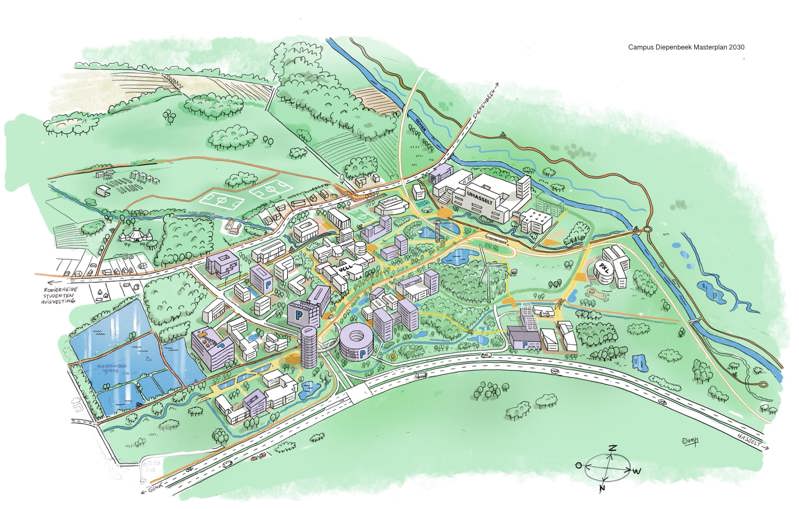
UHasselt's campuses are preparing for the future. With the arrival of the tram bus, Campus Diepenbeek and Campus Hasselt will become not only more accessible, but also greener, safer and more attractive places to study, work and meet. The redevelopment creates more space for pedestrians and cyclists, new meeting places and high quality green outdoor areas.
At Campus Diepenbeek, a central transport square will be created at the heart of the campus, together with a low traffic park boulevard and a mobility hub where different sustainable transport options come together. The campus is evolving into an environment where sustainable mobility, climate adaptation and high quality public space go hand in hand. For more information about the redevelopment works, project phases and how to travel to campus during the works, visit the 'Slim naar de Campus' website.
Biodiversity becomes a permanent part of our campuses
UHasselt is currently working with a range of internal and external partners to structurally integrate biodiversity into the development of its campuses in Diepenbeek and Hasselt. The ambition is not only to incorporate biodiversity into the design of buildings and outdoor spaces, but also into their construction and long term management.
Several initiatives are currently underway, including projects related to the future STEM Tower, the new campus building in Hasselt, and a broader exploration of biodiversity at campus scale. These initiatives focus on biodiversity monitoring, the development of design and management guidelines, and identifying opportunities to further strengthen biodiversity across our campuses.
These initiatives are being developed through a whole institution approach, actively involving students, researchers and staff. For example, this academic year an Interior Architecture student conducted a preliminary study on integrating biodiversity into construction projects. During the next academic year, students from the Architecture and Interior Architecture programmes will work on the STEM -Tower as part of the Live Projects course. In this way, biodiversity, education, research and campus development are directly connected.
Do you see opportunities to contribute to these initiatives through your research, teaching or expertise? Or do you have ideas for strengthening biodiversity on our campuses? If so, please contact the Sustainability Team at duurzaamheid@uhasselt.be.
Sustainability steering committee
The steering committee strives to make UHasselt sustainable in all possible areas, ranging from campus management to education and research. Therefore, the group is broadly composed of employees and students (through the Green Office) who will use their interest and/or expertise to realize the sustainable goals for UHasselt. Depending on specific projects, other experts can of course also join. The steering committee cooperates intensively with departments and faculties so that sustainability becomes a spearhead within the entire organization.
Contact
Single point of contact sustainability
Team sustainability
Professor Griet Verbeeck is academic leader for sustainability within UHasselt and chair of the sustainability steering committee.
Together with Kim Engelen (Rectorate), the team explores the ways in which sustainability can take shape within UHasselt.