
A University in the Making: Scale Model of Campus Diepenbeek from the 1970s
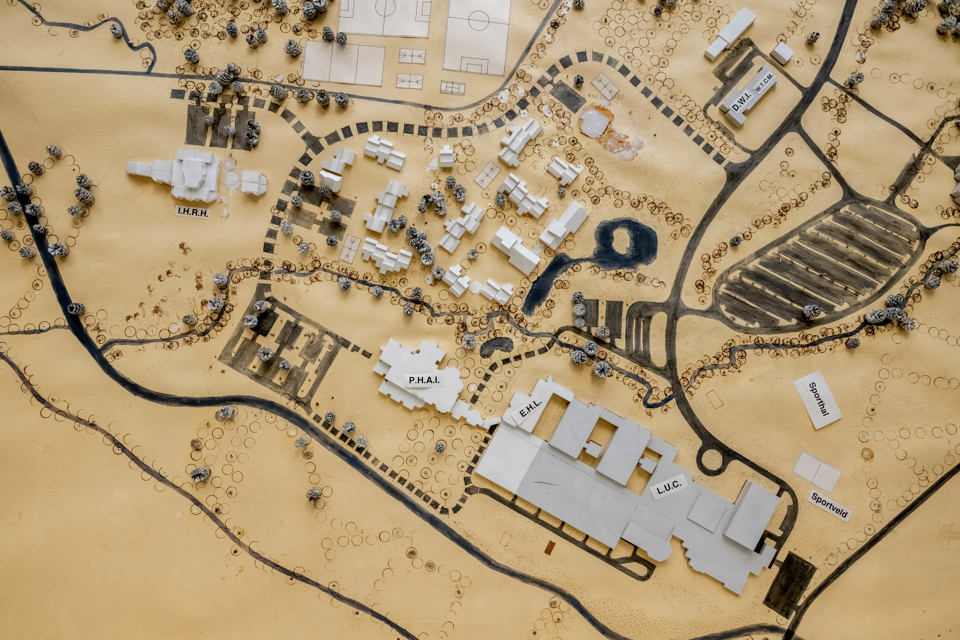
As of 2026, Campus Diepenbeek stands on the threshold of a major transformation. In the coming years, the site will be reimagined as an innovative experience campus: a place where studying, working, and spending time becomes even more enjoyable. Remarkably, that vision of the future strongly echoes the ambitious plans of the early 1970s, when the campus was first developed.
A University in the Making
“By the late 1960s, public support for a university in Limburg was enormous. *A university for all social classes*, *Equal opportunities for our young people too*, *Mines closed, university open*—with slogans like these, no fewer than 11,000 Limburgers marched through Hasselt in 1969. That demonstration is where our story truly began. Even so, it was not until September 1973 that Governor Roppe was able to cut the ribbon for the Limburgs Universitair Centrum (LUC).”
(Honorary Rector Luc De Schepper)
Choosing Diepenbeek
At the time, the question of where the university should be located sparked considerable debate. Hasselt and Genk both laid claim to it, but the निर्णायक factor was the need for 360 hectares of easily accessible land. In the end, two options remained: Kiewit or Diepenbeek. Diepenbeek was ultimately chosen, not for budgetary reasons, but because of its central location. At least, that was the plan. Several major infrastructure works, such as the A24, were never completed, which meant the campus lost some of that intended accessibility.
The site originally consisted of marshy farmland, expropriated by the province. Landowners received modest compensation and, in some cases, job security for their children. The project was conceived on a grand scale: 67 hectares for the campus itself—between Ginderoverstraat, Universiteitslaan, Agoralaan and the Demer—and more than 300 hectares designated as a public utility zone. In terms of ambition, it was comparable to Louvain-la-Neuve. In a short period of time, the entire site was opened up and developed with roads and buildings: a remarkable feat.
A science park avant la lettre
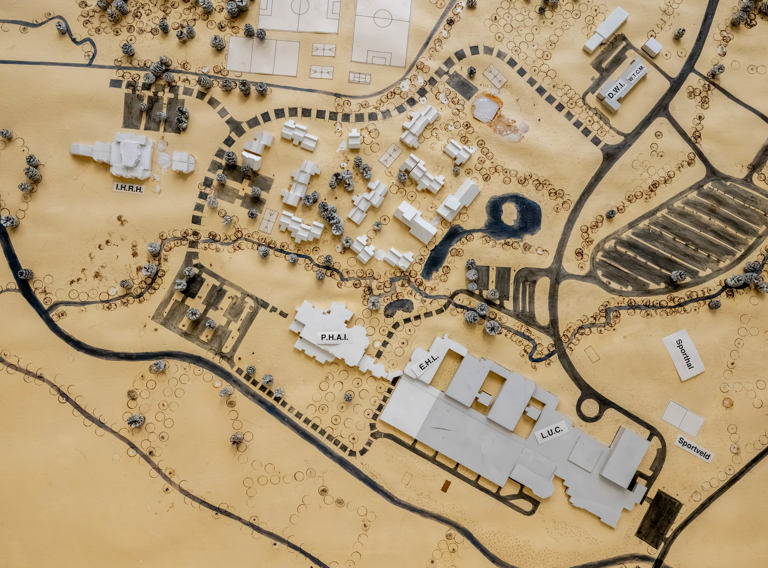
From the outset, the campus was intended to be more than just a place for teaching. It was designed as a science park *avant la lettre*, where education, research, and innovative enterprise would reinforce one another. The scale model from the early 1970s, which was updated over the following years, illustrates those high ambitions.
As student numbers rose steadily at first, infrastructure and facilities were expanded step by step. Professor Louis Verhaegen, the first rector, actively encouraged collaboration with the university colleges: the Katholieke Hogeschool Limburg (KHLIM), provincial education in architecture, and state education in engineering. In this way, Campus Diepenbeek grew into *the* centre of higher education in Limburg. Research institutes also found a place there, including a provincial and later a federal laboratory.
Distinctive choices
The original plans did not include student accommodation. A viable operation would have required at least 120 rooms, and this proved financially impossible. Instead, grant-holding students received a housing allowance: a system unique in Flanders.
The buildings, too, reflected this forward-looking vision. The main building (Building D) was financed partly by the Province of Limburg and partly by the Limburgs Universitair Centrum, and housed both the university and the School of Economics. The library and restaurant were shared, which strengthened cooperation between the institutions. It was only twenty years later, in 1991, after considerable political debate, that the School of Economics became a fully fledged faculty within the university.
A didactic vision cast in brick
“The architecture of the main building followed a Scandinavian model: students were expected to spend their days on campus, with community-building and social cohesion as key priorities. The long central corridor and the agora became the heart of the building—a concept often imitated elsewhere, but nowhere as successfully as in Diepenbeek,” says honorary administrator Willy Goetstouwers.
The innovative educational model also left its mark on the plans: active learning in small groups, with intensive guidance. Originally, there were hardly any lecture halls at all, although that was adjusted fairly quickly.
From LUC to UHasselt
The Limburgs Universitair Centrum laid the foundations for what is now Hasselt University: a university that has consistently placed innovation and international collaboration at the forefront. The scale model from the 1970s shows just how ambitious those first plans were, and reminds us that the current development of Campus Diepenbeek is not a break with the past, but a continuation of the same forward-looking dream.


