
Academic Heritage from the Austrian Netherlands: The Map of Count de Ferraris
Between 1771 and 1778, an exceptionally detailed topographical map of the Austrian Netherlands and the Prince-Bishopric of Liège was produced under the direction of Count Joseph Jean François de Ferraris. The project resulted in 275 hand-drawn map sheets at a scale of approximately 1:8,640 - a level of precision unmatched anywhere in Europe at the time.
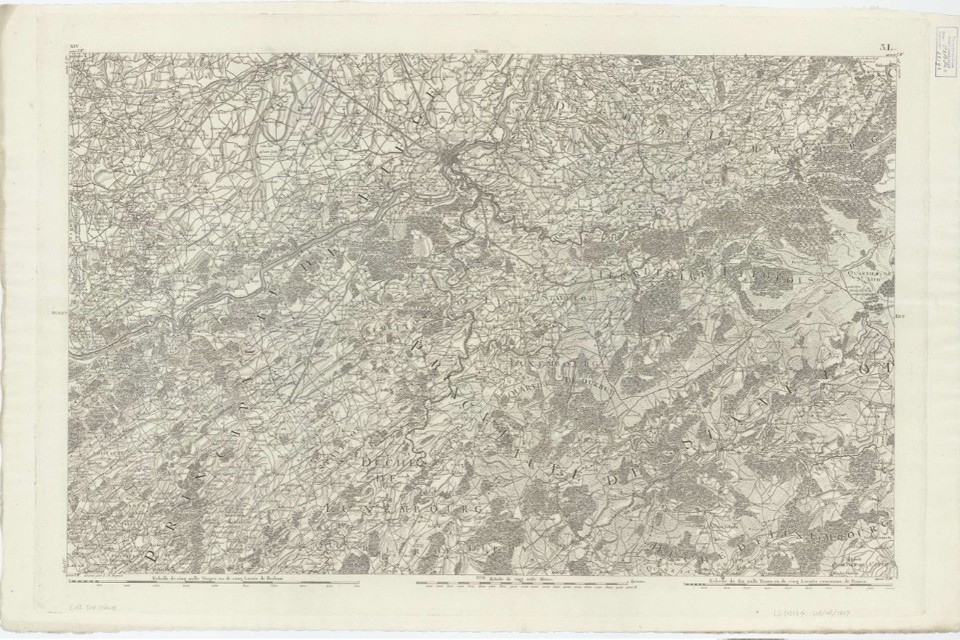
The map was commissioned by the Austrian authorities for military and administrative purposes. It provided a systematic representation of the landscape, infrastructure, settlements, and natural features, and served, among other things, for strategic planning, tax collection, and estate management. Today, the Ferraris map is an indispensable source for historical, geographical, landscape, and archaeological research.
The copies in our collection belong to a printed edition published after 1807. Rather than manuscripts, they are copper engravings issued as a series of twenty-five overview maps. This edition made it possible to disseminate the original and costly cartographic material more widely for administrative and educational use.
The scale of 1:8,640 was retained, allowing the maps to preserve an extraordinary richness of detail. Roads, waterways, relief, woodlands, farmland, villages, farms, mills, and chapels are all rendered with great precision. Symbols and hatching also make field patterns and land use visible, making the eighteenth-century landscape almost literally readable.
The University Library holds a partial set of this edition, consisting of four of the twenty-five sheets:
- page 1H, with the key to symbols and signs;
- map IV (1L);
- map IX (2L);
- map XIV (3L).
Together, these maps provide a continuous view of the eastern part of what is now Belgium in the late eighteenth century.
The maps came into the possession of the Faculty of Architecture and Arts through a donation. Although their exact provenance is unknown, the set forms a valuable whole because of its cartographic quality and its enduring scholarly and didactic significance.
Ferraris maps are still used in teaching today. When compared with modern topographical maps, GIS data, and satellite imagery, they offer insight into landscape evolution, historical geography, and spatial continuity.
Map IX (2L): Limburg and the Meuse Valley
Map IX covers a large part of what is now Belgian and Dutch Limburg, with the Meuse as its central geographical axis. The river functions both as a natural boundary and as a structuring element for settlements, agricultural land, and transport routes. The map shows a dense concentration of place names and a highly detailed rendering of villages, hamlets, and individual farmsteads. Towns such as Maaseik, Bree, Maastricht, Tongeren, Sint-Truiden, and Hasselt are clearly identifiable, as are smaller settlements that have since disappeared.
The area appears as a predominantly agrarian landscape, with arable fields, wet grasslands along the Meuse, and extensive woodlands on higher ground. The river itself is shown with its historical meanders, side channels, and flood zones. Dikes, ferry crossings, and bridges are also indicated. In combination with modern maps and aerial photographs, this makes it possible to analyse changes in river regulation and landscape structure with great precision.


