
Aim, Shoot, and Read the Result: Speed Guns in Mobility Sciences
Something that simply spent years travelling in the boot of a car on fieldwork can, over time, become academic heritage. The speed guns used by the School of Mobility Sciences are a fine example. With these handy devices, students record the speed of passing vehicles—an apparently simple measurement that, in practice, teaches them a surprising amount about traffic behaviour, data analysis, and road safety.
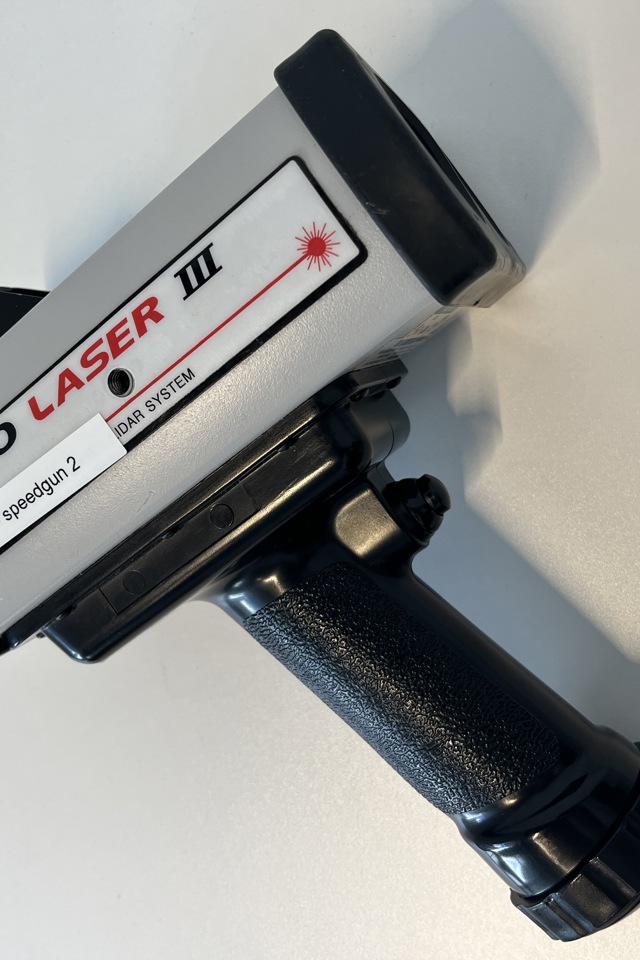
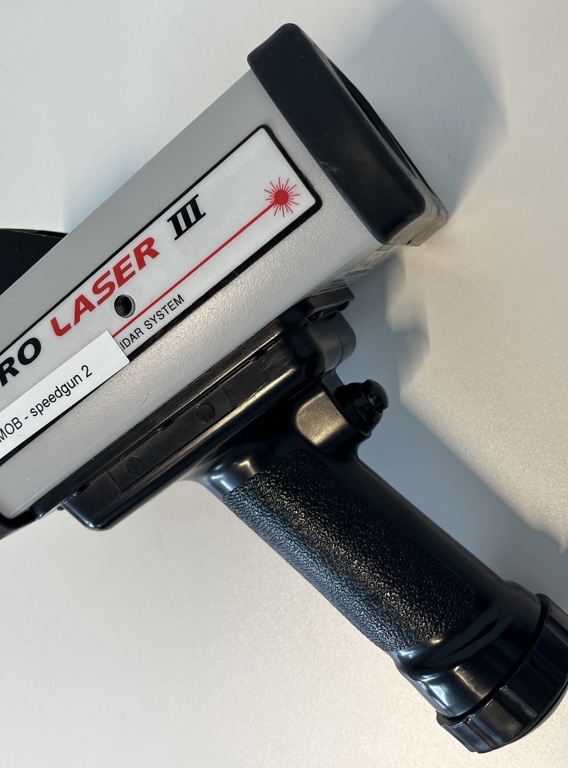
The speed guns were purchased in 2006 from TEC (now HIG) Traffic Systems, a company specialising in traffic technology, and are used primarily in teaching: to let students observe, measure, and draw conclusions for themselves.
Measuring in real-life cases: from municipal questions to mobility advice
Within the programme, the speed guns are mainly used in project-based courses and in bachelor’s and master’s theses. Professor Evelien Polders explains: “These are often practice-oriented cases brought in by cities and municipalities: assignments with clear social relevance, in which speed studies form part of a broader mobility project.” In this way, students learn not only how to measure, but also how to interpret and translate their findings: what do speed data reveal about the liveability of a street, about safety at a crossing, or about the impact of road design and policy?
In their analyses, students deliberately look beyond a single figure. They calculate the average speed, map the spread of speeds, and determine the V85: the speed not exceeded by 85% of drivers. That V85 is an important benchmark for assessing whether there is in fact a speeding problem. On the basis of these results, students then formulate well-grounded recommendations for adapted speed policies and targeted measures to improve road safety and liveability.
‘Safe speeds’ in Hasselt
The speed guns also have a fixed place in the *Traffic Safety* course. During workshop sessions, students work in groups on an assignment centred on the Safe System Approach. Lecturer Jeroen Luyck explains: “Students analyse a specific location in Hasselt—for example, an intersection on the Kleine Ring—and use the speed measurements as input for their traffic safety analysis. In a second phase, they develop an improvement plan for that location based on the five pillars of the Safe System Approach.” In this context, the measurement results mainly support the pillar of *Safe speeds*, ensuring that recommendations are based not on intuition, but on observation and well-founded argument.
New technology on the horizon
At present, two speed guns are still in use. They will continue to serve for the time being until the new generation has been screened and validated by teaching staff, although wear and tear is beginning to show: the devices are now around twenty years old, and their batteries are holding up less and less well. The newer models also offer additional features and a more modern interface. At the same time, the use of drones for measurement is beginning to come into view. This does require greater expertise: certification is needed, and drone operators must be clearly identifiable. Even so, some students—especially those working on a master’s thesis—use drones from the UHasselt fleet after the necessary training. Yet the speed guns remain popular with bachelor’s students: they are accessible, quick to deploy, and immediately intuitive—“aim, shoot, and read.”
That little bit more distinctive
Once the new devices become fully established, the old speed guns may gradually be pushed aside. From a heritage perspective, that is precisely the turning point. These instruments have been used intensively for twenty years and tell a characteristically UHasselt story: teaching that places students firmly in practical reality, with measurement work leading to concrete proposals for safer and more liveable streets. Moreover, Mobility Sciences is not offered at every university, which makes this kind of teaching equipment just that little bit more distinctive than one might think at first glance.


