
From Balsa Wood to Laser Precision: Models as a Time Capsule of Our Architectural Education
At our Faculty of Architecture and Arts, some real gems are on display. Anyone walking into the studios sees not only miniature buildings, but also a story of craftsmanship, imagination, and technological change. Through these models, you can trace how the production process changed profoundly over just a few decades, while remaining essentially the same in substance.
In the 1980s, 1990s and 2000s, models were often made entirely by hand. Fibreboard, solid pine, balsa wood, foam board, paper and even mosquito netting were the basic materials of the architecture student. These models were usually didactic in purpose: they helped students understand the structure and composition of often iconic buildings.
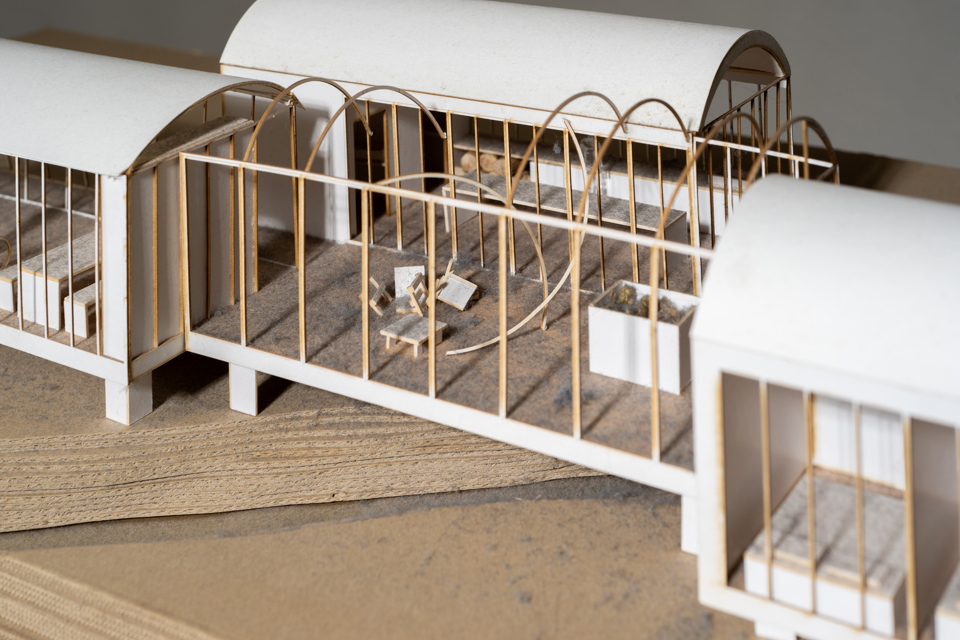
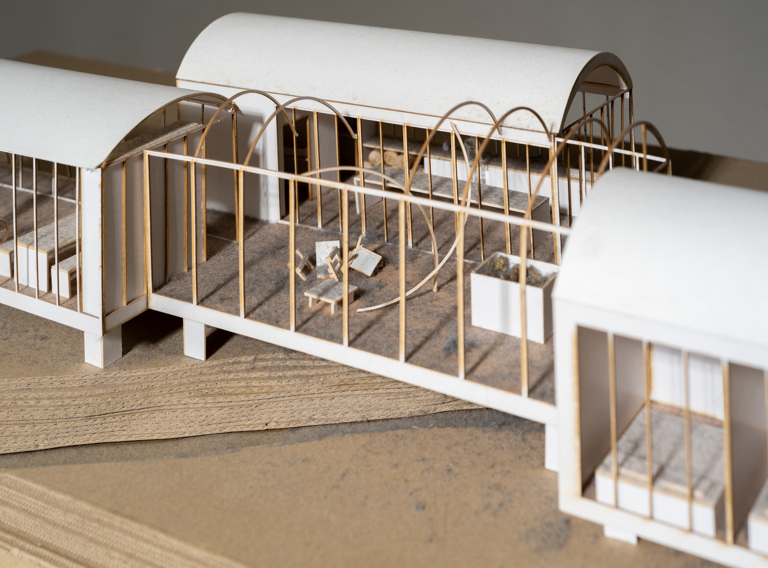
That aim remains exactly the same today. What has changed is the route towards it. Students now begin by drawing their design entirely in digital form. The model is then laser-cut layer by layer from cardboard, MDF or other materials. The result? Remarkable precision and a richness of detail that would once have been almost impossible to achieve. In a relatively short time, model-making has therefore evolved enormously.
Although the older models may appear more restrained than contemporary designs, they remain invaluable. Their craftsmanship has a powerful appeal. They are unique, quite literally. Whereas a digital design can be reproduced perfectly, a handmade model always bears the marks of its maker.
Whether it is hand-sanded fibreboard from the 1980s or digitally prepared and laser-cut cardboard structures from today, both types are emotionally equal in value, each born of the same love of the discipline. Together, they show not only architecture in miniature, but also how our teaching, our design methods and our technical possibilities have changed over the years.
Icons in Miniature
Villa Cook
The model of Le Corbusier’s Villa Cook was probably made for an exhibition on Le Corbusier held in the beguinage of Hasselt (c. 1987).
Built at a scale of 1:10, the model was made from fibreboard, with solid pine used for the window frames and details. It was finished in satin white, allowing the clarity and strength of the modernist volume to come fully into its own.


Villa Rotonda
The model of Andrea Palladio’s *Villa Rotonda* was probably produced במסגרת the *Form* course (c. 1980–1987). This volumetric model, built at a scale of 1:20, combines layers of wood and plaster panels, skimmed with plaster and finished in shades of white and pastel. It reflects a fascination with proportion, symmetry, and classical harmony.


House Model
Jo Kuypers’s house model, dating from around 1985–1988 (scale 1:50), shows just how inventive students already were in their use of materials: foam board, white-painted balsa or pine wood, mosquito netting for ventilation grilles, transparent plastic for windows, and even a mirror to suggest a surface of water. Bamboo skewers topped with polystyrene balls represent trees. The result is playful, tactile, and unmistakably handmade: a small universe in its own right.


Maison Tassel
The study panel on Victor Horta’s Maison Tassel shows how analysis and imagination come together. At a scale of 1:30, it combines a volumetric model of the façade in Bristol board and foam board with a watercolour drawing in Chinese ink. A colour and materials study based on the NCS system completes the work. It was produced in 2007 by the students Glenn Janssens and Yannick Van Grieken as part of the course Visual Representation.


Weissenhof Estate
The model of the Weissenhof-Siedlung by Le Corbusier and Pierre Jeanneret shows just how refined model-making can be. At a scale of 1:100, the landscape was built up in layers of brown corrugated cardboard, with trees made from dried sedum. The building itself combines white foam board, finely hand-cut Bristol board, and transparent plastic for the windows. Around 2012–2013, the students Jeroen Bohnen, Sibe Duijsters, Pim Jacobs and Sam Van Der Veken created this model as part of the Visual Representation (Beelding) course in the second year of the Bachelor of Architecture.


Mobipoint Yes!
The model of Mobipoint Yes! (Belle Brabants, 2019) is a presentation model from the first year of the Bachelor of Architecture, designed for a landscape site along the former fruit railway in Jesseren. The project combines a mobility hub with a multifunctional space and explores the tension between public and private space in dialogue with the surrounding landscape. At a scale of 1:50, the site is built up in layers of brown corrugated cardboard, with water rendered in transparent plastic. The buildings - and even the bicycles - were precisely laser-cut from white Bristol board.


