
From muddy field to festival zone: student society elections as intangible heritage
When you walk past the campus in Diepenbeek in April or May, you notice it immediately: the campus sounds different. There is music in the air, lights, queues, food stalls, and students everywhere pulling each other towards the festival field. What once began as a short election day has today become a professionally organised festival lasting no fewer than five weeks. And yet, at its heart, it is still about the same things: students convincing one another, associations presenting themselves, and a community reinventing itself year after year. That is why the preses elections are much more than “just a party”. They are a living piece of UHasselt history: a tradition that has grown along with the university, with new generations, and with changing expectations around safety and coexistence with the neighbourhood.
Early years
To understand why the preses elections in Diepenbeek have such a distinctive character, we need to go back to 1973: the first academic year of the Limburgs Universitair Centrum (L.U.C.), the predecessor of UHasselt. At the time, there was one overarching student association: Miezerik. The campus was small, and student life was still modest and personal in scale. Former members recall how candidates campaigned without social media: putting up posters, talking to students “in the corridors”, and making sure they were visible at the right moments. There were parties too, but on a very different scale from today: tea dances, or TDs, for a limited audience, often no more than a hundred people. That scale made things manageable, but the stories already reveal that something was being built: a campus culture that still had to grow, but already understood that celebrating together also creates a sense of community.
‘Real’ elections
As the university grew, more student associations were founded. And where a preses had often simply been “appointed” within a presidium, from the late 1980s onwards there was increasingly a real battle for votes. Alumni identify an important turning point around 1989, when two candidates at Hermes began outdoing each other with free drinks and food to win over students. The tone had been set: becoming preses was no longer just about taking on a role, but also about running a campaign. And campaigns became… creative. From stunts on the agora to absurd challenges, from driving around student houses to actions that now sound more like legends. It was all part of a period when student antics also meant a certain lack of restraint. Voting was done with pencil and paper; afterwards, the ballots were even burned, with the ashes kept as a strange trophy for the winner.
Mud, marshes and a relocated field
The place where people celebrate becomes part of the story. Until around the turn of the century, the preses elections were held for a time on a farmer’s field across the Ginderoverstraat — remembered by some as “the Diepenbeek marshes”, because things often got muddy there. When the rent suddenly rose sharply, a conflict followed that even ended with a ploughed-up field. The result: the elections moved back to the old football pitch opposite the main building, where they still take place today.
Packed tents and the ‘Woodstock feeling’
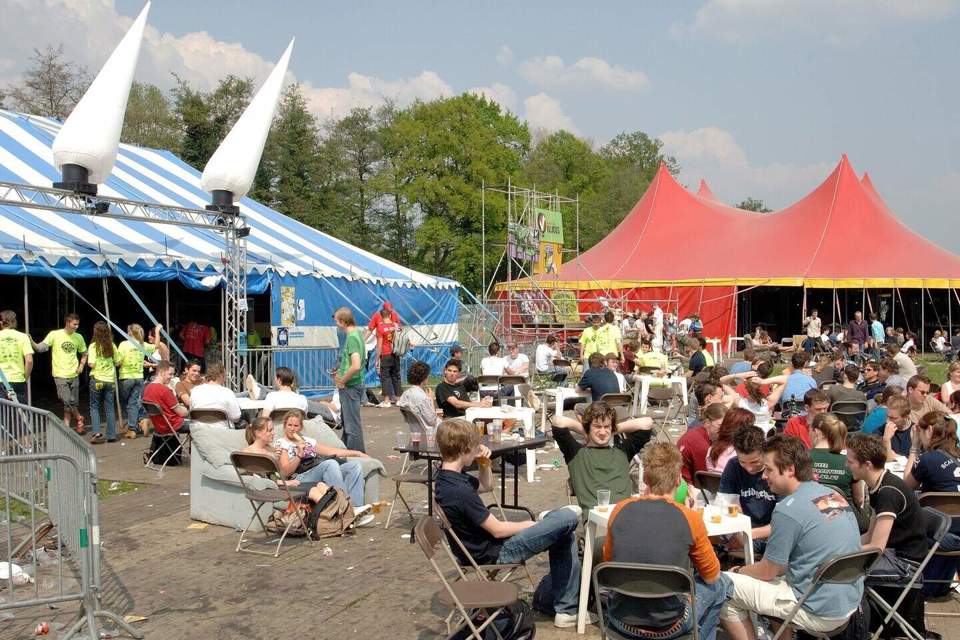
In the 2000s, the preses elections grew into a regional attraction. Alumni often refer to them as “the wildest years”, with crowds that also drew students from outside Limburg. Performances by well-known acts became a highlight, with 2011 standing out as a legendary year: the Vengaboys at the preses elections, an overflowing tent, and thousands of people on and around the field. Some describe that period as “Woodstock” in Diepenbeek: mud, improvised solutions, and an atmosphere in which anything seemed possible. But that image also has a darker side. The larger the event became, the greater the risks — and the more visible the nuisance for the neighbourhood.
Professionalisation as a turning point
Between roughly 2011 and 2016, much changed. Not only because of growth and complaints about nuisance, but also because of a broader awareness that large events need to be organised professionally. A clear framework of agreements was introduced: closing times, noise standards, measuring equipment, party stewards, a greater police presence and better infrastructure. Instead of a new tent being put up and taken down every week, the event developed into a permanent, well-equipped festival zone with paths, woodchips, entrance gates and sanitary facilities. The result was striking: fewer incidents, fewer complaints, and yet the core remained intact. It is still about student associations presenting themselves, celebrating together, winning votes and taking on leadership.
The Luca stand: ‘party sensibly’
One notable new element is the Luca stand: a recognisable point on the festival field where safe partying takes centre stage. The stand was named after Luca Pignatelli, a UHasselt student who died in 2024 after a night out, and is built around a simple message: having fun is allowed and encouraged, but preferably with common sense. Students can go there for practical support, such as free earplugs, as well as material and information on responsible alcohol use, including breathalysers, and sexual health, such as condoms. Anyone who wants to report transgressive behaviour can also find a low-threshold point of contact there: the stand is staffed by students who have received specific training for this purpose. In this way, the preses field now has a clear care-oriented dimension alongside the celebrations.
More than nostalgia
Preses elections tell us something fundamental about a university: how a community organises itself, which rituals it considers important, and how traditions adapt to changing times. They also show how UHasselt as an institution has evolved: from a young campus in 1973 to a university that today takes responsibility for a major event with thousands of visitors.
And perhaps that is the most valuable lesson: traditions do not survive because they have “always been there”, but because each new generation takes them up and gives them renewed meaning.
Do you have memories to share?
Did you ever help organise the preses elections? Do you still have posters, photos, wristbands, planning documents or memorable stories from your time? Let us know. Such materials and testimonies make it possible to keep telling this campus story in the future - not as one grand myth, but as a rich mosaic of students, associations and moments that helped shape UHasselt.


