
Rocks and Minerals: UHasselt’s Teaching Collection
When people think of academic heritage, they often picture archives or antique instruments. But sometimes the history of science quite literally fits in the palm of your hand. The rock and mineral collection of Hasselt University shows how tangible objects can at once serve as teaching material, research resources, and heritage pieces. It embodies exactly what is so distinctive about academic heritage: material that originated in a context of teaching and research and is still actively used in that role today.
From fieldwork to the classroom
The foundations of the collection were laid in the 1960s by Professor Van Autenboer, who systematically acquired specimens to strengthen the teaching of geology. Later, the collection continued to grow organically through finds made during geology excursions and research trips by, among others, Professor Mostaert and the collector Styn Claeys, now himself curator of the collection and a lecturer. In this way, the collection quite literally bears the traces of academic generations: gathered in the field, studied in the laboratory, and passed on to new students.
The emphasis is on rocks, although the main rock-forming minerals are also well represented. Students of biology and chemistry learn not only names, but above all how to observe: colour, texture, grain size, hardness, or effervescence in reaction to acid. Through such simple tests, they learn to identify specimens as a geologist does: by combining characteristics, ruling out hypotheses, and arriving at a well-founded identification.
From display cabinet to virtual guide
During the COVID period, the collection was given a digital extension. A substantial part of it was documented in detailed records containing descriptions, formation history, identifying features, and simple tests. The result is a clearly structured field guide that teaches students step by step how rocks are classified into igneous, sedimentary, or metamorphic types—not as dry theory, but as a practical skill.
Since then, direct contact with the physical specimens has been concentrated into an intensive three-hour practical session, prepared and supported by digital documentation and reference material. The collection has therefore evolved from traditional teaching material into a hybrid learning tool in which hands-on object study and digital guidance complement one another. It is not a static museum display, but an active archive of knowledge. In that sense, it perfectly illustrates what makes academic heritage so distinctive: objects that are at once historical witnesses and contemporary learning tools.
Captions
- Amethyst is a much-loved gemstone with purple hues ranging from lilac to deep violet. Its name comes from the Greek amethystos (“not drunk”); in antiquity, the Greeks believed the stone protected against drunkenness and mental confusion.
- Pyrite, also known as “fool’s gold”, is a common mineral with the formula FeS₂ (iron disulphide). It has a metallic, brass-yellow lustre and often forms cubic crystals.
- Malachite is a green copper-bearing mineral with distinctive banded patterns. It is a secondary copper ore and is widely used as an ornamental and collector’s stone.
- Breccia with Banded Iron Formation (BIF) and jasper - also known as jaspilite - is a very old rock dating from the Precambrian (c. 1.5–3 billion years ago). It consists of a mosaic of angular red to dark-coloured fragments and, in this case, comes from Western Australia.
- A goniatite is a fossil of extinct cephalopods from the Palaeozoic. This specimen from Morocco dates to the Middle Devonian (c. 393 million years ago) and can be recognised by its spiral shell with a zigzag pattern.
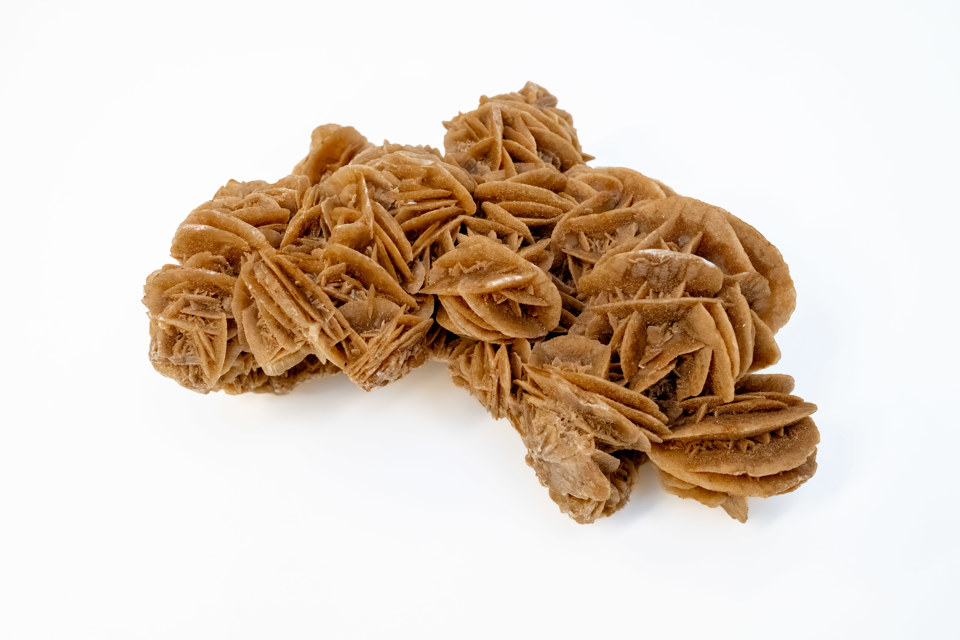
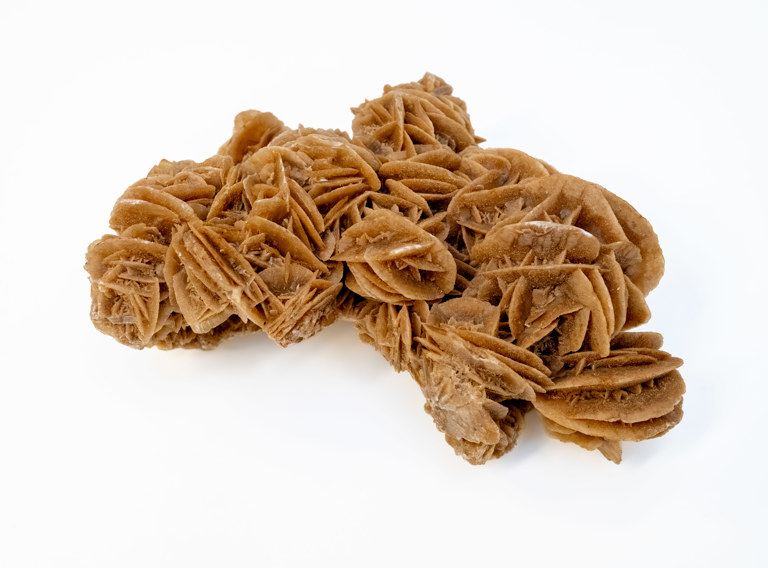
- Desert rose (sand rose) is a natural formation of gypsum and sand formed in desert regions. The crystals grow in a shape resembling flower petals.
- Antimonite (stibnite) with needle-shaped crystals. This specimen comes from Baia Sprie in Romania.


