
X-LAB: Academic Heritage in Waves, Numbers, and Signals
Housed in a modern pavilion on Campus Diepenbeek, X-LAB is UHasselt’s innovative and interdisciplinary laboratory. Today, it is a place where science, technology, and art intersect and enrich one another. At the same time, Professor Jean Manca of X-LAB has preserved here a remarkable collection of academic heritage from the Physics programme, which he was determined not to see lost. It includes equipment used by, among others, the late Professor Herman Janssen, his predecessor as head of the educational service within the Department of Physics, in the training of many generations of physicists: measuring instruments, computers, and calculators that show what scientific practice looked like before everything became digital, lightweight, and wireless.
These instruments were once the beating heart of practical classes, research laboratories, and lecture halls. They beeped, glowed, rattled, and traced lines of light across their screens. Together, they form a tangible timeline of how researchers learned to measure, calculate, and understand.
Oscilloscopes: making the invisible visible
Electrical signals cannot be seen. Yet they underpin almost all modern technology. Oscilloscopes - formerly often called oscillographs - make this invisible world visible. They show how an electrical voltage changes over time, as a moving line across a screen. For generations of students, this was the moment when abstract formulas suddenly took on a recognisable shape. The X-LAB collection reveals how these instruments evolved, from fully analogue devices with vacuum tubes to digital measuring instruments capable of storing and analysing signals. Early models, such as the Philips GM 3152 and the Telequipment Serviscope Minor, were entirely analogue. Electron beams traced the signal directly onto a phosphor screen. Later workhorses, such as the Telequipment D61 and the Hameg HM 412, offered further advances: higher frequencies, sharper images, and more reliable measurements. The Tektronix 5113 marked a new step forward, allowing signals to be stored temporarily so that rapid or one-off events could also be made visible. The Hameg HM 208, the Philips PM 3335, and the HP 54600B ushered in the digital age.


Multimeters: when electricity becomes measurable
A multimeter is perhaps the most familiar measuring instrument in the electronics lab. Voltage, current, and resistance: with a single device, researchers and students can check whether a circuit is doing what they expect it to do.
In the X-LAB collection, we can clearly see this evolution. Analogue meters such as the Phywe 0703400 and the Goerz Unigor 3N used a needle moving across a scale. Reading them required experience and a certain feel for the instrument. The Goerz Unigor 3N from the 1960s–70s, for instance, was already remarkably versatile: with a single rotary switch, the user could choose from no fewer than 52 measuring ranges.
Digital multimeters, such as those made by HSN, Beckman, Micronta, and Agilent, displayed numerical readings on a screen and offered additional functions such as automatic range selection and data logging.


Calculators: from clattering gears to pocket size
Before computers took over completely, scientists and students relied on calculators to carry out complex calculations. These devices saved time, reduced errors, and fundamentally changed the way people worked with numbers.
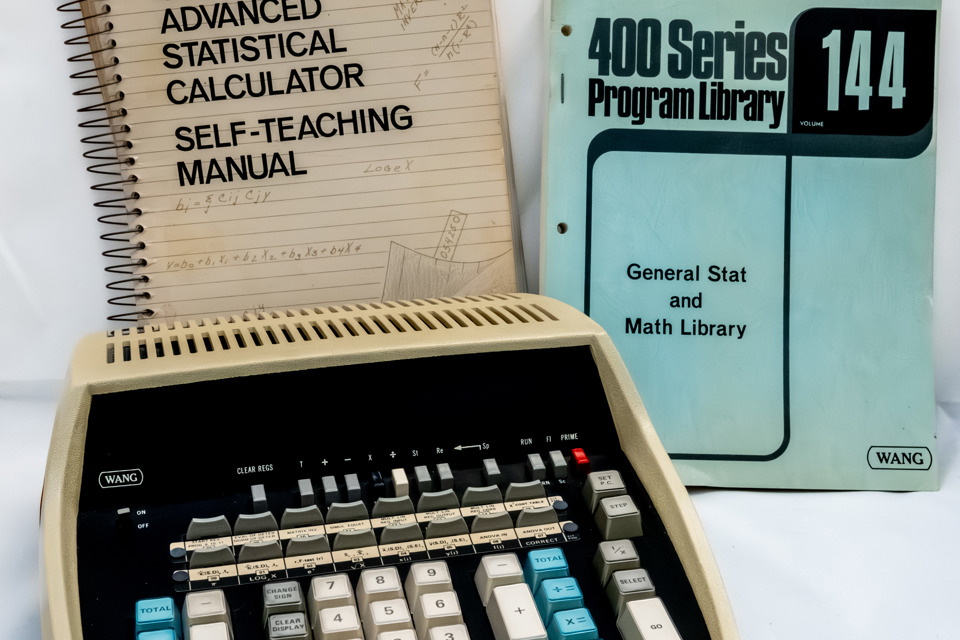
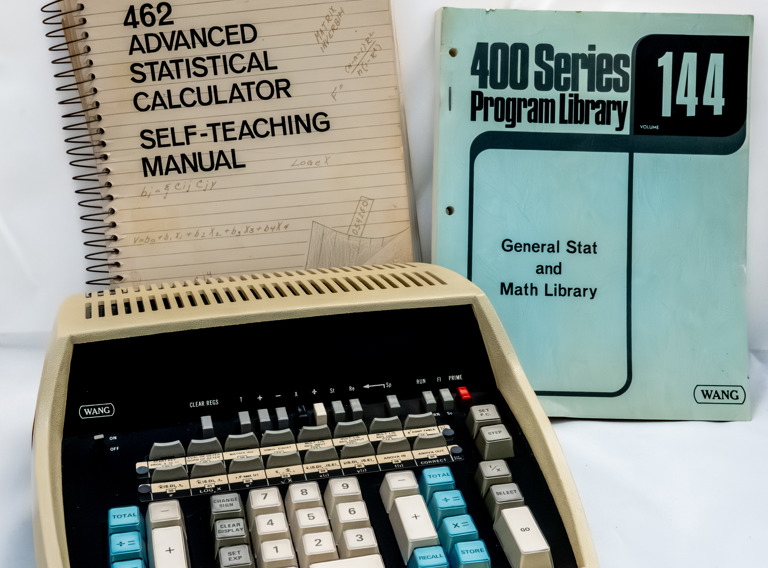
The collection captures that evolution at a glance. The Friden SRW (c. 1952) is a heavy mechanical calculator that operated with gears and levers. Every calculation is audible. With the Wang 462 (c. 1972), electronic circuitry entered the scene, making statistical calculations suddenly much faster. Pocket calculators such as the Texas Instruments TI-51III, the TI Programmer, and the HP-35 made powerful computational functions portable.
The HP-35, introduced in 1972, was the first scientific pocket calculator that genuinely fit into a shirt pocket. For the first time, engineers and students could perform complex calculations without a slide rule or logarithmic tables. That made the device revolutionary. The name HP-35, incidentally, refers to its 35 keys, including then groundbreaking functions such as sine, cosine, and logarithms.


When computers were still pieces of furniture: the forerunners of today’s laptops
The computers in the X-LAB collection recall a time when the “personal computer” was still more of a promise than a reality.
The Apple IIc, released in 1984, was the compact and relatively portable version of the Apple II series. It brought computing within reach of schools and households. Everything was housed in a single casing, ready to be switched on and used.
The Toshiba T3200, launched in 1986, was remarkable because it was one of the first truly portable computers, even though it still weighed more than seven kilos. It featured a sharp 10-inch screen and ran software that would normally operate on a standard PC. Some models even had an internal hard drive of 20–40 MB, which was rare at the time.
With the Macintosh PowerBook 165c, colour arrived on the laptop screen in 1993, making portable computing visually appealing. It had Apple’s characteristic design, with the keyboard set further back and a trackball at the front, which was highly innovative at the time.


Instruments that brought the laboratory to life
Beyond measuring and calculating, the collection also shows how researchers generated signals, recorded data, and shared results. Particularly striking are:
- The Interstate Electronics F34 Function Generator, which made it possible to simulate electrical waveforms.
- The EG&G Boxcar Averager, which helped make weak signals visible by filtering out noise.
- The Anritsu Network/Spectrum Analyzer MS420K, an instrument used to analyse radio signals and networks: it showed which frequencies were present, how strong they were, and whether interference occurred.
- The HP 7225B Plotter, a device that automatically transferred drawings and graphs onto paper using real pens, directly controlled by computers.
- The Leybold Heraeus digital chronometer, with its distinctive Nixie tubes, which displayed time down to the millisecond.


Other objects, such as microscopes, projectors, Morse keys, and cassette recorders, likewise show how knowledge was observed, shared, and recorded.


Academic heritage as a living resource
The X-LAB collection is not a nostalgic museum. It is a reminder of how knowledge was built: step by step, through trial and error, with instruments that may seem heavy or slow today, but were once groundbreaking. By preserving and presenting this heritage, X-LAB connects past and future. To look at these objects is not only to look back, but also to better understand how science continues to evolve.